
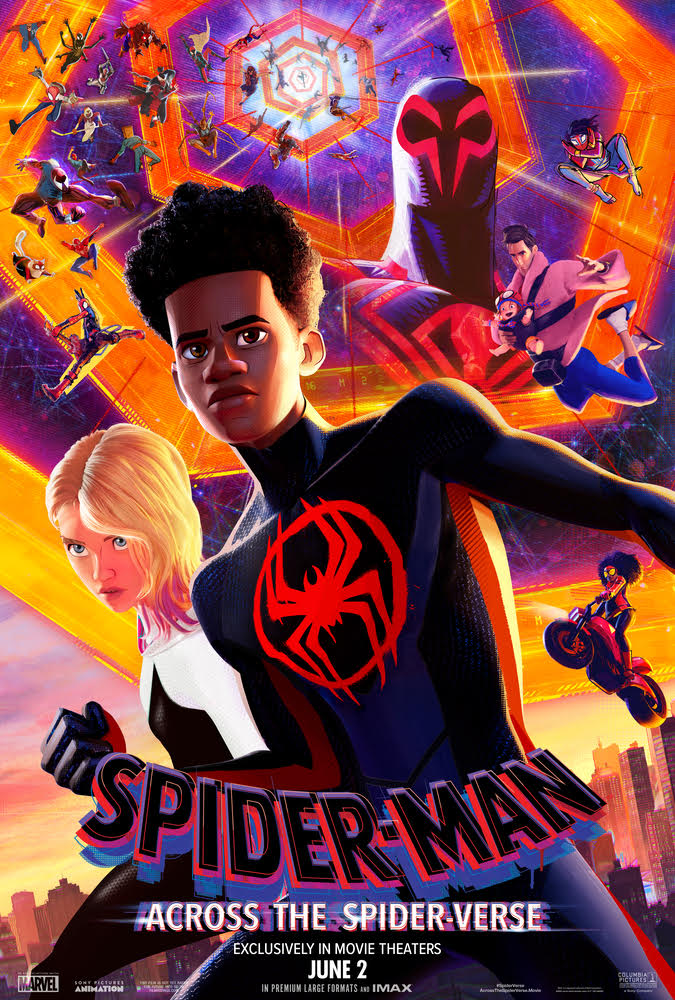
“Being Spider-Man is a sacrifice.”
I’ve had a couple of days to sit with this movie. To think about what I felt, the response of the audience, and the tale I was told. And, yeah, Spider-Man: Across the Spider-Verse wobbles near the end. Nevertheless, after two days of replaying every scene, I can tell you it’s brilliant in its animation and compelling in its storytelling. My goddaughter, Cub, said it, “This is the kind of story I’ve been wanting.” Same for me, Cub, same.
It’s been a little while since Miles Morales (Shameik Moore) and his squad of Spider-Folx saved the multiverse. They came, they conquered, and they returned to their worlds. Gwen Stacy (Hailee Steinfeld) is the hero of her own story too, and like the multitude of other Spiders-, life is hard in NYC and all of its analogs. Miles has grown physically but Gwen has taken a couple of punches to the chest. One of which knocks her into a formerly unknown Spider-Verse Central. Where she ends up working for Miguel O’Hara AKA Spider-Man 2099 AKA Oscar Isaac, while she swoons over the mentor she never knew she needed in Jess Drew (Issa Rae). The job is to keep the timeline sacrosanct—alternately called the “canon” here, in a nod to the fandom.

Meanwhile, back on the planet of Brooklyn, Miles has gotten really good at the hero gig (not so much the student role). He’s out here fighting villains while eating beef patties, so he’s feeling like danger can’t touch him. But he does miss Gwen, and he’s wondering if he can share the rest of his world with his parents (Luna Lauren Velez, Brian Tyree Henry). Would they love him the same if they knew? He’s not sure. Of course, heroes are going to get tested and when The Spot (Jason Schwartzman) shows up and Miles takes his pride, the villain becomes everybody’s problem. And that’s how Miles, Gwen, and the rest of us are sent hurtling across the Spider-Verse.
There are two things that boost the Miles Morales movies to the top-tier. Actually three (but we’ll start slow). First up is the art. It’s so candy-coated it’s like your eyes are eating Pop Rocks. The art styles morph and shift to match each dimension, but they also speak to you in the language of visual emotion. The same thing soundtracks do for your ears, the art of The Spider-Verse does for your eyes. You can see what the characters are feeling. In one scene Gwen has an epiphany and the background suddenly switches to abstract—that’s when you realize she’s improvising and the artists are giving us an ocular freestyle. You’ll even see homages to the various artists who have worked on Spider-Books. And you’ll recognize them instantly. The visuals in this multiverse are immaculate in their conception.


The second Boss Level factor of the Miles movies is the layers stacked up on layers of plot and character development. The creatives behind this series pay attention to everything. The way Miles engages with his Black-American father and Boricua mother. The nuance in their conversations, the body language, the jokes they tell. Even the way they’re treated by the school guidance counselor. This is a depth you can only accomplish in the realm of IYKYK. You have to know to truly get it—hey Kemp Powers, we see you—but this movie is written with such craft that these moments are no less fulfilling if you don’t know. The depths don’t stop with the Morales family or American culture. There is truth in all the familial dynamics and cultural cues, but also in the friendships and the maybe-loves. There’s never a moment when you doubt the validity of this fantasy world. That’s very hard to do. But this universe thrills you too. The action is high on dynamics but also on physics. Which makes sense if you’ve got more than a thousand scientists working together.
Plot-wise, writers Phil Lord, Christopher Miller, and Dave Callaham go full blast. The stakes are slightly complex but it makes the ramifications so much more interesting to contemplate. Which works because we have time. I don’t know if you’ve heard, but Across the Spider-Verse is Part 1 of a two-parter. The writing team kicks us off a cliff while they yell, “This is Sparta!” My goddaughter and I didn’t know whether to cry or show up on their lawns with laser swords drawn (but since we need to know how the story ends we’ll let them live).

I know. I promised you a third factor and that is the voice acting. No one comes in weak. This cast buzzes with the kind of harmony most of the other superhero franchises wish they could attune to. The new additions to the cast serve flames as well. Spider-Punk (Daniel Kaluuya) is the dreamy anarchist we not only wanted but need more of. Back to the art: To make sure it is clear that Hobie AKA Spider-Punk is a punk kid, he is animated in the style of a Zine—a quintessential part of the history of the punk scene. This includes collage styling, a library of fonts, and ever-changing paper textures and colors. Spider-Punk is animated perfectly and Kaluuya eats this role.
In my one wobble, the ending could have been cleaner. Perhaps 15 minutes could have been shaved off. That would have allowed the movie to slam into us harder when the cliffhanger happens. Still, I’m happy. I wanted the theater to restart the movie the minute it ended. I rarely give a film an A rating. 10/10 is big praise from me. Spider-Man: Into the Spider-Verse earned top marks and Across the Spider-Verse does the same.
Spider-Man: Across the Spider-Verse might as well be a virtual reality headset, that’s how deeply I got into it. And as soon as they let me, I’m going back in.
