
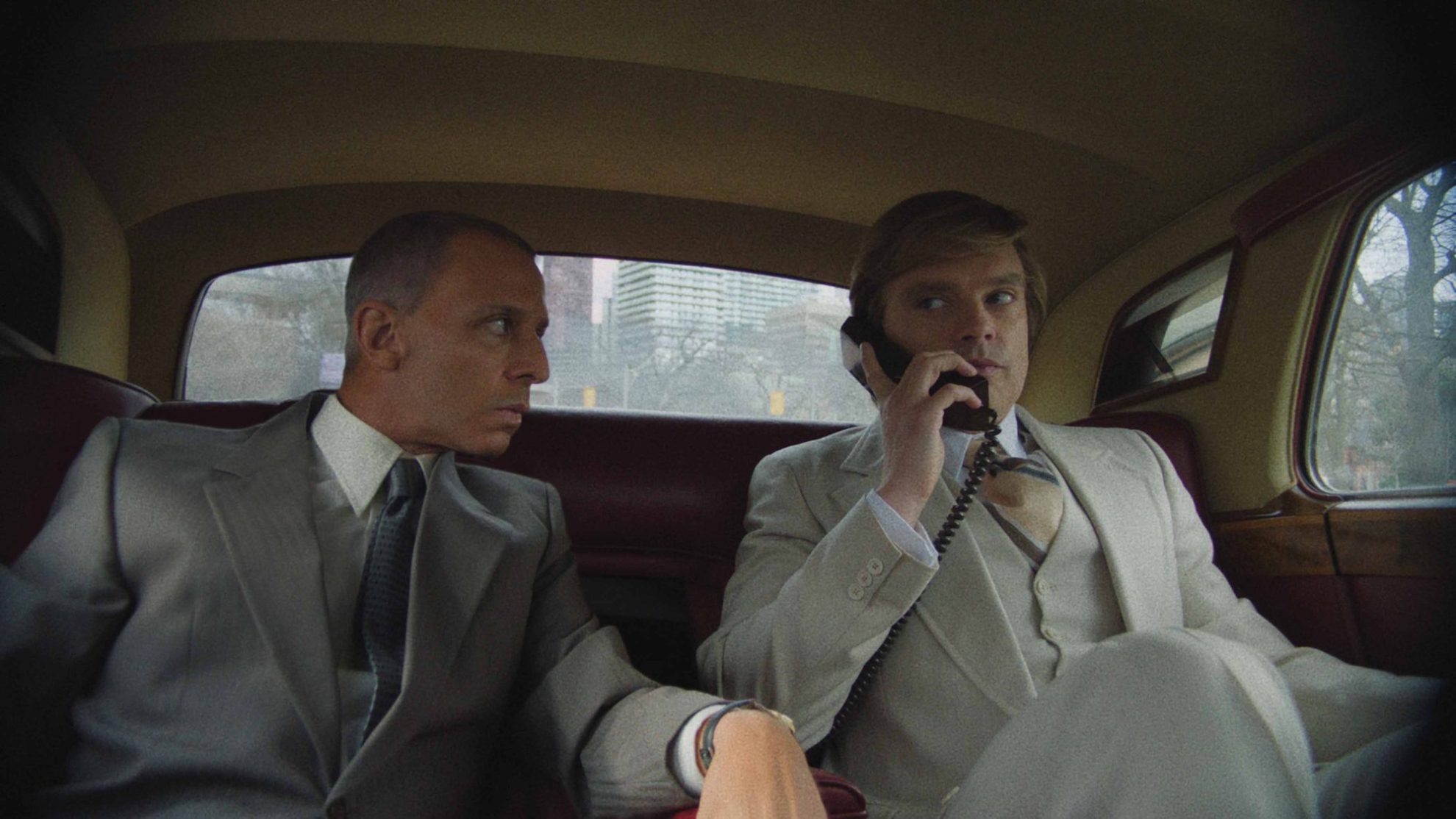
We’re under a month away from our third in a row Presidential election with Donald J. Trump as the Republican nominee. For many, he’s a champion of the people of the United States that’s unheard and have been struggling. For some, he’s a person who will and has been destroying this fraught Union with his quest for power. He’s more than just a divisive figure; he’s a tipping point in history, and as a person who’s been in the US public eye for almost fifty years, not much has been looked into him other than the stuff he’s done himself. Here with The Apprentice screenwriter Gabriel Sherman, known for writing the book on Fox News creator Roger Ailes, he’s now turned his attention to Trump. Directed by Ali Abbasi and starring Sebastian Stan as Donald Trump and Jeremy Strong as Roy Cohn, this film follows how a young Trump still working for his Father is taken under the wing of infamous lawyer Cohn and learns the basis of his whole methodology and how to move within the Business world of New York City until it becomes the man we know of now.

The film is based mainly on this relationship that is shown in many ways, like Emperor Palpatine and Anakin Skywalker or Master/Student, which we’d see in a Hong Kong martial arts film from the late 70s. Strong’s Cohn notices this naïve, young, and impressionable ball of clay with potential. Someone who clearly looks up to him but is also a huge square who is a very sheltered person. Strong’s performance is so captivating on screen. He’s so in his bag right now, acting like he’s radiating off the screen as this man. He’s utterly believable as this person who was such a figure in the real world. The performance is paired perfectly with Stan as this young Donald is looking for a way to be his own man compared to his Father. He wants to escape the way he does things that are too big, brash, and over the top that Fred Trump Sr. (Martin Donovan) won’t let him be. Stan captures that Trump, at least for me. One of my earliest TV memories is watching Lifestyle of the Rich and Famous, where you went to Trump’s house, and I have to say Stan did his homework.

A lot of this film is about Father’s and loyalty and becoming who you feel you were meant to be. While it doesn’t positively humanize Trump, it does it in a way that works well in a film as a character in a story. You see how his Father is terrible but small-minded. It is almost like he got rich despite himself and just off of being white; that’s not what Donald wants – he wants the power, and he wants to make people bend to his will. He can change reality with enough will and determination, and he learns that through Cohn and how he moves and interacts with the world. Cohn is always an underdog in his mind and a diehard patriot; he believes in the United States to an unhealthy degree. Their roles change as Trump ascends and Cohn has AIDS; this is where the film really dials into Trump as a person and what we really know. It makes you think if Cohn made him from the ground up or did Cohn’s rules, which reminded me of Biggie’s Ten Crack Commandments, just give him a path to achieve his true self that he didn’t know how to become.
There is one character that is humanized, and it’s Trump’s first wife, Ivana, played by Maria Bakalova. Here, you see the beginning of their relationship until its later hollow husk of marriage before he moved on to another marriage. Her character sometimes works like an audience POV as she’s initially skeptical of Trump. Still, also Cohn, and then is the voice that tells Trump just how depraved he is, a smack of reality as he overextends himself in all these multitudes of businesses that failed during the nineties. Another character, Fred Trump Jr., played by Charlie Carrick, is the most tragic and, in the film, a key figure for Trump, as he’s the oldest but chose to live a life against their Father’s wishes by being an airline Pilot or what Fred Trump Sr. calls a bus driver. This has a heavy effect on Jr. that leads to a tragic end and changes Donald’s view of himself and Fred Jr. over time as he ascends. If any characters are sympathetic, Ivana and Fred Jr. are in this story.

Abbasi and his cinematographer Kasper Tuxen do what you expect on how the film looks for a good portion of it. They made and filmed New York City to look like films from the mid to late seventies. That gritty and graininess, along with picking the right locations that can still look like that dirtier and older NYC, is very much becoming a memory. What interested me visually, though, is that as the film moved more into the eighties, there were scenes that switched to video, so it added this 20/20 news report look to some scenes like this was the point where Trump is now TRUMP, the icon of 1980s American Wealth. You know, Gold doors and Gold toilets and Trump Tower and all. There’s a lot to reconcile with this film with everything going on around, and that’s without going into the trials they’ve gone through to release it. I know many people who don’t want to see it because it’s Trump, period, and that anything with him isn’t essentially helping him. There are, of course, people who think it’s tearing him down, so they don’t want to see it. Yet, in the end, The Apprentice, to me, is probably one of the better lenses through which to make a story around him. From Abbasi’s outsider view, he’s able to have some distance and tell this distinctly modern US story that can hopefully give people a window to recent history to go read up on to understand a bit more about why our society is the way it is right now.
B+