
“Home. Everyone you love, everyone you know, everyone you ever heard of, lived out their lives on a mote of dust, suspended in a sunbeam. Think of the rivers of blood spilled by all those generals and emperors, so that in glory and triumph, they could become the momentary masters of a fraction of a dot. In our obscurity, there is no hint that help will come from somewhere else to save us from ourselves. The Earth is where we make our stand. It underscores our responsibility to preserve and cherish the only home we’ve ever known.”
– Carl Sagan, Pale Blue Dot: A Vision of the Human Future in Space
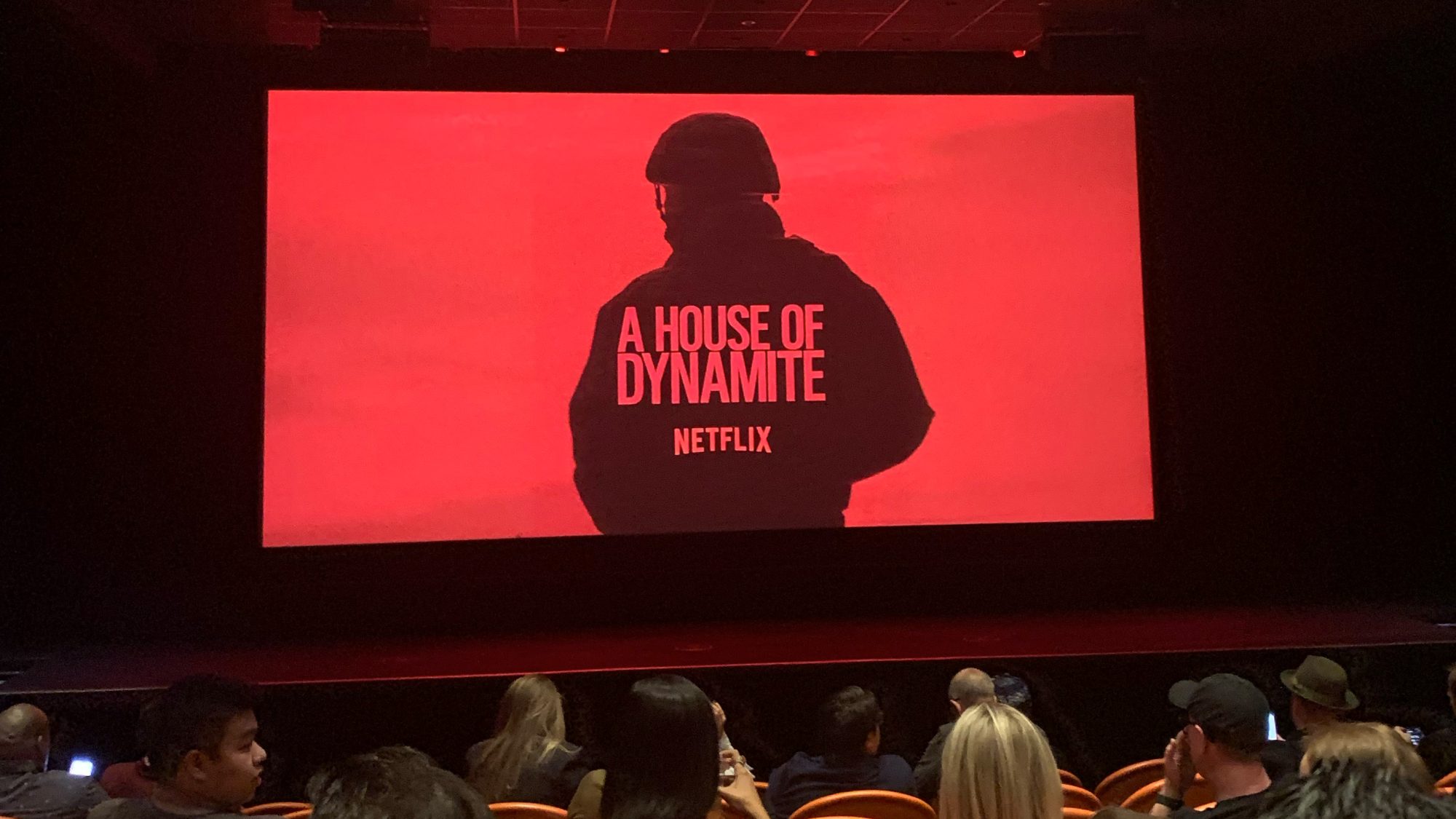
On a Manhattan day, where the weather was sunny and walkable and alive, I entered The Whitby Hotel, descended a staircase painted in vivid leaves, found a seat in an orange chair, and watched a film that lives inside the above Carl Sagan quote and in our lives. And because so many of us are seeing the mortality of everything in a way we haven’t before, I’ll begin at the end.
The upcoming Netflix film, A House of Dynamite, envisions one of many possible apocalypses: a global conflict triggered by weapons of mass destruction with no clear idea of who started it. In other times, it might have been a cautionary tale, something left for the backstory of your favorite science fiction franchise. Yesterday it was possible, but improbable. Lately, it seems more probable than impossible. Perhaps that’s why, when you check the 2000s-era filmography of director Kathryn Bigelow, you’ll see it’s a possibility she’s been pondering since K19: The Widowmaker, but more famously in The Hurt Locker and Zero Dark Thirty.

“We decided to break it into three chapters in order to stay in real time, and because an 18-minute journey would have been, obviously, too brief for a feature. And so, we broke it into three phases in order to kind of do a deep dive in each one of the halls of power as you climb up the, sort of, food chain.” –Kathryn Bigelow
In 4 out of 5 films since the year 2000. Bigelow has primarily dealt with war from varying vantage points—exploring international conflicts as a body of work. Writer/producer Noah Oppenheim seems equally enthralled with the end of days, with work like Zero Day and The Maze Runner. In A House of Dynamite, Bigelow’s fourth film on the subject, she and Oppenheim immerse us in a possible world-ending scenario from inside the White House and allow it to play out three times from three perspectives. The result is so real, A House of Dynamite feels like a thriller that’s also a precognitive documentary, and the sense of terror is in the room with us right now.
“The movie is predicated on this notion that the president of the United States has the sole authority to decide whether to use nuclear weapons. It’s only up to him in our system. And so we asked this former official. We said how much does the president practice? How much does he read on the subject? How much does he prepare for that moment? And the person’s response was, “Not at all.” –Noah Oppenheim
The next day, I returned to The Whitby Hotel for a talk with some of the talent and creatives behind the film: director Kathryn Bigelow, writer/producer Noah Oppenheim, composer Volker Bertelmann, editor Kirk Baxter, Rebecca Ferguson (Captain Olivia Walker), Tracy Letts (General Anthony Brady), Jason Clarke (Admiral Mark Miller), and Anthony Ramos (Major Daniel Gonzalez)


The cast worked extensively with consultants leading up to the shoot, and in many of their scenes, the real-life professionals were there as their scene partners and background.
“The help I had was mostly in the room, in that a couple of our Technical Advisors are extras. They’re background players there. And they’re guys who have actually sat in my seat. And so, I’m able to turn to them at any time and say, Would I do this? What am I trying to do here? It’s very well-written on the page. Very thoroughly researched on the page. So, for me, it had more to do with attitude than anything.” –Tracy Letts
“I asked every single question down to who would get this email first? Like, I think for us, the authenticity of creating something recognizable for anyone who would have worked in the room to go: That is exactly correct. And we had all of that at our disposal.” –Rebecca Ferguson
Outside of their careers in the hot seat, the characters also have family concerns to deal with. This is where the film is at its most effective. Partners, parents, children, unborn babies, and hometowns—all have a role to play in the desperate decisions made, and some of those decisions will shock you. Family ties aren’t peripheral in A House of Dynamite, but clear and present at the heart of the action. One of the big questions the film leaves you with is: Would you tell the people you love that total annihilation is headed their way, or would you let their final minutes of life be blissfully unaware? I hoped to learn if that was one of the things the filmmakers intended for us to grapple with, but the time ran out. And time running out is a form of gallows humor when you think about the themes here.
The usage of time is another standout in this movie; we experience the same 18 minutes three times, but we gain a deeper understanding of it each go-round. In that way, you could easily imagine A House of Dynamite as a limited TV series, with each episode ending in a cliffhanger until they all pile up into the ultimate monster cliffhanger. Editor Kirk Baxter had to pull off what Bigelow calls “three-dimensional chess” to make the final cut as innervating as it is.


Kirk says, “I sort of say that I cut the movie two times. The first time we went through in chronological order… And then did a second pass all the way through the film, concentrating on accuracy. ‘Cause it was, I guess what I call row, row, row your boat, where you’re just picking up bits of information and dialogue as the movie progresses… With a caveat of only if it services the movie. So every now and again, I would sort of slip time if it played better. But if I could be completely real about it, then that’s what I was going after. In a journalistic way, really.”
By the end, teetering on the precipice of global fallout, A House of Dynamite is an intense thought-provoker. Yet it refuses to answer any questions and instead fades to black like the last scene of The Sopranos. I think that ambiguity comes from the idea that the question isn’t “how did we get here” or “what happens if.” It’s “Is it too late?”
For insights on that, I’ll leave the last word to Kathryn Bigelow, “Well, I think how it ends, is it really, it’s an invitation to the audience to take away something. My hope is engaging in a conversation about nuclear weapons. I mean, there’s nine nuclear countries and only three are members of NATO. I mean, that in and of itself should kind of give everyone pause. And so it’s really an opportunity, and I guess, a reach out to the audience to then hopefully take the conversation further.”
A House of Dynamite in select theaters October 10 and on Netflix October 24
Full Cast: Idris Elba, Rebecca Ferguson, Gabriel Basso, Jared Harris, Tracy Letts, Anthony Ramos, Moses Ingram, Jonah Hauer-King, with Greta Lee, and Jason Clarke. Also starring Malachi Beasley, Brian Tee, Brittany O’Grady, Gbenga Akinnagbe, Willa Fitzgerald, Renée Elise Goldsberry, Kyle Allen, Kaitlyn Dever.
