
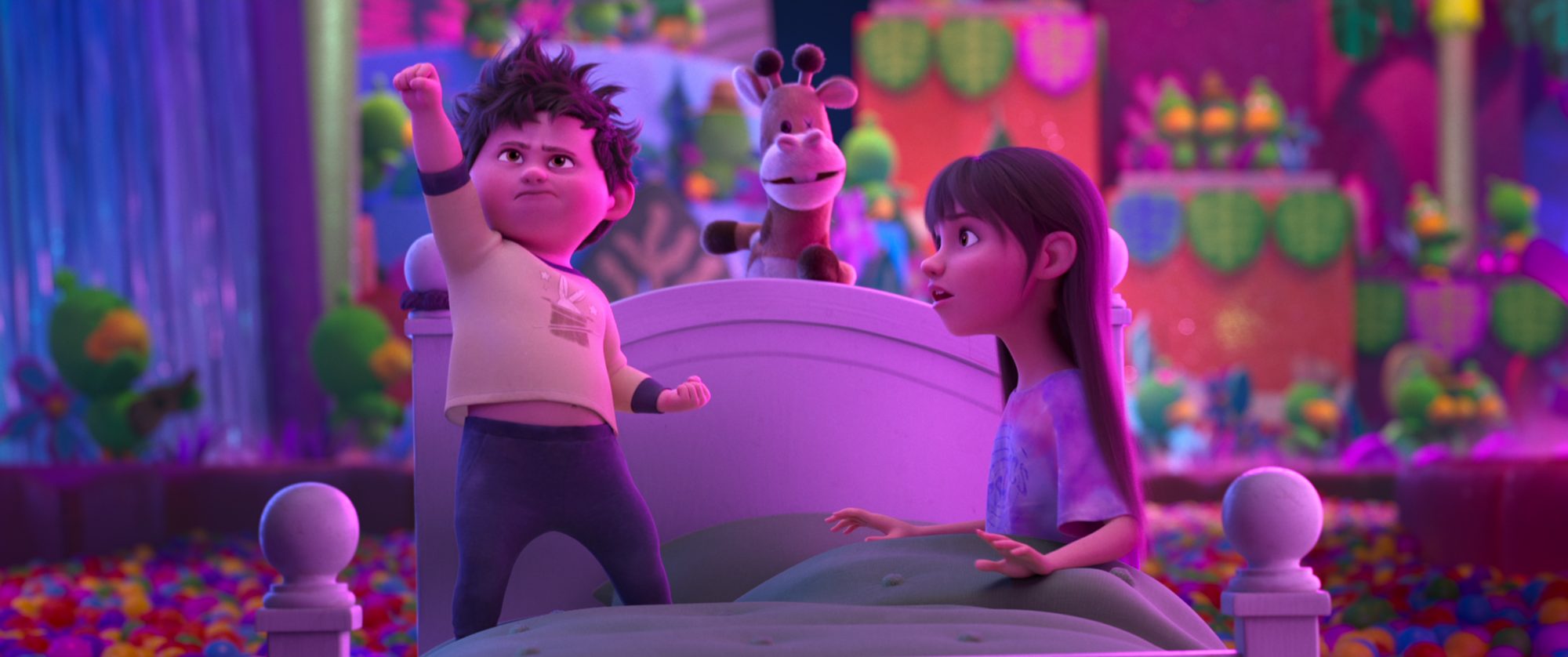
When a pair of siblings hack their combined subconscious to set their world right, you know you’re either watching a kid movie version of The Matrix or Netflix’s latest animated adventure— it’s the latter. Although I kind of want to see the first one now. In Your Dreams arrives on Netflix today, continuing the studio’s ambitious animated streak that began with Klaus‘s hand-drawn magic, reached new heights with The Mitchells vs. The Machines’ genre-bending family chaos, and popped off spectacularly with KPop Demon Hunters.
Directors and writers Alex Woo and Erik Benson, alongside writer Stanley Moore, have crafted something that sits at the crossroads of the psychological exploration of Inside Out, the fantasy quest structure of Over the Moon, and the dream-world navigation of films like Slumberland. Grounded in Woo’s own childhood memories of his “mom leaving for a little while,” the film is infused by the fantastical and made tangible by the realities of fracturing families.
The story follows 12-year-old Stevie (Jolie Hoang-Rappaport) and her younger brother Elliot (Elias Janssen) as they embark on a surreal journey through their dreamscape in search of the legendary Sandman (Omid Djalili), to ask him to grant their ultimate wish: happy parents. At times accompanied by their stinky but snarky stuffed giraffe, Baloney Tony (Craig Robinson), Stevie and Elliot navigate goofy towns populated by breakfast foods that go zombie rather than rotten, and stormy skies ruled by the queen of nightmares, Nightmara (Gia Carides). All while their parents (Simu Liu and Cristin Milioti) grapple with marital struggles caused by their dreams diverging in the waking world.


In Your Dreams has a soft realistic palette and style of animation, that serves to enhance the fantastical elements making them feel like the combination of experience and subconscious found in real dreams. That works well because dreams are often the place we workout things we’re struggling with in life. Stevie and Elliot’s quest is about learning to cope with the complexities of family, change, and the space between hope and reality where you still have a chance for your dreams to come true.
I’ve been sitting with In Your Dreams since Halloween, because I needed some time to figure out my thoughts. I’m a fan of animation, and there are some truly great family titles this year: LITTLE AMÉLIE, KPop Demon Hunters, Ne Zha 2, The Bad Guys 2, and, honestly, ELIO isn’t bad. In Your Dreams has a beautiful soul, but it doesn’t make the list. Everything is there, but when it all comes together, the impact is slight, and it isn’t likely to linger in your memory or become a go-to rewatch.
Side-by-side comparisons aren’t really my thing, but this time I need one to make my point. Let’s go with KPop Demon Hunters, another Netflix title. It’s clear In Your Dreams was the expected breakout of the year, but KDPH stands out for more than a nearly perfect soundtrack. The impact comes from how well we know the characters—their layered motivations, personality quirks—and that the themes are woven seamlessly into both the plot—the way the tale unfolds, and the story—the purpose for telling the tale in the first place.

Where KPop Demon Hunters utilizes themes of using your voice, reconciling the darkest parts of yourself, and trusting your loved ones to love you back, to tell the story of Rumi and Jinu’s evolution into the better versions of themselves. In Your Dreams uses Stevie and Elliot to make the point dreams help us deal with life, but shoudn’tl become a replacement for dealing with reality. Especially when your family is fracturing.
Did you catch the difference? In KPDH, the characters and their journey are the primary focus; who they are enhances the story. While in IYD, the leading characters are cute and funny avatars for difficult emotions we all recognize or can relate to. But who are they? I’m not saying the sibling relationship isn’t truthful, but the characters seem built only to convey that, without being rendered to feel like they exist beyond the frames of the film. Unlike our favorite animated characters, Stevie, Elliot, and their parents feel like they stop existing when the credits roll.
Another comparison is in Baloney Tony versus Tiger (AKA Derpy). In Your Dreams mostly features Baloney Tony running away, but there’s no story behind his fear. It’s a device used only so he can ‘deus ex machina’ a key moment but—without a defined internally obstacle outside of the joke of him abandoning the kids in previous key moments—Tony overcoming his fear has no meaning. It’s a plot device without a story engine. Other than the universal comfort of a favorite plushie, Stevie and Elliot gain very little from Tony. Tiger/Derpy, on the other hand, is fully realized with quirks and a backstory. He’s not only there for the jokes but for the ways he helps Rumi and Jinu to grow. He has purpose to go with his personality.


The world-building of In Your Dream is the same; it’s all about the cuteness or the cleverness, but it’s not cohesive. Nor does it develop the characters. The dreamscapes don’t hang together to give us a full picture of how they relate to Stevie and Elliot’s subconscious beyond the surface. Think about the Inside Out franchise and the layers upon layers it gives us, not only furthering Riley’s story, but also each of her Emotions, too. Her interior world has something to say and is constructed to reflect more than her surface preferences or goals. The world isn’t built only to deliver a message, but to enhance character and connection. For Stevie, however, we get breakfast land because making breakfast is a treasured family tradition. And that’s that. So, while this is a movie families should watch because its themes matter, it’s not one I’m excited to recommend.
In the end, In Your Dreams is more focused on its themes and jokes than on telling a story that connects them to each other or to us. Is it sweet? Yes. Does it have meaning? For sure. But it’s all plot, no story, and that’s not dreamy.
Rating: C
Level of Enthusiasm: 60%
