
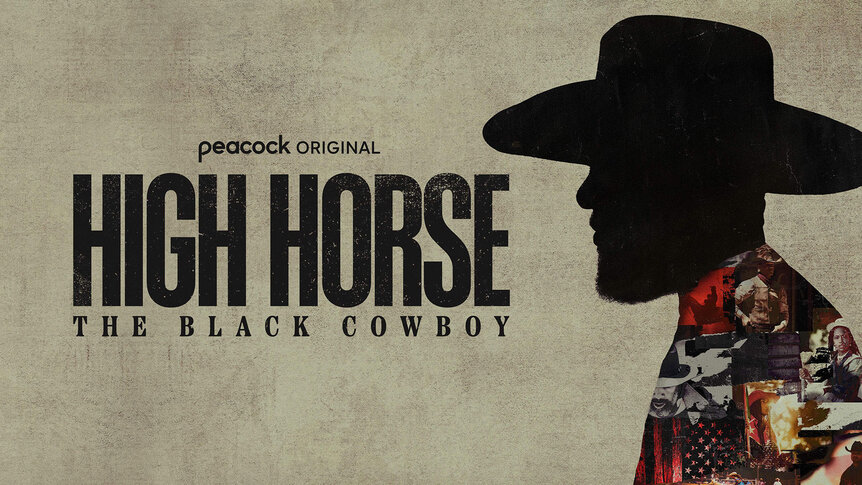
After sitting in on an NBCU panel and catching previews of Monkeypaw’s High Horse at the New Orleans Film Festival, this three-part documentary series shot straight to the top of my must-watch list.
I grew up a city girl, so the closest I ever got to a horse was watching Gunsmoke and Bonanza with my granny. Even spending summers down South as a kid, I never saw horses or cowboys, so that whole culture felt foreign to me—a world that existed strictly on television. The only time I ever thought about John Wayne was while rapping the line from Public Enemy’s “Fight the Power.” (And once I later read about his beliefs on white supremacy and Native Americans… yeah, it was really f#% John Wayne.) But I digress.
Fast-forward to motherhood. With a child attending a predominantly white elementary school, it was extremely important to me that he had a strong grasp of Black culture. Picture this: third grade. The class is studying westward expansion and the American frontier. Now, I’m no fan of the Manifest Destiny doctrine, but that’s not really a debate for a bunch of seven- and eight-year-olds. The point, for me, was to show my son and his classmates that Black people were present in the West, too. Because we didn’t just sprout up out of cotton fields in colonial times and then teleport to cities in the 20th century.

So I started reading. I learned, and taught them, about people like Bass Reeves, the real Lone Ranger; Bill Pickett, the bull wrangler; Nat Love, a.k.a. Deadwood Dick, the sharpshooter; Biddy Mason, L.A.’s first female landowner; and Cathay Williams, who disguised herself as a man to enlist in the Buffalo Soldiers. I also taught them about the origin of the word cowboy, and how what was meant to be a derogatory term somehow became the thing to be (because, seriously, who’s lining up to be called a cowhand—or worse, a cowpoke?).
Which brings me back to High Horse.
Directed by Jason Perez, this visually stunning, super-cool, hip-hop–leaning entrée into the wild, wild West premiered Thursday, Nov. 20, 2025, exclusively on Peacock. Featuring cameos from pop culture figures like Tina Knowles, Bun B, Lynae Vanee, Jordan Peele, the Compton Cowboys, and leading Black voices in academia, episode one explores the origins of cowboy culture and how Black people made it sexy. Because, let’s be honest, that part did not happen by accident.

It’s a primer on the true, largely untold history of Black life on the plains. And how, as the documentary plainly states, as soon as “cowboy” became cool, it was taken from us. A tale as old as time.
But this time? No. We’re not letting it slide.
While episode one felt like the most elementary of the three, it lays the groundwork the series needs: a breakdown of the word cowboy and the details of our widespread erasure from that culture. But since Black people don’t exist only in urban centers, Black cowboys and cowgirls have always been here, been thriving, despite popular imagination acting brand new. The documentary introduces us to the No. 1 Black cowgirl in America, Paris Wilburd (#BlackGirlMagic), winner of the Bill Pickett Invitational Rodeo. Yes, that is a real title, and yes, she earned every bit of it.

In discussing Black rodeo culture, modern-day cowboy and actor Glenn Turman perfectly sums up Black American life in the U.S.:
“If you haven’t been to a rodeo before and you get a chance to go to a Black rodeo, go. Rodeo is about grit. When life deals you a hand that knocks your face in the dirt, what you gonna do? You better get up as quick as you can.”
Time and time again, that’s exactly what we’ve had to do.
If episode one is the basic education, episode two is gonna piss you off. This is where the focus shifts to the Great Land Robbery and how Black people were robbed of over 14 million acres of land in the past century—land stolen by both the U.S. government (eminent domain) and white vigilantes. High Horse touches on towns like Boley, Oklahoma, a Black town that, like Tulsa, was ravaged and destroyed because Black people were too successful. Apparently, thriving while Black has long been, and unfortunately many times still is, considered a punishable offense.

But, returning to Turman’s words, Black folks aren’t laying in the dirt–they’re cultivating it. Enter the resurgence of Afro-pastoralism: a return to the land that also acknowledges our history did not begin with slavery. Beyond the celebrity farmer montage featuring people like Kyrie Irving, Serena Williams, and Kelis (no last name necessary), the documentary highlights farm owners and activists like the Mallerys and John Boyd.
Episode three, “The Cultural Heist,” examines how our cultural treasures were co-opted by white people, who then boxed us out of our own art forms. The most scathing rebuke is aimed at Nashville and the country music radio “mafia” that attempted to suppress legends like Linda Martell and Charley Pride and block newer artists such as Lil Nas X, Blanco Brown, and even Beyoncé. That last attempt backfired spectacularly and gave us one of the greatest musical revolutions of the 21st century: Cowboy Carter. Oops.
While High Horse, with all of its fast-paced editing and whiplash-inducing one-liners, is clearly aimed at Gen Alpha, it’s educational and entertaining for the entire family. The celebrities and costuming may draw viewers in, but as the second and third episodes unfold, it becomes clear this documentary is about more than reclaiming a name or a lifestyle. It’s about the devastating economic and cultural impact of young Black people being disconnected from their heritage—and the power in reconnecting anyway.
Rating: B
Level of Enthusiasm: 85%
