
Anyone who says they don’t want politics in their science fiction or social commentary in their epic fantasy probably didn’t grow up reading those things (or any comic books either). There’s something about seeing the problems in our very real world reflected in fantasy that makes them somehow easier to reckon with, to figure out without anger, and maybe one day work out solutions.
That’s why it’s good to see that James Cameron has listened over the years as he’s developed his world of the Na’vi— his Pandora. A world I now realize is Cameron taking inspiration from author Frank Herbert. He’s creating a universe that reflects socio-political impact and the dangers of unlimited power back at us. This is James Cameron’s DUNE.


Although there are still moments that’ll make your eye twitch in the portrayals of indigenous peoples and cultures, these Avatar films have grown increasingly more sensitive. And as they gain self-awareness, they get bigger and more beautiful. And the storytelling deepens. Whether grappling with colonization, environmental issues, or the systemic eradication of cultures, people, and animals to the brink of extinction, Avatar: Fire and Ash digs its nails into its cautionary tale and draws blood.
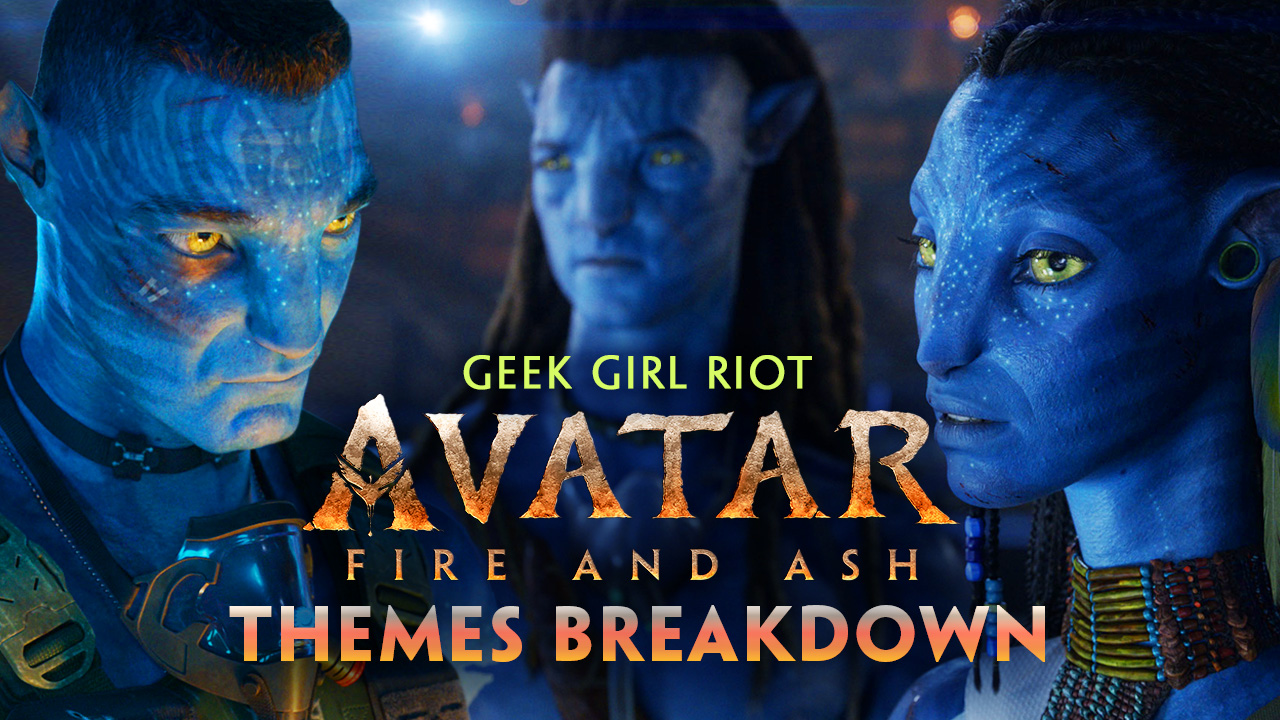
This new movie begins where the last one ends, with Jake Sully, Neytiri, and their children reeling from the loss of their oldest child and elder brother, Neteyam. The world of Pandora itself is also staggering from the invasion of the Earth military complex. Survival is uncertain, unless all the inhabitants of Pandora —the Na’vi, Tulkun, Ikran, and others—stand together and fight.


Through its character arcs, Avatar: Fire and Ash is also about loss, about outcasts and those who are misunderstood, about fighting for your culture. And how, sometimes, the contagion that destroys your world comes from inside your community. A theme SINNERS does well too. Fire and Ash is also an epic, filled with the kind of action set pieces, big fights, and explosive battles that we want to see in science fiction/fantasy.
But I’m also an art girl, and the production design, the creature design, and the animation itself—it’s all so deeply gorgeous and immersive.
And because of that, Fire and Ash posits that our embattled and bloody history will be repeated throughout the universe IF we don’t change our ways. Yeah, the villains have a nefariously acidic charm, and that’s a PROBLEM. But somehow, Quaritch, Varang, Ardmore, Scoresby, and Selfridge’s charisma enhances the sense of “oh, so everything our planet is going to burn out in a giant rage cluster of invader hate? Yeah, I can see how we might want to say no thanks.”


When all the themes come together, this epic allegory gives us room to analyze the issues, and what we see is rough. So yeah, I may have cried. My chest doesn’t pump Kool-Aid, but the crying has purpose because those tears are reflections of how everything that happens to the Na’vi, happened here.
When all the themes come together, this epic allegory gives us room to analyze the issues, and what we see is rough. So yeah, I may have cried. My chest doesn’t pump Kool-Aid, but the crying has purpose because those tears are reflections of how everything that happens to the Na’vi, happened here.
So yeah, before that happens, I’m going to say it: RELEASE THE SQUID! 1

