
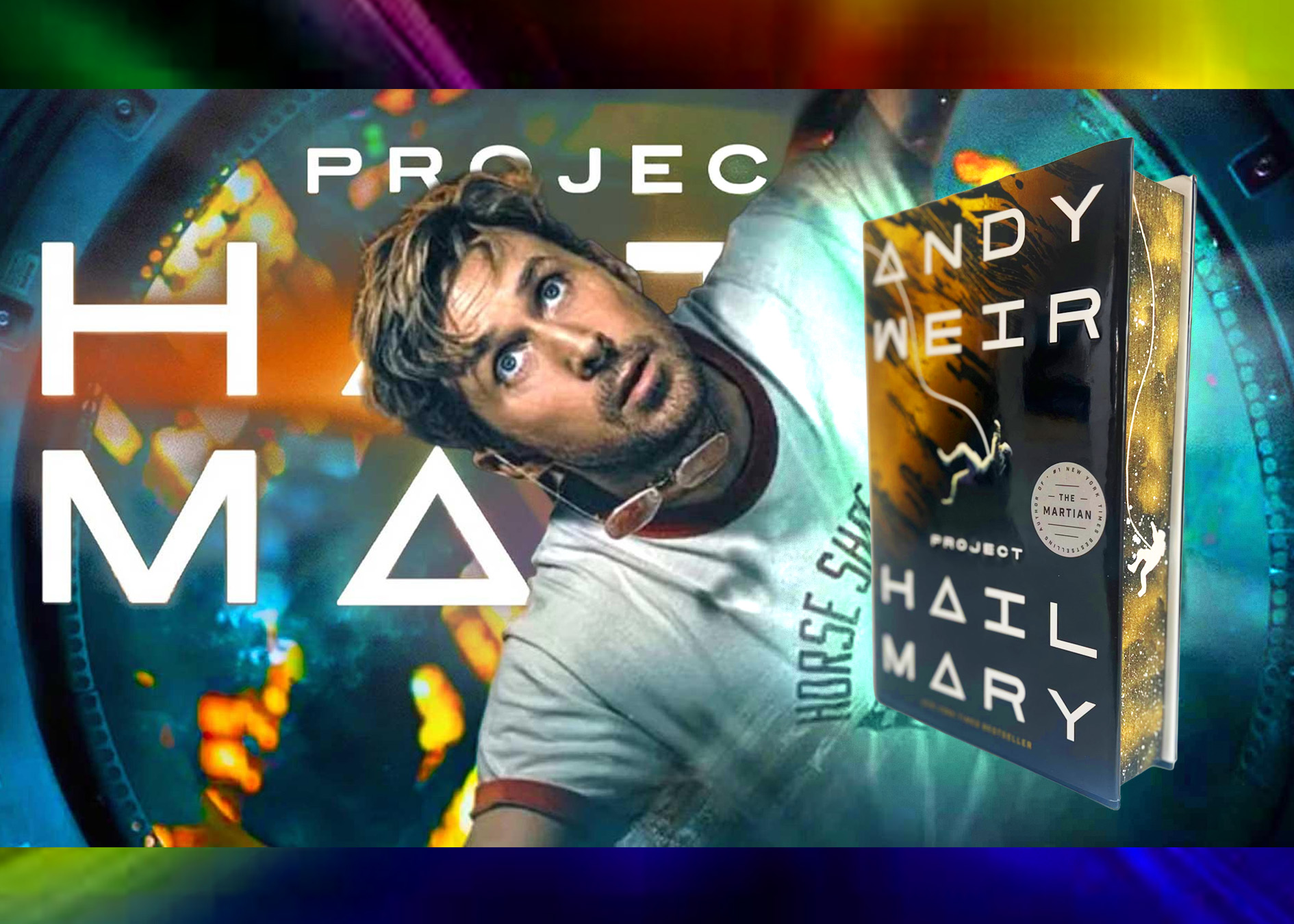
DrewNote: Based on the novel by Andy Weir (The Martian), both the book and the movie have strengths and weaknesses but they tell the same story, one is just more condensed.
WHAT IT IS (OR, THE STORY OF PHM):
In Project Hail Mary (both the book and the movie), junior high science teacher Ryland Grace (Ryan Gosling) wakes up to find himself light-years away from Earth, approaching the star Tau Ceti. Why? He has no idea. All he knows is that he’s in an advanced spaceship, the other two astronauts are dead, and he has to figure out this mission from scratch, with only his reluctant memories to help him along. Oh, and things get weird when it turns out he’s not the only sentient spacefarer out there…
As Grace begins to remember things–such as his science class being terrified that the recently-discovered “astrophage” will eat the Sun and kill them all–he realizes that he’s out in deep space to find out why Tau Ceti, among all the local stars, isn’t being consumed by these microscopic parasites. He remembers Eva Stratt (Sandra Hüller), the project manager, who sought him out because of a controversial theory in his PhD dissertation–and how that spun out into mankind’s greatest feat: Project Hail Mary. A spaceship, powered by astrophage itself and crewed by those best able to endure years of a medically-induced coma, with the mission to find a way to save Earth before the Sun goes dark.

He’s barely reached the system before he finds something blocking part of the infrared “Petrova line” that shows where the astrophage organisms are passing from the star to a planet. And that “something” turns out to be a massive alien spaceship that chases after Grace.
LET’S COMPARE AND CONTRAST…
Both book and movie detail how freaked out Grace is at this development, with the book taking a bit more time to describe how the alien ship extends a docking tube, how Grace waves to a robot (and it waves back), and how they establish the basis of communication through metal figures sent by the aliens. Once inside the tube, book and movie align–we meet Rocky (James Ortiz), a five-legged stone spider that is blind but a mechanical genius.

The movie skips over Weir’s details of how communication is established, condensing the process down to a brisk few minutes. (Directors Phil Lord and Christopher Miller, with screenwriter Drew Goddard, know they have no time to waste.) But soon Grace and Rocky are partners determined to save their world.
Book and movie also align on how they figure out the next step; if astrophage is in balance between the star and the planet, there must be something on the planet keeping that balance in place. So they devise a scoop (in the book, the making of the chain takes a considerable amount of time; again, this is cut down to “here’s what they did”) and use it, getting the samples they need but putting the Hail Mary in danger. The ship careens out of control, the fuel tanks torn open (and having to be jettisoned) as Grace is knocked unconscious by extreme centrifugal force. Rocky is forced to leave his protective “hamster ball” to save Grace and the ship, leaving him hideously injured. While Grace waits to see if he recovers (and the movie skips over an ill-fated attempt to help Rocky heal), he begins to cultivate nitrogen-resistant predator organisms he calls “taumoeba.”
From here onward, the basic story is the same.
WHAT’S BEST ABOUT BOOK AND MOVIE:
Pros of reading the book: a few things that might be confusing or underwritten for the movie are spelled out in great detail. Weir is a tremendous writer and makes even the most complex science easy to understand. Wisely, he chose a teacher as his point-of-view character, so that he would be able to explain things to readers. We also get to spend some time with his deceased crewmates, getting a sense of them that the book can’t quite deliver in the same way. It’s pretty cool that Milena Vayntrub (aka Lily from the AT&T commercials) and Ken Leung play Ilyukhina and Yao respectively, putting faces to the characters Weir gave us.

Pros of the movie: there’s quite a bit of detail in the book that the movie can’t accommodate. It has to tell a story, even if there’s a spacious two and a half hours to do it, and some cuts have to be made. Fortunately, Goddard also adapted Weir’s The Martian, so he knows his way around Weir’s prose. And directors Lord and Miller keep things nicely balanced between awe-inspiring, overwhelming, silly, and heartfelt.
Not only that, but the visuals are beautiful, the effects are practical, and the emotional tension when the mission is in danger is more visceral on the big screen.
IN CONCLUSION…
Okay, so what’s the verdict? You’ll get a more complete and more expansive version of the story in the book, naturally. Weir is able to go into detail about many things–including the experiments they run, the problems they face, and the hurdles they overcome–that the movie has to sprint through to the ending (which includes additional scenes not in the book, by the way). In the movie, you’ll get an astounding performance from Gosling, Ortiz (who is both Rocky’s lead puppeteer and voice), and Hüller as the tough-as-nails Stratt. (Worth noting that the movie isn’t able to delve into Stratt as deeply as the novel but does give her a warm, humanizing moment doing karaoke.)

They’re two faces of one great story. Watch the movie and read the book, you’ll be on an incredible journey.
Find the book on Amazon.
See the movie in theaters now.
