
The thing that caught my attention was the title of an article on TUDUM. It read, and I quote: You’re Invited to a Week of New Wes Anderson Shorts This September. Followed by, and I quote again: The celebrated director is bringing four Roald Dahl short film adaptations to Netflix. How wonderful I thought. I had loved the works of Dahl as a child for their untamed whimsy and startling edge of real-life iniquity. On a second thought, I remember the other side of Dahl, one I didn’t learn about until I was an adult but was rightfully acknowledged by the author’s museum. So here we are contemplating an artist’s creative contributions in order to enjoy what they bring while never forgetting who the man was.

Back to the new Wes Anderson quartet or perhaps his new quadtych. Starting today, with The Wonderful Story of Henry Sugar, Netflix will roll out a series of four shorts based on Dahl’s work, written, directed, and produced by Anderson. The others are The Swan, The Rat Catcher, and Poison. Why shorts? Anderson says, “I’m not sure [the feature] method of storytelling would have worked for that. It made more sense to me to do these short stories as short story movies.”

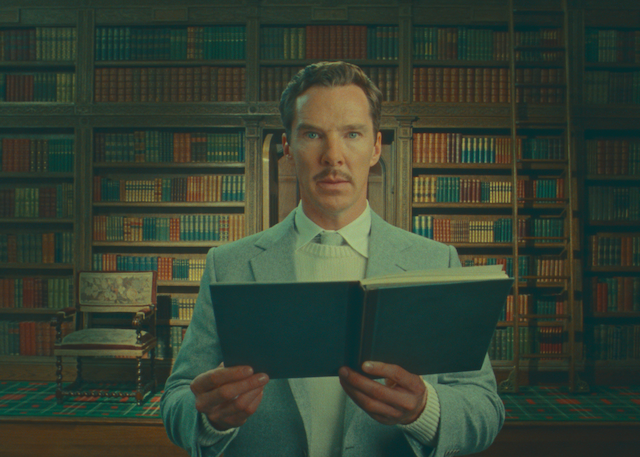
Sugar stars Ralph Fiennes, Benedict Cumberbatch, Dev Patel, Sir Ben Kingsley, and Richard Ayoade—each playing several roles in costumes fresh off a children’s illustrator’s brush (Kasia Walicka Maimone). It tells the tale of a wealthy man who seeks the power to see without using his eyes, to make more money at gambling—but this fairytale has other plans for him. Anderson mentions it took him years to figure out how to tell the story because:
“I am equally interested in the way Dahl tells the story as I am in the story itself.” The story completely hooked me as a child, but if you take away his words, well, I guess, it’s not a movie I felt compelled to do. It’s a great Dahl story, but if I do it using his words, his descriptions, then maybe I know how to do it.”

Thus, in Henry Sugar, Anderson creates a storybook set in motion—where the sets fly and the characters transform with the same playfulness as our parents switching voices during bedtime stories. On the surface, it reads as a morality play but because of the effects of two Indian actors and one Nigerian one (all of them Brits), alongside the Yogi character at the heart of the tale, there is something else we might take away: One cannot steal from a culture and not be profoundly changed by it and eventually the bill will come due.
