
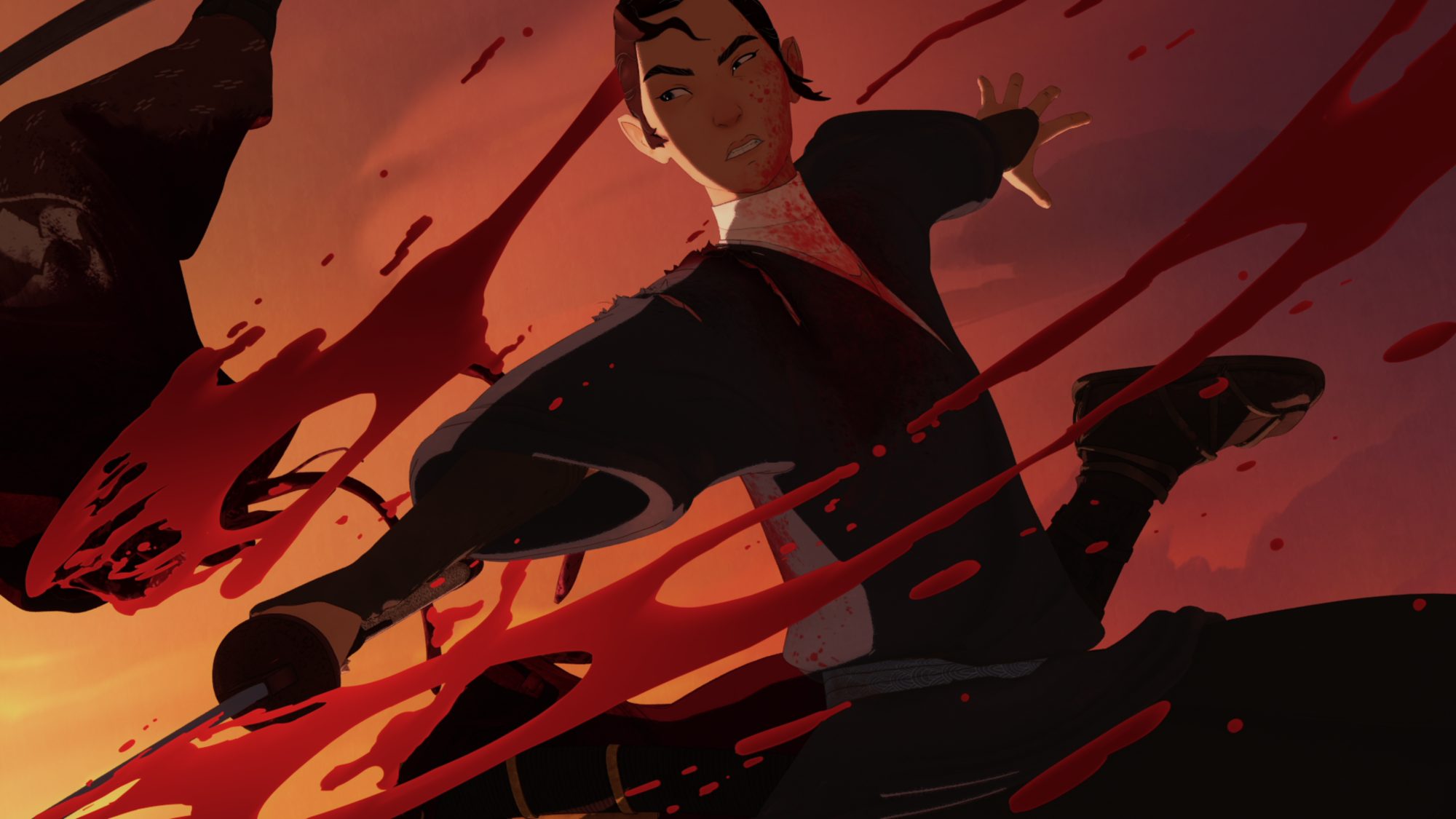
The pages of history are filled with women who posed as men to fight wars, either political or artistic. Not trans men (who also populated history), but women who donned the armor of masculinity that allowed them to move freely. Blue Eye Samurai is a fictionalized version of stories like these. Co-creator Amber Noizumi calls the new Netflix series, “an Edo-period tale of revenge — Kill Bill meets Yentl.” I’m good with that description. Others will see parallels to Mulan (1998). Both are lushly animated, both feature a legendary woman warrior who fights while disguised as a man. However, Mulan lived in China during the 4th or 5th century. Mizu (voiced by Maya Erskine) is the brainchild of Noizumi, who was inspired by her bi-ethnic identity (Japanese and white). As a little girl, she dreamed of seeing a hero like herself who reflected the way she fit into the world. The other inspiration is her child with co-creator Michael Green, a baby born with blue eyes, something that was taboo in 17th-century Japan.

Fans of animation are about to benefit from Noizumi’s vision coming to fruition. Alongside her and Green are director/producer Jane Wu, and production designer Toby Wilson, with a major assist from stunt choreographer Sunny Sun. Together they made a series that I can’t stop shouting about—everywhere from the CCA Women’s Committee to the other Rioters on this very site and beyond.
Blue Eye Samurai is an absolutely gorgeous adult animation, in which a woman goes through the nine rings of hell to get revenge on the white man who made her a pariah by passing down his his blue eyes. The series is harsh, bloody, and full of nudity, but it enthralls most with backstory twists and betrayals abounding. If this show doesn’t hook you by the end of episode 1, you’re a toothless zombie who doesn’t recognize brains when you see them. I watched Blue Eye Samurai in one night, like there was a test the next day and I couldn’t graduate without it. The storytelling is intricate, mercurial, and sharp; the fight scenes are real enough to make you dodge the splatter; while the characters befriend you without trying.

Our main character, Mizu, is surrounded by a cast of characters who are equally well-rendered and complex in their story arcs and motivations. Up first, there is the sweetly ambitious Ringo (Masi Oka), a disabled ramen chef who is on a quest to become the greatest. Princess Akemi (voiced by GGR fave Brenda Song), who dodges the wilting flower trope to become a strategist with blades for petals. Cary-Hiroyuki Tagawa comes through (as he always does) as The Swordmaster who trains Mizu. While Taigen played by Darren Barnet is an arrogant but charming samurai who lacks skill but balances the scales with determination. Meanwhile George Takei as Seki, Ming Na-Wen as Madame Kaiji, Stephanie Hsu as Ise, Harry Shum Jr. as Takayoshi, and Chiaki played by Mark Dacascos round out a cast that has no weaknesses. Definitely not in its villains, who give the high levels of evil that make things spicy, Heiji Shindo (Randall Park) and Abijah Fowler (Kenneth Branagh).

Episodes like “The Tale of the Ronin and the Bride” will leave you sputtering, shattered, and ready to fight, while “Peculiarities” lands like a cheer and a scream stuck in your throat.
Are you ready for this? ‘Cause I’m ready for you to see it.
Watch Blue Eye Samurai
on (Friday, Nov 3). The fight scenes, the animation, the characters, the flip-flopping emotions—totally worth it.
