
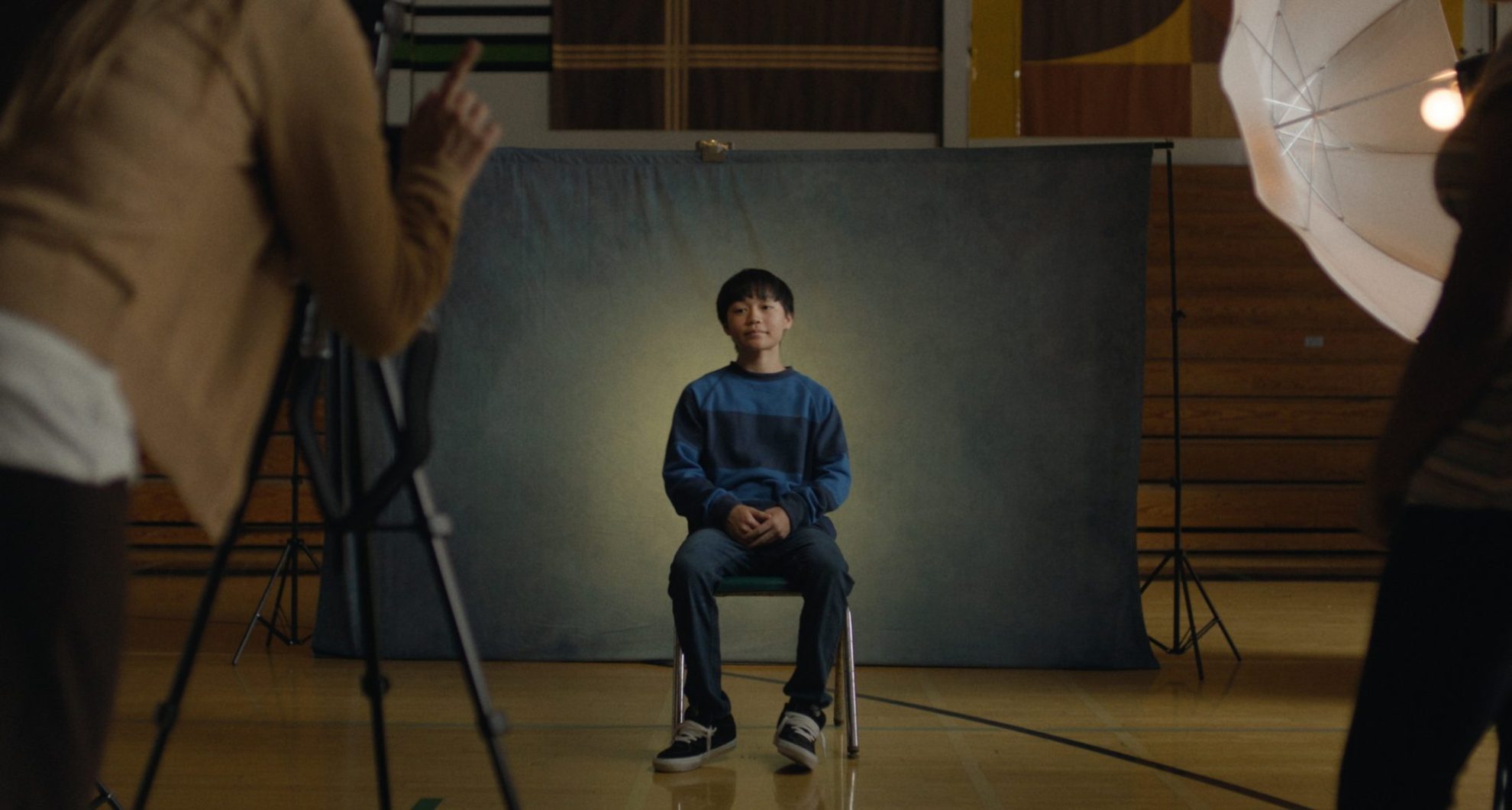
Didi aka Chris aka Wang Wang is trying to get through his last summer before high school starts. He hangs out with his friends. They play pranks on each other, go to parties, and talk to girls. What Didi does is no different from what teenagers were doing in 2008 or 2024. The movie Didi stands out from other coming-of-age movies with its late Y2K filter, diverse characters, and suburban settings yet remains grounded in naturalism.
It’s not a surprise, given writer director with Sean Wang’s prior experience in documentaries, that his first feature film would incorporate textures to the story that give it a lived in authenticity: filming the movie in his hometown in Fremont, California, street casting local teenagers and directing his own grandma Zhang Li Hua, to highlighting the uneven skin texture of his lead character. There’s lots of analog details before even getting to displaying what male adolescence looks like in the 21st century.

One of the hooks of Didi is the perspective; it feels like someone whose adolescence was desktop social media, not apps. Didi is very much a late 2000’s scene kid toggling between MySpace and Facebook (which makes sense since 2008 was when MySpace was declining and Facebook was still popular with people under 25). Using AIM (AOL Instant Messaging) to IM (now dm) your friends and crushes. And YouTube quality topped out at a painterly 480p. In the movie the use of language online is a mix of slang, acronyms, and emoticons that is at once a capsule of its time and current in a way teen films today don’t incorporate enough. The sound editing alone – the opening and closing of a door when someone comes on or offline, conversation chimes, using pop punk song lyrics as your ringtone, all render a sharp pang of nostalgia, especially amongst millennials.
As an elder millennial watching Didi you forget how much insecurity, fear, and shame undercut your life as a teenager. Teen boys mask their inexperience with bravado and girls with ennui. Even though there was no reason for Didi to be insecure in his interactions with everyone, he makes rash decisions which lead to unwarranted self sabotage – when Didi types something too honest or too vulnerable and responds instead with an emoticon or blocks his crush after an embarrassing incident instead of talking about it. While I felt maternal sympathy for Didi during these scenes, Cub was covering their face and groaning along in shared embarrassment. See below for Cub’s voice to text review.

When you’re starting new friendships and romantic relationships and experiencing situations for the first time as a teen you’re so scared you’ll mess it up and too immature to ask for advice. Before Didi goes on a date with his crush, Madi (Mahaela Park) he looks up on YouTube how to kiss (with surprisingly PG results). When Didi meets a group of skaters for the first time he lies about knowing how to film so he can hang out with them more instead of with his childhood friends Fahad (Raul Dial) and Soup (Aaron Chang). He borrows his mom’s camcorder and researches online on how to become a filmer.
It’s not only the new friendships and relationships that are in flux with Didi, but within his Taiwanese immigrant family as well. His Dad is offscreen in Taiwan “making money”. His Mom (Joan Chen) is a quiet storm. She’s not like the typical Asian immigrant alpha mom obsessed with grades and getting her kid into Ivy League school. She has her own artistic hobbies and ambitions. She casually switches between English and Mandarin to Didi and his sister Vivian (Shirley Chen). Not because she doesn’t know how to speak English; it’s because she uses whichever language can express her feelings more comfortably. Having grown up in a household where my own parents and grandparents spoke Tagalog to each other yet switched to Taglish (a mix of Tagalog and English) for me and my brother, the way the Wang family communicated felt very familiar.
Out of all the relationships in the movie, the unconditional love his Mom gives to Didi and her family is truly the heart of the movie and ultimately what guides Didi back to staying true to who he is even as he is trying to figure it out.

With film inspirations as Stand by Me, Ladybird, and The 400 Blows, Didi can stand confidently (even if the title character wouldn’t feel like he is) amongst these films as screenshot of what it’s like to navigate as a teenager in the new millenia. It’s loud. It’s messy. It’s being captured online for you to look back on with a mixture of cringe, fondness, and Y2K nostalgia.
*If you want to keep riding the wave of nostalgia after watching Didi check out the video op ed by Didi writer director Sean Wang did for the New York Times, Why You Should Open Your Yearbook H.A.G.S. (Have a Good Summer). Think of it as a hopeful yet wistful epilogue to Didi.

Here’s Cub’s unedited voice to text train of thoughts review of Didi –
it was so good!! some parts were relatable, some had me hiding my face, some made me tear up.. 😭
i like how as the movie goes on you can see how complex chris is a charecter, i like the switches between chinese and English because it really reminds me of how lola talks, i like how the movie feels real,, like the acting is insanely natural!! i also love the filming style and the mixed media and the way it immerses you in the film!! i love the way how things go fast when he’s with new friends and then the next it slows down and you’re hit with this unexplainable feeling!!
i also love how he loved his family and how they understand one another even without saying! i like how they didn’t make him hate his family like in some coming of age movies.
done 🎊
