
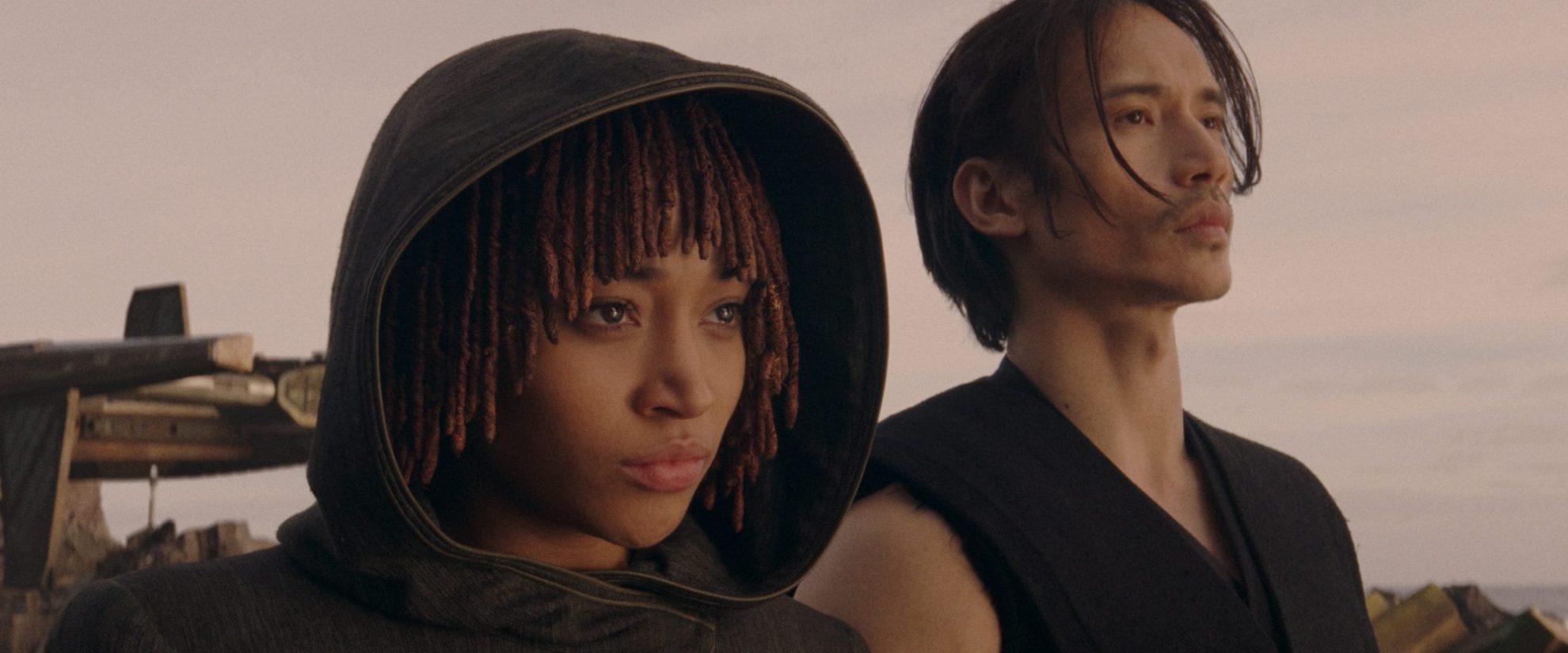
If I say the Jedi are “dirty dirty” will you send a Mandalorian to my residence? If so, send the right one. The latest from Disney+, Star Wars: The Acolyte challenges our long-held perceptions of the Jedi. This change is important. If the Jedi stay stagnant, or even unexamined, there’s nothing new for us to explore. A lack of discovery would make it easier to walk away while covering our yawns. But if the Star Wars Universe flips our standpoint by giving the Jedi a journey of redemption, that gives us a reason to get geeky-nerdy again. What if we frame The Acolyte as the first step in a classic hero’s journey? This time the Jedi go through a collective ‘dark night of the soul’ and reemerge as the heroes they were always meant to be.
That could relaunch the next phase of the franchise with a morally gray underbelly, like Andor and Rogue One. Before we go further into these thoughts (and I admit I woke up and wrote them in my iPhone Notes at 4AM), let’s address the Bantha in the room. The Acolyte stirred up a black hole of intergalactic bitterness. Despite that, this show succeeds in a lot of ways (see below). It also has a series of questionable moments. Upfront: the decision to leave Mae behind with a convenient amnesia twist. The plot gymnastics of it all! Basic, yes, but we’ll take that gamble, for now, because separating the twins was necessary to set up Season 2.
Now, let’s get into the juicy stuff. Forget the “cop” theory; this is more like the Crusades in space. The Jedi Order are the Knights of the Crusades. They’re on a mission to keep their stranglehold on power by masquerading as the only conduit to the Force. Why? Because they’ve wrapped themselves in a cloak of moral superiority, and they’re not letting go. The Acolyte rips the holy veil off of the Jedi’s so-called nobility. Which we now question. Is their way of life nothing more than a desperate attempt to control the galaxy’s spiritual narrative? It can’t only be about protecting the galaxy from the Sith or the Night Sisters; not when we’ve seen their treatment of other witches and religions. Maybe it’s about ensuring that the Jedi’s interpretation of the Force remains unchallenged, and that’s a power play older than The Gree.

Let the old races bear witness: the Jedi approach has always been a bit suspect. Their quest to control access to the Force—essentially their version of God—disconnects them from true spirituality. The Acolyte peels back those layers and I, for one, am here for it. It’s about time someone called out their practices. Especially in their training and rejection of children. Although I was joking when I said they’re “dirty dirty,” I’m not sorry. We’re seeing further evidence they’re not as heroic as we always thought. That’s because they may be why the galaxy goes to flames and acid. Or at least part of the problem. The Acolyte and its creators blow a wind of change at our beloved space monks and expose the rot hidden beneath their robes. After hanging out in the era of the Galactic Republic, it’s not that they’ve lost their way; it’s that their way was never as pure as we were led to believe. The show forces us to confront the uncomfortable truth that the Jedi, with their rigid dogma and moral absolutism, could be the architects of their own downfall—and maybe even the galaxy’s. And rather than be mad about it, pour me a blue milk milkshake because this might be good.
Speaking of bad attitudes, The Jedi don’t fear the Sith; they birthed them. The Sith are the natural byproduct of the Jedi’s arrogance and disconnect. From what we’ve seen in The Acolyte, the seeds of oppression were planted long, long ago. Maybe when we meet Yoda in the swamp, he’s not just grieving the fall of democracy, but he’s found some form of enlightenment. That or he’s twisting in a hot mosquito stew of guilt.


What I like about The Acolyte is the challenges. The series digs deep into the Jedi’s history, showing us, as our history does, that rigid dogma and unyielding moral superiority have paved the way for the Sith’s—aka evil’s—rise. The Jedi’s insistence on suppressing emotions and severing personal connections has created a vacuum where natural human desires fester and mutate into easy corruption and vengeance. This repression, rather than fostering peace, has bred resentment and rebellion. The show vividly illustrates how the Jedi’s lack of insight into their own flaws and the suffering it causes has directly led to the creation of their greatest enemies. The Sith, in this narrative, are not just power-hungry villains but dark side mirrors shaped by the very Order that claims to stand against them.
Moreover, The Acolyte, as I mentioned above, hints at a more complex understanding of Yoda’s character. His grief and melancholy could stem from a profound realization of the Jedi Order’s inherent flaws and their role in the galaxy’s turmoil. This interpretation adds another facet to Yoda, as someone burdened with the knowledge that the principles he upheld contributed to the galaxy’s downfall. In fact, when we meet Yoda in the swamp, he’s in the same headspace as Luke in The Last Jedi. And isn’t that the same for Torbin’s meditative state in The Acolyte? When thinking about The Last Jedi, Luke and Qimir are in similar physical spaces. (Hello, rocky coastlines of Ahch-to.) Which is a metaphor for their reactions to their disappointment with the Order or their places in it.
What is it about the Jedi that causes disillusionment or outright villainy again and again and again into infinity? If what we’re getting is a more nuanced portrayal, that’s so much more interesting than rehashing what came before. A question of the Jedi’s culpability challenges our perception of them as infallible heroes. It encourages us to examine the true nature of heroism and villainy in the Star Wars Universe.

If the Jedi weren’t corrupt, as presented in The Acolyte, they wouldn’t find it so easy to overthrow their morals. Green Baldie frames her guy, Sol, so easily. All in the name of maintaining a facade of righteousness. The witches? They are the living evidence against the unbearable weight of Jedi persecution. Sol’s story features prominently in the main plot but it is also a microcosm of what’s wrong with The Order at large. Every Jedi we meet reflects this corruption. Indara blames a child for a massacre she orchestrated to dodge accountability. Sol kidnaps a child to fulfill his desire to be a father figure. Torbin is so homesick that he becomes a pawn, and Green Baldie (seriously, what’s her name?), oh yeah, Vernesta frames Sol to avoid the checks and balances inherent to any true democratic republic.
Their downfalls are swift and inevitable because The Jedi Order was tainted long before we met them. This is where Star Wars shows its roots and starts to feel a lot like Dune. The new properties in the franchise are exploring what happens when a ruling government drifts towards fascism, while its religious order—its so-called moral compass—rots from within due to an obsession with control. “Power unchecked corrupts,” and, Rioters, we are seeing it play out.
That’s what’s so fascinating about this show. Even with its faults. The Acolyte seems poised to dismantle the Jedi as we know them, exposing their flaws to rebuild them. It’s an evolution at a great cost, but perhaps a necessary one.

Let’s talk about heroes or the lack of one. Someone suggested that what’s most dissatisfying about The Acolyte is it leaves us with no heroes. Maybe, but I think it gives us a look under the cape and dismantles the framing that makes us see certain acts as heroic (when they’re probably not). Mae is a traditional hero archetype flipped on its head. She makes a mistake, gets scapegoated, seeks revenge, learns love matters more, aligns with her oppressors’ opposition, outs the true villain, and sacrifices everything for love. It’s a big ole flip-flop of expectation, showing us that even our cherished heroic archetypes are manipulations perpetuated by the power system.
In The Acolyte, heroism isn’t a saber and a cloak; it’s a gritty, blood-filled swamp of moral ambiguity. The series forces us to re-evaluate our earlier, more simplistic notions of good and evil in the franchise. The character evolution throughout the episodes is complex from every viewpoint. Osha and Mae, The Twins aren’t on your typical hero’s journey. Their path is a messy, often painful exploration of sacrifice, redemption, and the blurred lines between hero and villain. Something reflected in the Jedi themselves.
Star Wars: The Acolyte is more than just another entry into an epic franchise. It’s a critique and a deconstruction, possibly a star chart for a new way forward. With so much intrigue, and so little Qimir, a second season seems inevitable. Sidebar: Am I the only one thinking Osha and Qimir are going to make their own natural-born Baby Sith Lords at some point? Either way. May the Force be available to us all, as we navigate the murky waters of Jedi corruption and galactic deception.
This is the dark side of the Jedi seen through the eyes of an Acolyte. Maybe in the end, Star Wars is enhancing its heroes, making them more heroic, by holding them accountable. And that’s a whole new hope.

