
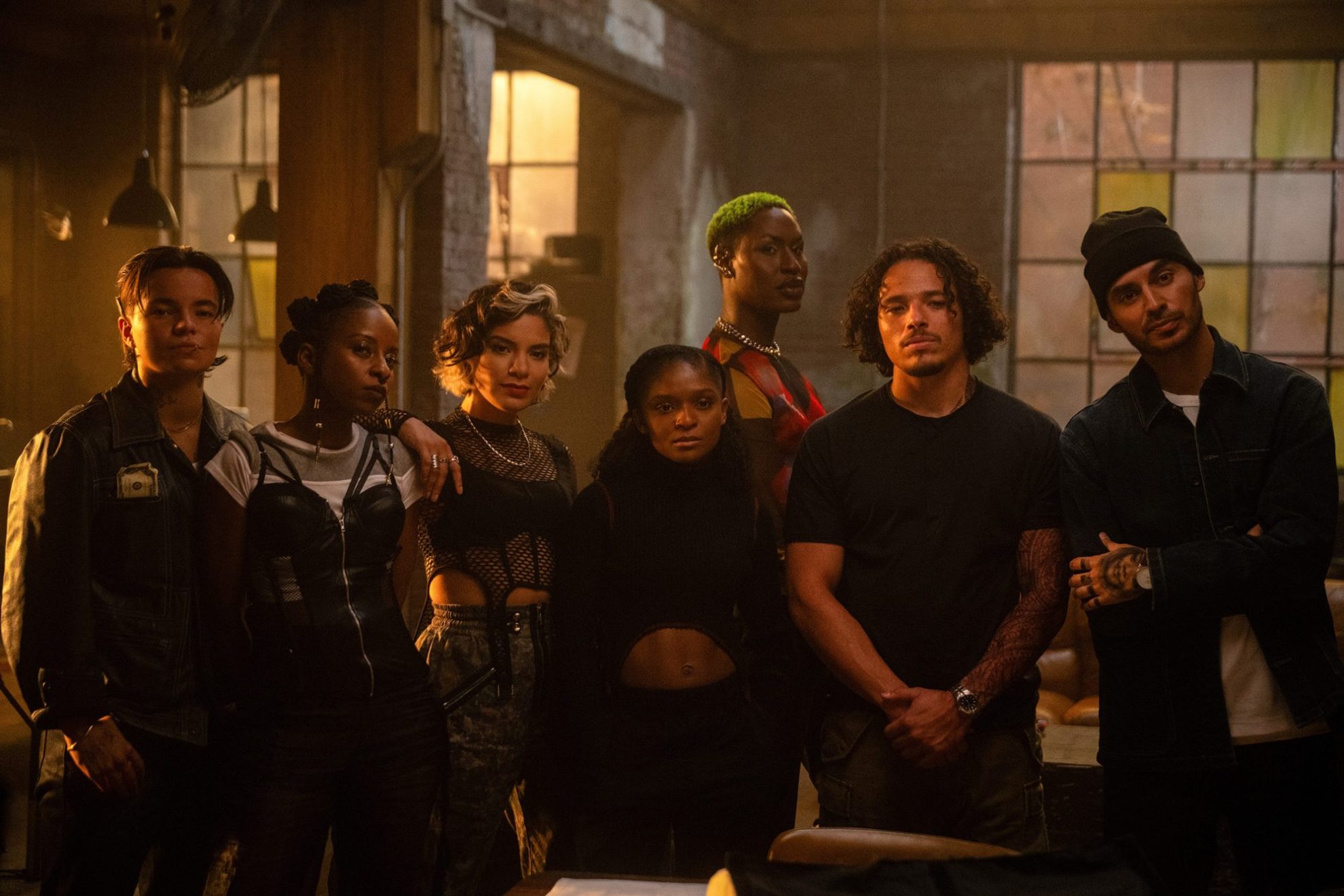
Marvel Television’s latest series, IRONHEART brings us another member of the tech-powered, mecha-suit-wearing, genius hero family. It’s Riri Williams’ turn. Fresh out of Wakanda Forever, this brilliant prodigy finds herself caught between the worlds of technology and magic when she leaves MIT and returns to Chicago. With its Black girl scientist, it’s fringe technology, and superhero origins, this is my kind of show—or it should have been—but when it came time to review the limited series, I said: “IRONHEART left me with strong 50/50 feelings. I’m here for the cast, the creatives behind it, and the visuals, but the story doesn’t energize me.”
That quote says a lot, but since the series received so much unjustified review bombing, I want to explain myself. IRONHEART has moments of genuine sparkle. We already know Dominique Thorne is incredible and multihued as Riri. And Anthony Ramos never misses. There’s also Lyric Ross—a woman who needs a leading role immediately—as N.A.T.A.L.I.E. and the mystical realm inside Stanton’s Sweets, the shop owned by Madeline (Cree Summer) and Zelma Stanton (Regan Aliyah). That’s where the show feels most alive and unique. It’s also where we find an inkling of a Marvel series we haven’t seen before. That gave me an idea for a version of the show that would capitalized on its best features. More on that shortly.
“My death won’t make the news,” Riri says in the second half of season one. “Well damn, that was dark,” replies one of the Blood Siblings, Jeri (Zoe Terakes). “But I low-key felt it,” says the other, Roz (Shakira Barrera). I felt that too. It might be my favorite moment of the 6-episode series. I’ll confess, I didn’t fully wake up to the show’s potential until the second half. That’s when we enter the more mystical side of things and learn more about the women connected to the magic.

That’s the type of story I hoped for more of—stories that dare to imagine these young women in spaces beyond the overworked cliches. Way too often, when we have a young Black lead, the story immediately lands in the streets. It’s about facing hard times on the streets, gun violence on the streets, and street smarts—on the streets, in the streets, because of the streets. It’s not that those stories aren’t valid; they are deeply valid and needed, but they cannot be the only stories we tell about the kids. That’s why TV and films like Forever and the Spider-verse franchise are so appreciated; they swerve from the typical framing, offering a fresh perspective that proves there are other stories to tell with working-class teen heroes.
I know the main beats of IRONHEART are based on the comic book, but Marvel Television consistently strays from the illustrated pages, and this series definitely does. IRONHEART could have given us something different that honors Riri’s enrollment at MIT as a teenager and her genius while keeping the spirit of The Hood (Ramos) intact, rather than sending her home after being expelled for “plagiarizing” herself for profit.
IMAGINE THIS: IRONHEART Re-envisioned

IRONHEART as an intercollegiate tournament for young inventors, where they build mechs and clash annually in popular televised battles from Chicago. The tech coming out of this tournament is so revolutionary the inventions start disappearing, secretly taken by A.I.M. (Advanced Idea Mechanics), a shadowy in-universe corporation.
As the stakes rise, A.I.M. starts kidnapping the original inventors, the college kids, forming sweatshop-style Tech Think Tanks that exploit their brilliance by shipping them off to satellite offices all over the world. Here, “the streets” are replaced with trafficking, a street-level crime with tragic personal and global ramifications. The universities are either getting kickbacks or don’t have the resources to find the kids; either way, they do nothing and become complicit in their silence. Within this world, we have Parker Robbins AKA The Hood acting as a Robin Hood anti-villain, stealing tech from corporations to give back to Chicago’s communities when he discovers what’s going on. At first, his moral compass is skewed under the influence of Cousin John (Manny Montana), one of the true antagonists.
Realizing there are degrees of villainy and that’s not his type, Parker teams up with Riri, but he can’t be trusted for long. Riri is doing her own investigation after suit-stomping a crew of kidnappers who came for her, and she’s having panic attacks because the same thing happened to her missing bestie, Natalie (Ross). She was powerless to help back then. Riri’s guilt causes her to inadvertently copy her brainwaves and create the A.I. consciousness N.A.T.A.L.I.E. Her student advisor, the incognito Zeke (Alden Ehrenreich), gets caught in the crossfire and becomes a wild card who could go either way—good or villainous—embodying the conflict between ambition and morality. All of this unfolds while Zelma schools Riri and N.A.T.A.L.I.E on the ways of the mystical arts, so when everything goes down, they can fight toe-to-toe using combined magic and tech.
END SCENE
The budget might’ve been challenging, but imagination can counter that. We’ve seen the season one story already, not with an iron suit, but these storylines seem almost inescapable when the stories are about Black teenagers and young adults. I’m just saying, there were other ways to go. Perhaps that’s why I want talk about the parts of the IRONHEART series that worked for me, too. There are three core themes: unprocessed grief, magic versus tech, and the power of authentic connection.
Unprocessed Grief: The Weight of Loss

At its heart, IRONHEART is a meditation on grief and how we choose to face—or avoid—it. We see this most powerfully in three parallel narratives: Riri’s mourning of her stepfather, Gary, and bestie Natalie, Zeke’s complicated relationship with his father, Obadiah Stane’s corrupt legacy, and Parker’s relationship with his father and pain at losing Cousin John. The series reminds us that attempting to forget or avoid it only sharpens grief. Whether it’s memories or resentment, Riri and Zeke initially try to outrun their memories—Riri by throwing herself into her work, and Zeke by hiding behind the alias of Joe McGillicuddy. While Parker sinks into more and more destructive behavior, refusing acceptance. Yet avoidance only intensifies their pain, with very different results for each of them. This becomes one of the show’s most acute themes.
Technology vs. Magic: The Battle Within


IRONHEART presents a crucial lesson about power through the clash between Riri’s technological marvel—her Iron suit—and Parker’s mystical artifact—his hood. It’s not about fighting tech with tech or magic with magic; it’s about the mistake of trying to use your enemy’s weapons. While Riri channels her genius through her advanced armor, and Parker feeds his corrupted emotions through his hood’s supernatural abilities, the show demonstrates how true victory comes from embracing your authentic power, fighting your opponents “whatever” with your “everything.” Although the execution sometimes feels more obligatory than inspired, the contrast between science and sorcery embodies the fundamental conflict between Riri’s morals and Parker’s villainy.
The Power of Connection: Finding Your People


The series sparkles when exploring the intricate web of relationships that ground its characters. Here, we see two parallel bonds: Riri and her AI recreation of Natalie, versus Parker and his Cousin John. In both cases, the second figure serves as an essential anchor in their lives, grounding their respective journeys. Beyond these personal connections, there’s the broader dynamic of Parker’s Gang, AKA his heist squad. Riri finds herself entangled in a world where honor among thieves requires loyalty or the crime will consume everyone tied to it. This is proven when the pressures of ambition begin to erode the gang’s bonds from within. These layered relationships—whether preserved through technology, personal connection, or tested by the strains of criminal enterprise—demonstrate how our connections shape who we become, for better or worse.
—
And there it is. The Heart of IRONHEART—a series with an incredible cast, creatives, and visuals that doesn’t quite deliver satisfying storytelling. It has potential, with a compelling protagonist caught between worlds, yet too often the show opts for cliches rather than the innovation its premise promises.
