
I’m not surprised by the current change in Dwayne “The Rock” Johnson‘s public persona; he’s on his promotional campaign for the new A24 film by Benny Safdie, The Smashing Machine. One of the things that separates great professional wrestlers from good ones is how to read the crowd, and I’d say the difference between pro wrestlers who stay within that world and those who can become bigger is when to change who the public sees you as completely. In wrestling, it’s changing one’s “gimmick,” and Johnson has done this before, very early on in his career. After being The Scorpion King, we saw him in action-style hero roles like Walking Tall remake and The Rundown, but it was his character in Be Cool that had people seeing he could be more than just a new Schwarzenegger. Johnson got smaller, for him and less of a hulking presence on screen, and we got more family movie Johnson as he went by his name and distanced himself from his wrestling persona.
It was his return to the WWE, his bulking back up, and basically coming home to gather back up his loyal original fanbase as the Hollywood one moved on and started to write him off. He was back as The Rock, and he brought that energy into films with his role in Fast Five. And from that point in 2011, The Rock became an ever-present force. He, by himself, was just as much of a draw as an MCU movie or Tom Cruise in Mission Impossible films. Yet that ever-present presence began to weigh on the public, especially once you get to everything with Black Adam and his want to take over the DCEU with him at the center. This moved over to his character in WWE as well, becoming The Final Boss and putting his weight into a pretty big story of John Cena’s final wrestling run in the company before he retired in 2026. It blew back in his face.
John Cena connects to this as well during these last twenty-plus years; other pro wrestlers have followed the path Johnson created. Cena and Dave Batista, being the two main stars and those two to be different from him, have chosen different types of roles and gotten chances to give performances that are very layered and emotionally complex. To the point that people are like Johnson isn’t a good actor and that these two are in a battle over who’s the better actor. Both have been willing not to be the star and look “great” and be flawed people on screen. So Johnson needed to change things; he had to switch the gimmick.

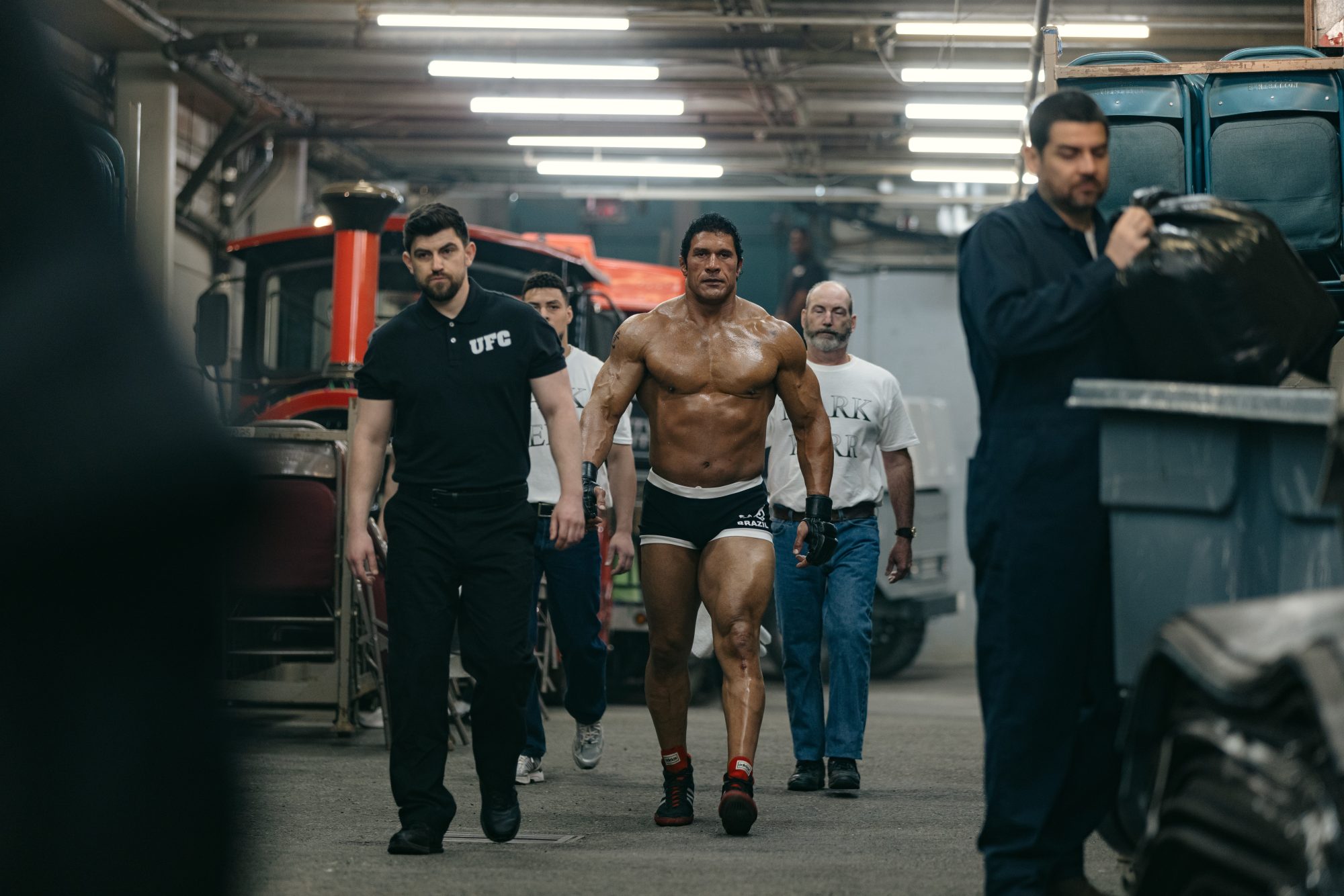
What does this have to do with The Smashing Machine, you might be thinking? Well, here Johnson plays former amateur wrestler and mixed martial artist Mark Kerr, an early champion in the sport, former UFC Heavyweight champion, World Vale Tudo champion, and PRIDE fighter, in a story of a period in his life from 1997 through 2000. Written, Produced, and Directed by Benny Safdie, the film shares its title after the 2002 documentary about Kerr, and it seems to cover the same material but from a more interior perspective that the documentary couldn’t really do. A lot of this feels like it’s from Kerr’s perspective. This gentle and soft-spoken man, who is very focused on being the best fighter he can be, whose purpose is winning.
It’s the performance of Kerr that brings Johnson’s talent back into the limelight. Along with some amazing makeup, you wouldn’t believe you’re watching Johnson on screen. He took on the affectations of Kerr and a gentleness that he rarely gets to show. There’s no performance on top of the performance here. After a long time, Dwayne Johnson is acting again and not as The Rock or as the Rock as insert character archetype. You feel for Kerr through his struggles with substance abuse and dealing with his losses. It’s his scenes with Emily Blunt where I think he brings forth the greatest empathy for Kerr and impresses the most on screen.

Blunt plays Kerr’s girlfriend and future wife, Dawn Staples. A character in this story that I don’t feel shows her as a fully well-rounded character. Dawn in this film is the source of all of Mark Kerr’s pain. His love for her and her need to be the center of his life, even at the cost of his career and health. Blunt is great, and being that these two actors have worked together before, there is a comfort level between them on screen that you feel. Her hair, makeup, and costuming made a mark on me in each scene she’s in. I wish there were a bit more to show Dawn a bit more well-rounded, also for Blunt to do more in the film, but she did do great with what we saw in the film.
Along with Dawn, there is a lack of a point in the film for the story being told. Is it that different than what was shown in the documentary completely? It doesn’t feel like it. It’s also a very short period of the man’s life, so at times it feels like a character study vignette that might feel worth the two-hour runtime for all viewers. There is some great filmmaking here with Benny Safdie, as I love his use of close-ups and framing the characters on the screen. The change of look of the old TV or video for certain parts brings you further into the world and time of the film. He does some camera holds on characters that add to performances, as you can get into the mind of characters at specific points. Yet it does feel aimless, and I don’t completely come away with anything other than this was a pioneer of a sport. That works for me as a critic, but I don’t know if it will for everyone.

I don’t want to leave out Ryan Bader, as Mark Coleman, who is a big part of this film and gives an excellent and authentic performance. I hope he does some more acting because I did enjoy him in this. That’s the thing with this film: the performances are what stand out, and I think Dwayne Johnson’s performance is worth all the dialogue surrounding it. It’s that good that he deserves the nomination talk. It’s just that the film leaves many people wanting to a degree that it can hurt that performance. The Smashing Machine wanted to introduce Mark Kerr to people who didn’t know him, and on that goal, it was successful.
Rating: B
Level of Enthusiasm: 80%
