
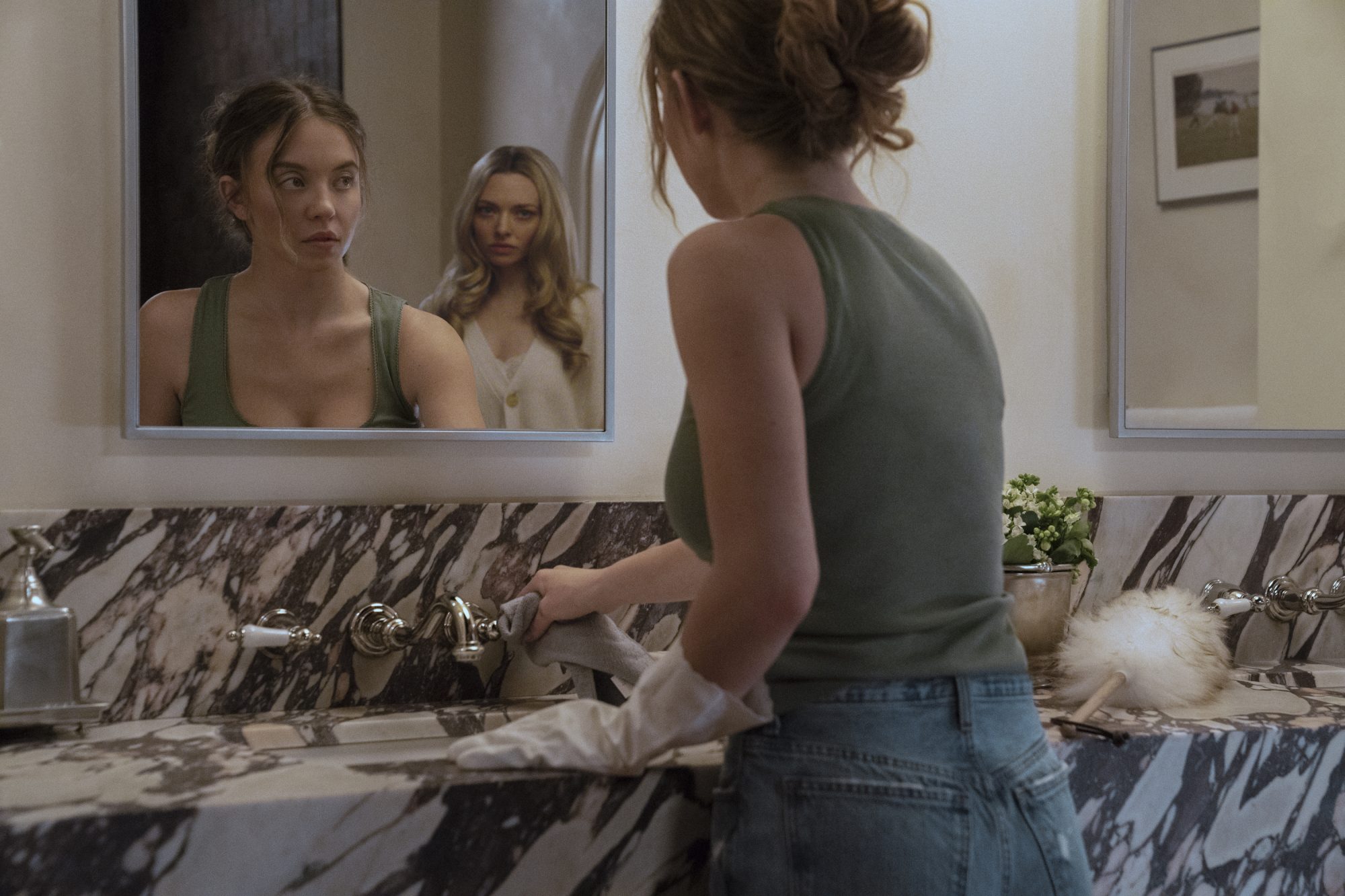
The Housemaid is shamelessly addictive. If you’re like me, who deeply and unabashedly enjoyed A Simple Favor, then director Paul Feig’s The Housemaid—written by Rebecca Sonnenshine and based on the book by Freida McFadden—is a must-watch. It’s a deliciously dramatic psychological thriller that plays on our own biases and sexism. As soon as Amanda Seyfried’s Nina Winchester, a wealthy woman seeking a nanny for her daughter, tells Millie Calloway (Sydney Sweeney), the aforementioned nanny who’s secretly on parole, that the winding staircase might just be the death of her one day, you’ll be locked in.
Millie is sleeping in her car and is at risk of going back to prison—the reason she was there in the first place is later revealed in one of the film’s juiciest twists—before she’s hired by Nina. The two seem to get along at first, but Nina’s attitude towards Millie takes a turn very quickly. All of a sudden, Nina is smashing plates because Millie allegedly forgot to print out her speech and raging at Millie for minor things that, in reality, shouldn’t be an issue. What ultimately saves Millie from being fired is Nina’s husband, Andrew (1923’s Brendan Sklenar), who takes pity on Millie and is constantly apologizing for his wife’s behavior. So, of course, Millie takes a liking to him, but it’s also what ultimately sends the trio’s dynamic into utter chaos.
There’s little to dislike about The Housemaid, which is as wild and unrestrained as possible. It’s not as silly as A Simple Favor, as it chooses to lean into darker territory, but it’s able to balance some of the more absurd moments with the lethal ones. Crucially, Feig’s film is an examination of the ways women can so often play into sexist behaviors, often to the detriment of other women and themselves.

Almost as soon as Nina’s behaviors take a turn, Millie begins to distance herself, believing Nina is “crazy” and jealous. The film even goes so far as to critique our own biases and prejudices regarding mental illness, with every character blaming Nina without question. It’ll, perhaps unexpectedly, make you look inward regarding what we’re taught from early on and how these attitudes about and towards women shape us.
Beyond these thoughtful themes, The Housemaid is a propulsive watch. It’s over two hours long, but it never feels that way; the pacing runs like a well-oiled machine, building towards an explosive final act that will leave you gasping and completely riveted by what happens.
Amanda Seyfried’s performance is one of the biggest reasons the film works so well. As Nina, the actress plays up the jagged edges of her character, almost to the point of not feeling bad for her—at least at first. With wild eyes and a frenetic energy, Seyfried perfectly embodies Nina’s unhinged behavior, switching things up when needed to create a character whose pieces are much more well-rounded than initially believed.

Though Sydney Sweeney doesn’t always slip into her roles so effortlessly, she does so here. Millie is a nice person with an edge, but she’s stuck in a position she can’t leave. Treading softly around Nina is a challenge for her, and Sweeney plays up that internal struggle well. Her scenes with Seyfried are particular standouts, with the two gelling together even when their characters are on entirely different sides. Then there’s Brendan Sklenar, whose boyish good looks and charm lull the audience into a sense of security despite certain decisions that will have you side-eyeing him (this is the nicest way I can say this without spoiling anything!).
All told, The Housemaid is precisely the kind of Paul Feig film I can get behind. While it’s occasionally self-serious, the psychological thriller is a spectacularly fun time. With great characters and cast, a luscious story that takes its time laying its groundwork before its sharp twists and turns, and a slow-burn escalation, The Housemaid will have you enthralled by every moment. It’s not often I recommend films that I’d rewatch over and over again myself, but this is certainly one of them.
Rating: B
Level of Enthusiasm: 98%
