
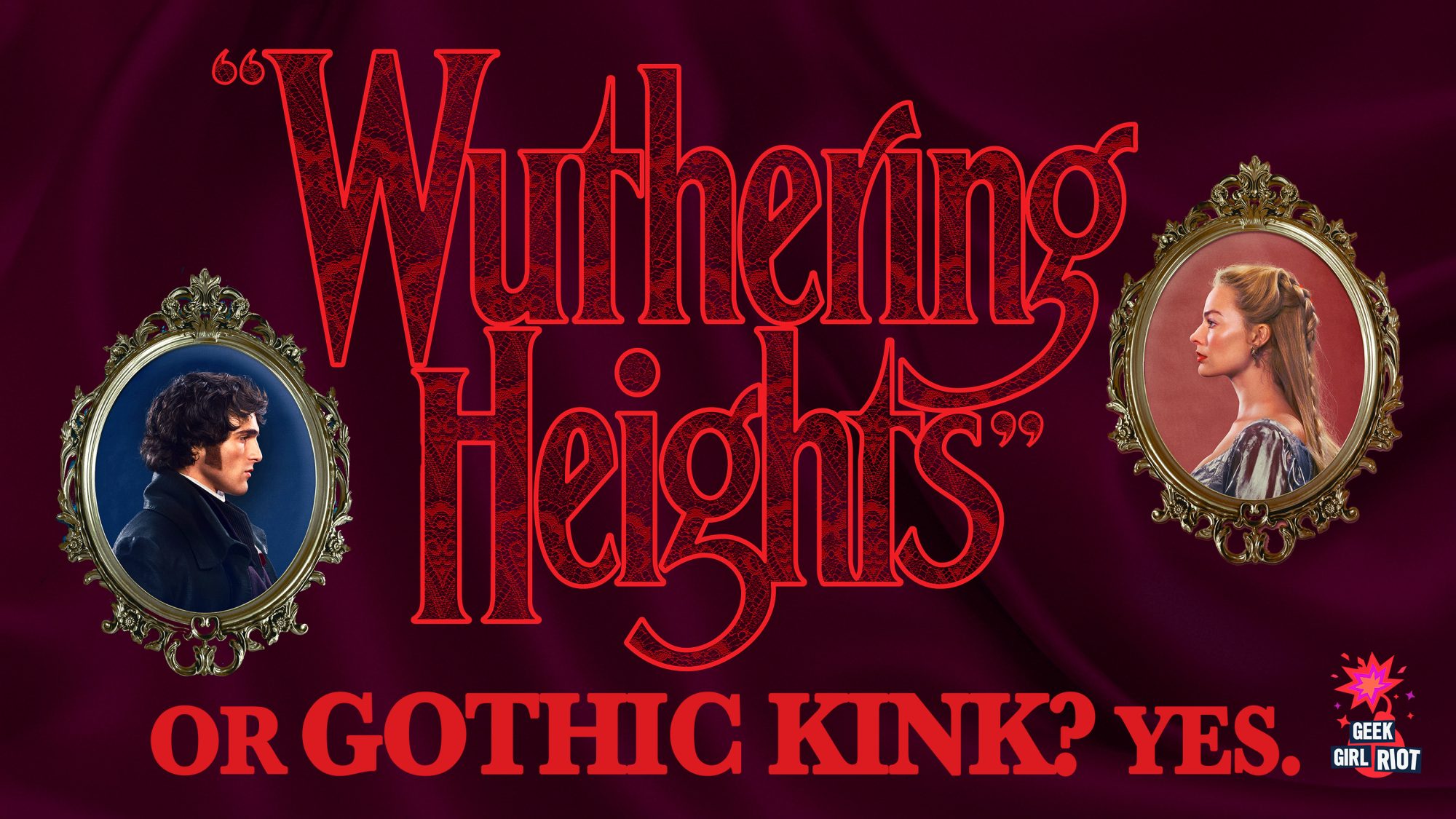
Y’all, you cannot imagine the think pieces that are about to be unspooled when Emerald Fennell’s “Wuthering Heights” drops this Friday the 13th—a truly significant date, because these characters are cursed. Gothically. Demonstratively. Cursed, my loves. Starring Margot Robbie as Cathy, Jacob Elordi as Heathcliff (the smoulderer), Hong Chau as Nelly, Shazad Latif as Edgar, Alison Oliver as Isabella, and Martin Clunes as big bad daddy Mr. Earnshaw, the quotes around the title are meant to warn you: This is and isn’t Emily Brontë’s gothic romance. Hard emphasis on the isn’t, harder emphasis on the theatrical k!nk of it all.
Before the literati, book lovers, romance girlies, and cinephiles go into a feeding frenzy on your timelines, allow Julian and me to prepare you for this dazzlingly demented doom spiral. Are you ready? Then come along, follow us to the Moors.
After Promising Young Woman and Saltburn, we know Emerald Fennell will never play nice, but a shockingly gorgeous film is her playground. The visuals, the performances, and the symbolism are forever top-tier, but the storytelling remains in question from film to film. What were your first reactions to “Wuthering Heights”?


Julian Lytle: My first thoughts are that Fennell and cinematographer Linus Sandgren made a visual delight of a film. While I’m not familiar with the book or any previous adaptations, I get what Fennell is going for with this one, and I think it hits its mark. Some great performances, an embrace of the artifice of cinema to its strengths, and some slapping music kept me interested for the whole two hours. Wasn’t expecting just how modern it would be in regards to how it shows sensuality, desire, and sex – especially the k!nk forward parts.
“Some great performances, an embrace of the artifice of cinema to its strengths, and some slapping music kept me interested for the whole two hours.” –Julian Lytle
Sherin Nicole: Visually, Fennell, Sandgren, production designer Suzie Davies, and costumer Jacqueline Durran should be welcomed into the MoMA for this film: the color palettes, the sculptural elements, the lighting. There are times when they take us to the theater, like we’re watching a play. For instance, the black and white tiled archway that leads to the main house at the Wuthering Heights estate. Or the liquid red floors and the fireplace mantle made of white plaster hands stacked to the ceiling at Edgar’s home, Thrushcross Grange.
However, while Fennell piles sensual exploits into the film, that’s not a modern convention. Authors were writing explicit works like that in the 1800s. Brontë just wasn’t one of them. For me, the futuristic elements come from the music (Charli xcx is spellcasting), costume design, and the sets. Like in referencing how Edgar made his fortune, they use fanciful fabrics that didn’t exist in the late 1700s and early 1800s (diaphanous iridescents and translucents). It all adds to the dark fantasy appeal that makes “Wuthering Heights” such a sumptuous spectacle to watch. As a designer, I applaud the craft that went into this film’s aesthetics. But pretty is NOT enough. “Wuthering Heights” is frequently so bombastic the emotion is muted. That’s a shame because these actors are giving ovation-worthy performances. And when it comes to dialogue, Fennell’s script pours out the good stuff like champagne—it sparkles, it’s clever, and it’s dangerous. That makes the flawed storytelling that much more perplexing.
“Gorgeously grotesque…but pretty is not enough.” –Sherin Nicole


JL: I use modern in terms of how things are visually conveyed in the medium. There are visual storytelling techniques that will feel and connect with people with how they experience the world now. I think in some ways this film is like when they adapt a classic play these days in London or on Broadway, and they visually modernize it, like the recent Romeo + Juliet. I enjoyed how it looked and told the story, as for me, it filled a void that I feel Vogue’s September Issue used to – a complete world of visual artistic spectacle centered around Margot Robbie, who at this point is no stranger to films of this nature. Her ability to emote so much through her facial expressions was pretty amazing. I think she does carry this film, even with such fantastic performances around her.
SN: I kept thinking about Vanity Fair garden parties, too. But I agree, Margot Robbie devoured this role. She played Cathy as capricious and at times innocently cruel but with a competing desire to do what’s right. I didn’t expect that level of complexity and it’s appreciated. Another character with wild depths and two faces is Martin Clunes as her father, Mr. Earnshaw; he’s a villain, but a great one. His demeanor changed quicker than trends, and in a lot of ways, he’s a distorted mirror for Cathy.


JL: Yeah, Martin Clunes killed it in this and made a character that could be completely one-note, had all these layers, with not much time on screen. The one supporting character that, for me, is the core of the film, though, is Hong Chau’s Nelly. The Nelly character in this is the only character I ended up caring about and empathizing with the entire time. A lot of that is because of Chao’s performance and Vy Nguyen’s as young Nelly. I don’t know how people are going to react to her once the film is out, but I think that no matter what, the performance of the character is fantastic. She does so much with body language and how she looks at people, such quiet power that a lot of the time I wished the movie was about things from her perspective.
SN: Hong Chau and Vy Nguyen were both so nuanced and measured, with entire storms raging below the surface. I really liked what they did with the Nelly role. I’m worried about the reception for this character and whether audiences will have compassion for her. I was so shocked that people didn’t understand Grace in SINNERS that it makes me want to explain what was really going on with Nelly and why she made the choices she did. Maybe we can do that after the movie is out. Owen Cooper as Young Heathcliff carried a lot of unspoken emotion too, and Jacob Elordi did well with the two sides of Heathcliff, but he flourished in the darkness. The same with Alison Oliver’s Isabella. I read the book too long ago, I don’t remember anything but the Moors, so I don’t know if the character has an unexpected turn there, but Oliver transforms. Why the writing called for it is the question. It doesn’t seem to have meaning beyond glossy indulgence.
Having this conversation, I realizing this is a film about duality. Each character has it. Waiting to see what side of them will show up from scene to scene adds intensity. We also see it in wealth, versus status without wealth, versus poverty. Although that’s three sides, it’s usually one against another in each act of “Wuthering Heights.”
For me, Emerald Fennell’s storytelling starts fiery, turns into wildfire, and then combusts into total destruction—burning everything that worked down. I don’t usually like her films past Act 2, and “Wuthering Heights” proves it. There are too many elements that are played to be as gross as they are engrossing. That’s why I call it gorgeously grotesque. Like the opening scene, where we think it’s sex and it turns out to be death. And yet, corporeal punishment doesn’t play a part other than spectacle—or maybe it does as symbolism and I’ve only just realized the analogy. (I won’t spoil it.) However, Promising Young Woman worked right up to the end (my review is here). Saltburn didn’t work beyond the visuals. “Wuthering Heights” is in the middle, but it’s the first time the final scenes resonated with me, even though Act 3 didn’t.


JL: I think I ended up liking this more than you. While I don’t like the way Fennell ended her previous efforts, I think it’s because some of the work of the ending is not her own but instead working with the original material. I feel like Fennell works well with Elordi, especially as a romantic focus, maybe a muse of sorts. This is a film I could see watching again, and I do think it connects some things that a film like Materialists tried to talk about but ended up being less honest about. I believe “Wuthering Heights” works well with this new tension in our society, pushing conservative ideas of relationships versus what people actually want and how they actually live. While I fear the online dialogue, I think it’s good and can be a great actual conversation starter.
Sherin’s Rating: C-
Level of Enthusiasm: 50%

Julian’s Rating: B
Level of Enthusiasm: 60%

“Wuthering Heights” smokes up theaters on February 13
