
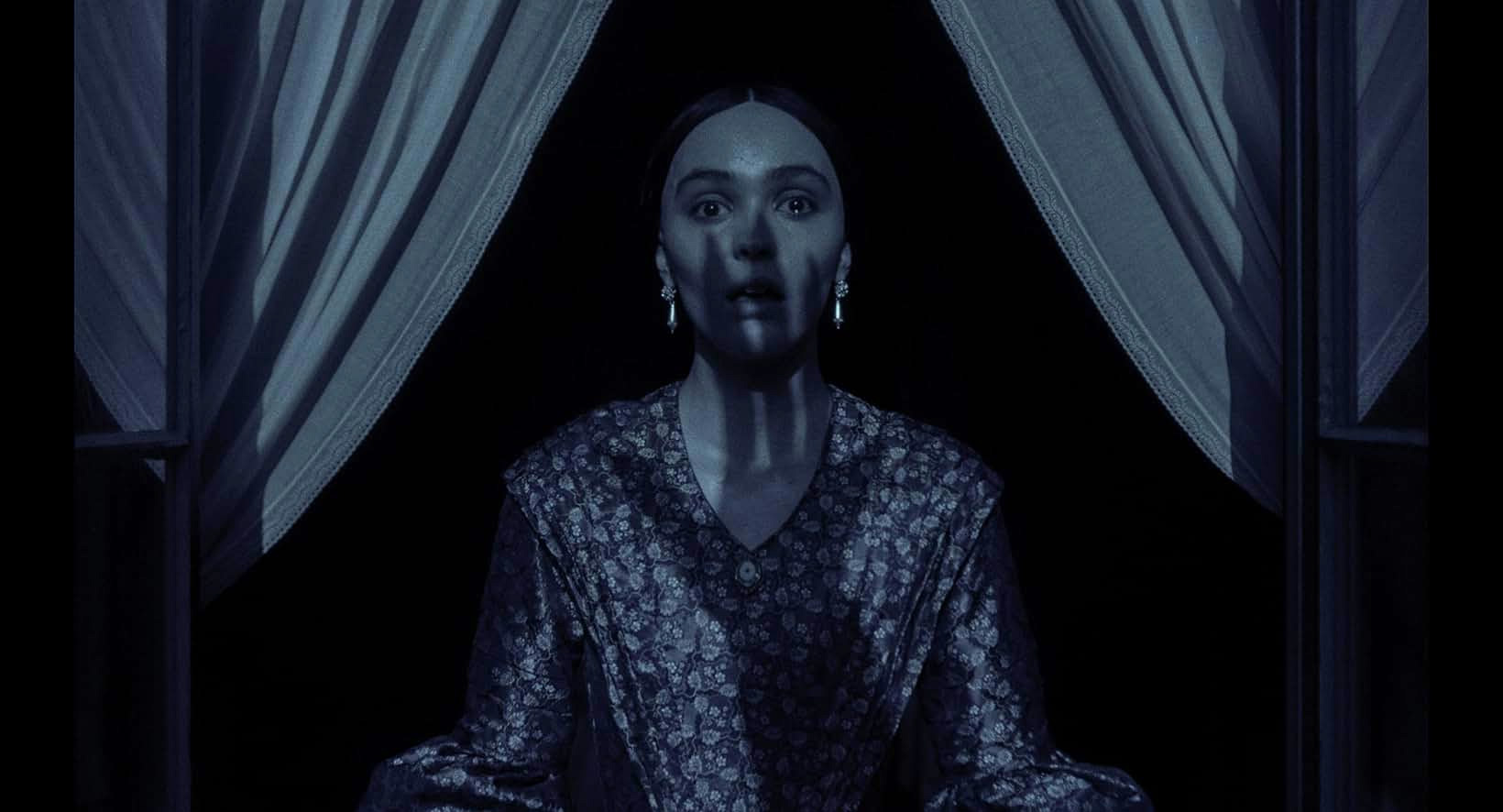
Welcome, seekers of terror. As the accursed sun sets, let us light our lanterns and follow this gothic tale of obsession known as Robert Eggers‘ NOSFERATU. Written, directed, and produced by Eggers, and inspired by the silent film, this reimagining explores the twisted connection between a young woman and the terrifying Transylvanian vampire who haunts her.
Allow me to be your guide for this foray into darkness. First, let’s unravel the shadowy origins of Count Orlok the Nosferatu. Nosferatu: A Symphony of Horror is a 1922 landmark in the cinema of frights. Directed by F.W. Murnau, the film is an unauthorized adaptation of Bram Stoker’s Dracula that attempts to dodge the copyright by reimagining the vampire mythos. Unable to secure the rights to Stoker’s work, Murnau, Prana Film, and screenwriter Henrik Galeen made—let’s call them “strategic”—changes to the story: renaming characters, altering plot elements, and adding to the lore. This audacity wasn’t appreciated by everyone. Bram’s widow, Florence Stoker launched a legal battle against the filmmakers and, in 1925, a German court ruled in her favor, ordering the destruction of all copies of Nosferatu.


However, like the rest of the pantheon of horror, the Nosferatu refused to fade into darkness. By then, it was already a cult classic, and one print survived to create the fascination we have today. Possibly because Nosferatu’s biggest contribution to vampire lore is that sunlight is lethal to vampires—a now irrefutable fact. In Stoker’s original novel, the daytime only weakens them. This innovative twist on fighting vampires, its heart-stopping visuals, and controversial history make Nosferatu one of the greats of horror cinema.
Skipping past three other versions (see below)1: From the moment the 1920s-styled logos flicker across the screen in this latest NOSFERATU, we are transported into a world where the boundaries between reality and nightmare blur like shadows at the edge of our awareness. Vampires are known for their ability to enthrall or mesmerize their prey. For me, the “thrall” is in the production design and cinematography and how they invite you into macabre surrealism. Eggers and his longtime collaborators, cinematographer Jarin Blaschke and production designer Craig Lathrop, have crafted a supernatural world so immersive, so richly detailed, you’ll find yourself hoping for a Nosferatu-themed park where you can wander through its shadowy corridors and gothic architecture.
Shot on 35mm film, the visuals have a tactile quality that digital can’t replicate, evoking the textures of 19th-century Romanticism with modern depth and dimension. Varying light sources—from moonlight to lanterns to flames—intensify the fear that what lurks just beyond illumination cannot be stopped. Conversely, the eeriest scenes are desaturated and speckled with film grain darkness that feels alive. Each time we enter the otherworldly night-scapes of Count Orlok’s hunting grounds, lamplight is the only color—an inflamed orange glow—that dares to push back against the blueish black and white.


As with Dracula, this is the story of three beings locked in a deadly—sometimes lust, sometimes love—triangle. At its center is Ellen (Lily-Rose Depp). Typically used as the object of affection for the Count and her husband to squabble over like a wolf and a hound with a juicy piece of meat, Eggers sought to flip the paradigm. He wanted a woman with agency. Although it’s only vaguely suggested, Ellen has supernatural leanings of her own. I see her as a medium, someone whose spiritual conductivity allows her to communicate with ghosts and monsters. Ellen’s place at the heart of the NOSFERATU love vs. lust story plays out more like the film Past Lives, where the past, the present, and what lies ahead are the lady’s choice.
Nicholas Hoult is Ellen’s husband, Thomas, the poor unfortunate soul who is sent to sell Count Orlok an estate and ends up in real estate hell. I guess next time he’ll listen to his wife, who told him to stay home. The elder Romani women in Transylvania, who told him to stay away. Or his gut instinct, that told him nope. The last leg of Thomas” journey to meet the count contains some of the most visually stunning sequences in the film. The sense of anticipation builds with the expectation there will be blood, but everything is cast in a glowing contrasty blue-tinted black & white: an impossibly straight tree-lined road, a possessed carriage straight out of Sleepy Hollow, and a jutting castle around the bend. Hoult plays these scenes with all the nebbish hesitation of Ichabod Crane, with his ambition stalling his caution. Whether as Juror #2 or here as the tragic Thomas, Hoult is great at this acting thing. I can imagine him as Superman as easily as Lex Luthor.


The third character in NOSFERATU’s twisted triangle is the vampire himself. On RIOTUS, we like to say: If you want a villain, hire a Skarsgård—or Mads Mikkelsen, but for this review Skarsgård. Bill Skarsgård steps into the role of Orlok combining the elements we expect from the character—elongated fingers and sharpened nails, stalking the shadows, uncomfortably slow movements—with the Gary Oldman version of Count Dracula. To those traits, Skarsgård adds the bearing of the merciless nobleman and creates a humorless narcissist who believes his status and power make him untouchable; that life exists only to serve him. But while Orlok could have been played as a monstrosity, Skarsgård finds the affectations and quirks of wickedness that make the count fascinating. This Orlok is someone we almost want to interrogate rather than run from…almost.
These performances are at the pulse of this retelling. Lily-Rose Depp channels the essence of her creepy-woman foremothers. Ellen is sinister in her strangeness, with a duality that is part sweet, part sulfur. Hoult sells every chilling setup with a conviction that makes you believe in the unbelievable. Then there’s Skarsgård whose voice alone is a low, rumbling menace crafted through working with an opera singer. They are joined by Willem Dafoe as a bright beam of nervous energy and cold-blooded purpose as Prof. Albin Eberhart von Franz, a ringer for Van Helsing. NOSFERATU also stars Aaron Taylor-Johnson, Emma Corrin, Ralph Ineson, and Simon McBurney.


Storywise, I wanted to understand the backstory better. So much is vaguely alluded to but undefined. I have questions: What is it about Ellen that calls to Count Orlok? Is the Count the only one of his kind? And why didn’t the heroes use the advantage of daylight to burn all threats to the ground?
Even when the logic falters, NOSFERATU is designed to stalk your senses. The sights of freaky jumpscares. The sound immersing you in wind, whispers, and agitation. The costumes by Linda Muir ripple and sway, while transporting us back to the early 1900s. Sound, design, cinematography, effects, direction—this is stellar craft. However, after the iconic Nosferatus over the years, the design of this new Orlok ain’t it. I get that he’s meant to mirror Vlad Tepes aka Vlad the Impaler, the 15th-century Romanian ruler and the model for Dracula, while embodying death and disease. But the mustache and the spindly corpse-like desiccation detract from the lethality. Although, thematically that may speak to what happens when we unmask our fears (you’ll know what I mean when you see it).


Still, Eggers knows the iconography well. The most recognizable scene from the 1922 original is reimagined when Orlok’s giant taloned hand casts its shadow across a city ripe for his destruction. So good! In the end, NOSFERATU is proof of Eggers’ singular vision of horror.
So come, children of the night, bear witness to this gothic danse macabre. May it chill your bones as deeply as you desire.
This twisted game of beauty and beast creeps into theaters
on Christmas Day, December 25th
—x—
- • NOS4A2 (2019) television series based on the novel by Joe Hill
• Shadow of the Vampire (2000) film, directed by E. Elias Merhige, written by Steven A. Katz
• Nosferatu the Vampyre (1979) written and directed by Werner Herzog ↩︎
