
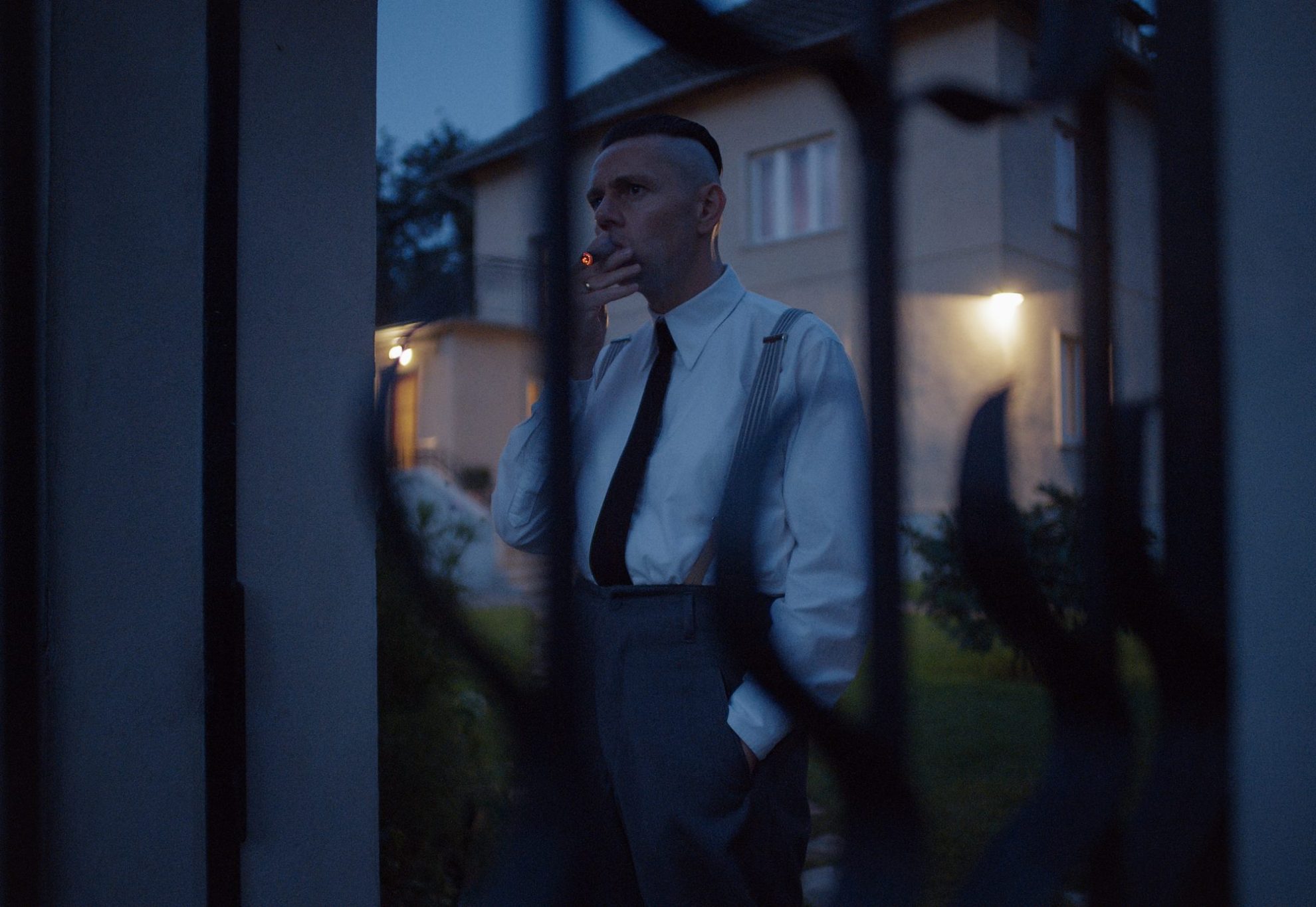
The Zone of Interest is all about what you don’t see. As an artistic medium, cinema is often all about what a filmmaker constructs inside the space of a single frame through visual and sound. But from the moment Jonathan Glazer opens his latest film, there’s an inherent obfuscation at play. Adapted from the Martin Ames novel of the same name (albeit loosely, as Glazer chooses to include the real family Ames used as a base for his fictional inspiration), The Zone of Interest tells the story of Auschwitz commandant Rudolf Höss (Christian Friedel), his wife Hedwig (Sandra Hüller), and their family as they live and work in their home adjacent to the concentration camp. So, you know, it’s real light stuff.
At its core, Zone functions as a domestic drama. Rudolf is obsessed with his work, while Hedwig is left to curate her dream home and raise the children. The overwhelming ordinariness of it all fuels the grotesque horrors lingering at the edges, as shown in slice of moments like the film’s opening alongside a riverbed with a framing and style that evokes a Monet painting or a pool party that looks like a Slim Aarons photo. It’s a staggering decision that doesn’t evoke empathy but does evoke an understanding of similarity. On some level, aren’t we all like the Hösses? Don’t we all just want a place to rest our heads?

Glazer fills the movie with these images, almost to lure the audience into a false sense of security before unleashing the secondary movie lingering around the edges. Auschwitz is never fully represented visually, only in obstructed glances, such as the front gates, the rooftops, or a smoking chimney. Instead, Glazer lets the sound of the atrocities loom large. If filmmaking is one-half visual, the other half is sound, and it’s in the auditory space where the actual movie takes place — using the audience’s understanding of what happened at Auschwitz to fill in the lines accordingly. The result crushes beyond belief, giving the film a haunting terror that constantly threatens to swallow the audience whole.
The tension of The Zone of Interest lies in how unaffected the Höss family is by everything unfolding around them and how they’ve seemingly tuned out the noise. The inverse will likely be true, where the ambient noise overwhelms the visuals to the point where it’s baffling how utterly blind the family is to everything unfolding around them. That’s the movie’s thesis, which uses the Hösses to push beyond the reductive concept of “the banality of evil” into something beyond hellish or nightmarish, whatever the German word for the devil incarnate gets close but remains far from accurate.
The final moments of The Zone of Interest drive home that indescribably sinking feeling. In a brilliant conceit, Glazer allows Rudolf to have a moment of clarity, a chance to reckon with the evil he’s actively inflicting upon the world. The horror of Auschwitz that lingers around the edges establishes a sensation for the view that feels like riding a rollercoaster for an hour and a half, where you’re constantly ticking upwards without the relief of the drop. In these final moments, a plummet does arrive. Only it’s not one of relief, but rather, a descent into a new level of Hell thought previously unimaginable. This moment of willful ignorance solidifies The Zone of Interest as a masterwork with an impact that will linger for a long time.
The Zone of Interest is now playing in limited release.
