
From the moment the first frame of BLINK TWICE flickers into life there’s an uncomfortable tension. We watch Naomi Ackie’s Frida stare at her phone with a vacant intensity that screams something has already gone very wrong. That discomfort is intentional. It’s what writer/director Zoë Kravitz and her co-writer E.T. Feigenbaum want you to feel. As though the world they’ve invited you into is irrevocably tilted, and they keep you spinning from there.
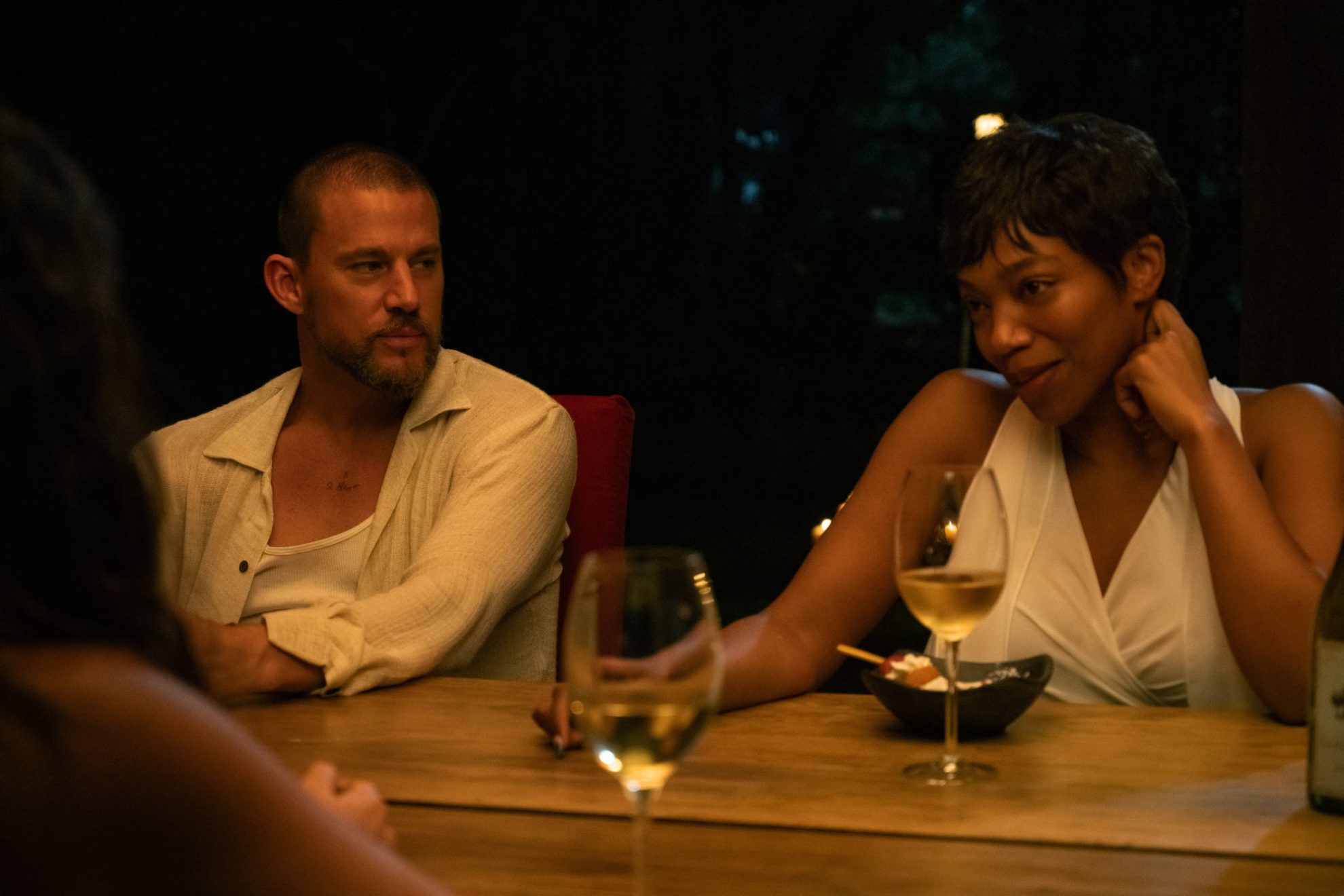
Frida is a fan of Slater King (Channing Tatum), the brilliant billionaire who we meet while he’s publicly apologizing for a misdeed that’s never revealed. This is Tatum at his most magnetic and therefore most dangerous. When Frida and Slater meet at a cocktail party—one she and her bestie Jess (Alia Shawkat) crash—the chemistry is immediate. Perhaps because they’ve met before and he complimented her nails. Perhaps because there’s something between them that’s as magnetic as he is.


Slater invites Frida and Jess to his private island for some Dionysus-inspired hedonism alongside his buddies and their “girls.” A rivalry sparks between Frida and Sarah (Adria Arjona), who seems unhappy with her partner Cody (Simon Rex). At the same time, Vic (Christian Slater) and Tom (Haley Joel Osment) are paired up with Heather (Trew Mullen) and Camilla (Liz Caribel). Circling them, keeping everything running smoothly, is Stacy (Geena Davis)—a woman who is more than Slater’s assistant, she’s his sister.
At first, the days seem to run together—the way they tend to do on vacation—but then Frida begins to lose track. Which day is it again? None of the women can answer. But there’s dirt under their fingernails and an escalating sense something isn’t right. That’s when you’re likely to flash back to the opening: the staring, the sweating, and the scar. It’s a visual that represents an instinct most women share; that feeling of unease when we walk into a space that poses a risk. The risk here is high.

BLINK TWICE is a film steeped in both metaphor and psychological chills. When the filmmakers drag us into the intersection of male desires, wealth, and misogyny the storytelling begins to pop like fireworks—and the cast is fire. Imagine a melding of a Jordan Peele thriller with a Rian Johnson mystery. You got it? Yeah, it got me too.
There are so many themes at play, each of them stacking on top of each other to thicken the experience. The trifecta here revolves around memory in three ways: trauma x memory, visual cues x memory, and scent x memory. Each of these things infuses the movie. Every object you see and every reference you hear is symbolic, leading you to a gory conclusion akin to going down a blood-red rabbit hole.
Thematically, BLINK TWICE is what Don’t Worry Darling was reaching for, but it’s also a type of commentary on the excesses of wealth that’s a twin for Saltburn (minus the ick factor). Without spoiling the trick, I want to give you a few things to think about when you leave the theater. For example, the way systems of subjugation will always produce their antithesis/antidote. Or how the erasure of history will cause it to repeat. Put more simply: forgetting your past will make it your future. And finally, there’s something my friend Jerry used to say. It came back to me while I was singing along to the perfectly chosen needle drop that underscores the climax: Gentlemen, the same thing that makes you laugh will make you cry.
Don’t blink, never forget, and see this movie.

