
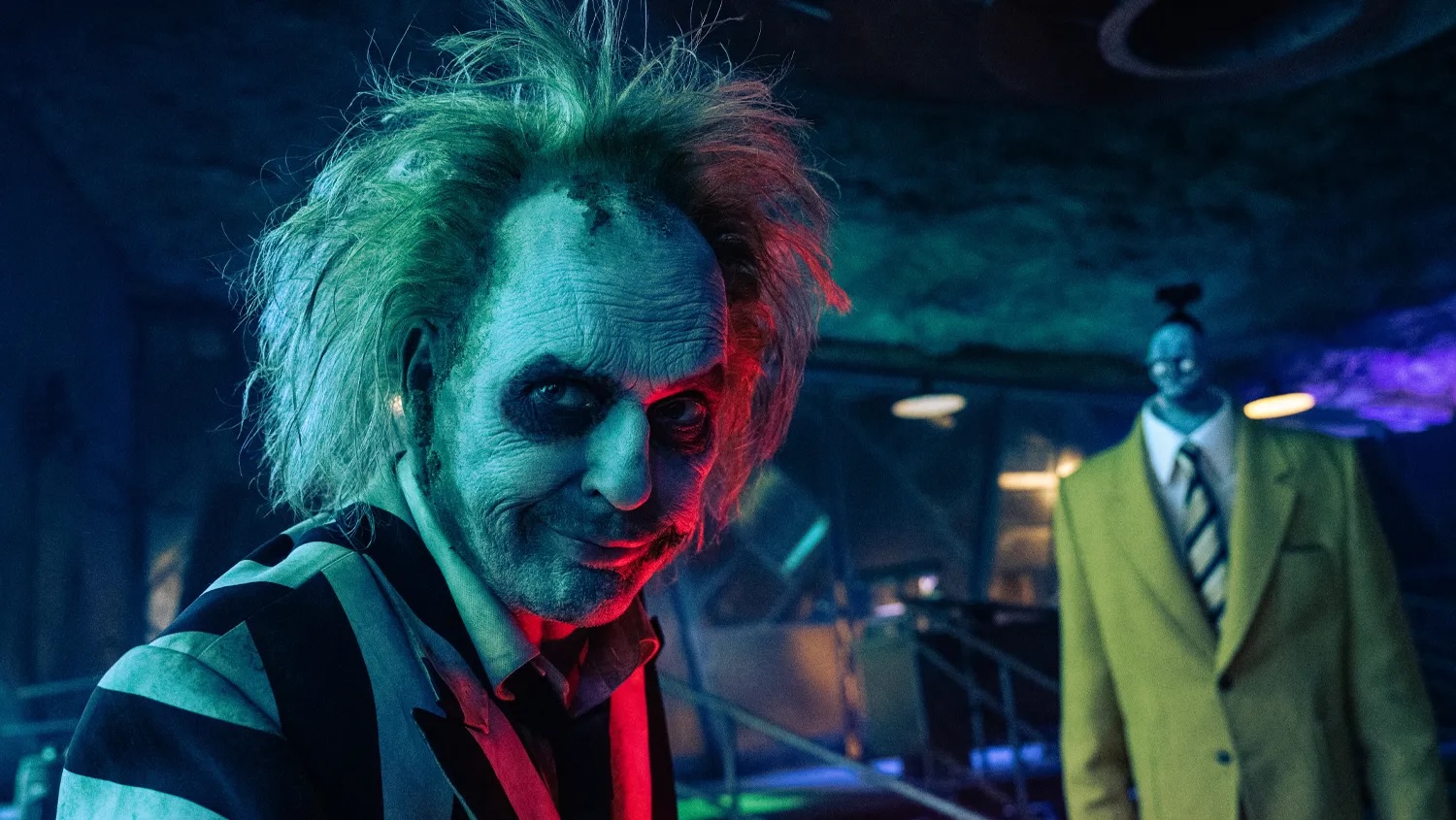
Basically… Tim Burton and Michael Keaton pick up the story thirty years later, with new characters, new stakes, and a few new wrinkles on the afterlife.
Okay, there’s a lot going on here, so a quick recap is probably in order.
Adam and Barbara Maitland (Alec Baldwin and Geena Davis) died. With some “help” from spectral bio-exorcist and troublemaker Beetlejuice (Keaton), they tried to expel the troublesome Deetz family—father Charles (Jeffrey Jones), stepmother Delia (Catherine O’Hara) and Goth daughter Lydia (Winona Ryder)… but ended up coming to terms with them instead and getting rid of Beetlejuice.
Thirty years later, Lydia is host of “Ghost House,” exploiting her talent for seeing the dead. The only one who doesn’t believe in her is Astrid (Jenna Ortega), her daughter, who struggles with her father’s disappearance/presumed death in the Amazon. As her manager Rory (Justin Theroux) offers some aggressive empathy, her stepmother calls to say her father died in a plane crash. Thus the family heads back to the house in Winter River, and an appointment with destiny.
As the family comes to terms with estrangement, loss, and mortality, Beetlejuice rears his head once more, this time on the run from a murderous ex-wife and seeking help. Astrid faces her own challenges when an accident brings her to Jeremy (Arthur Conti), a teenage boy in a treehouse, with whom she clicks even as Lydia has her own relationship issues.
Tim Burton returns to his offbeat afterlife, with its skewed geometry and “waiting room of the damned,” in a sequel that really demands affection for the original. There are a large number of callbacks and resonances from the first, even though Baldwin and Davis are absent (their spirits have moved on), and the plethora of plots are juggled well, echoing how the first had… quite a bit going on, honestly.

Ortega fits skillfully into the “troubled teen” role that Ryder occupied in the first, using her large eyes to expert effect. She has good chemistry with Ryder in particular—who is perhaps reaching her zenith as an actress with her recent roles—and their struggles as daughter and mother holds the most emotional depth of the movie. The context is different, of course, partly because Lydia and Delia have long since made peace, but the estrangement, disappointment, and longing for truth and affection between them is a powerful combination.
Keaton is in the film more this time around, with plenty of sight gags, sly double entendres, and such to keep the audience amused every time he pops up. He’s less overtly gross than last time—maybe the responsibility of running a business has sanded off some of his rougher edges—but he’s just as entertaining. Keaton, as his recent movies show, hasn’t lost a single step.
O’Hara is given plenty to do this time around too, evolving past the cold artist/bitchy stepmom she was before into a surprisingly sensitive and insightful grandmother. She’s still a kook but she’s more endearing than disdainful. And she does it very, very well.
All in all, this movie has the feel of a classic, employing practical effects, stop motion animation, even claymation instead of dousing the entire production in CGI. The handmade feel gives a tactile immediacy to the film that many current movies can’t quite achieve; by itself, that’s a remarkable accomplishment. But when it brings back these characters, it’s all the better.
B
