
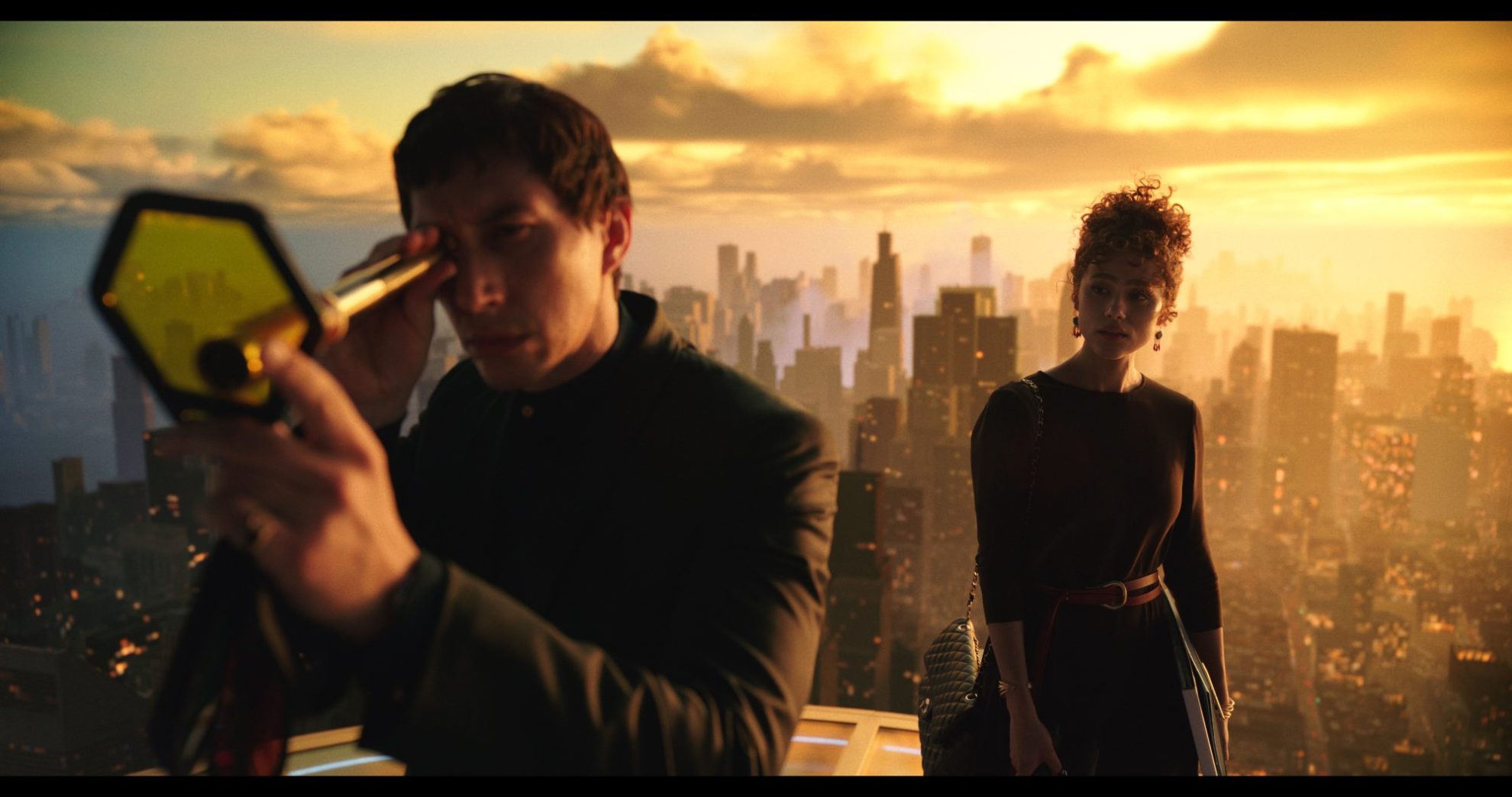
Francis Ford Coppola is back with a mercurial head-scratcher that, at least, isn’t boring. Megalopolis is a puzzlement, which is a mystery because its inspiration is seriously relevant. It’s a parable that positions modern America as a duplicate for the Roman Empire. In Megalopolis, the city of New Rome is on the verge of collapse, leading to the fear the republic will be lost and an emperor will rise. The story’s tropes are equally clear: the battle between the wealthy and the working class; an unstable Romeo & an untamed Juliet; the way journalism is merging with influencer culture; and democracy versus autocracy explored through a science fiction metaphor.


Here’s the setup: Visionary architect Cesar Catilina (Adam Driver) aims to transform New Rome into a utopia with a Pulitzer Prize-winning invention called Megalon. He’ll start one neighborhood and expand outward. His plans face fierce opposition from: the city’s conservative Mayor Franklyn Cicero (Giancarlo Esposito), his wacky cadre of vain and excessive cousins led by Clodio (Shia LeBeouf), and his influencer ex-paramour Wow Platinum (Aubrey Plaza). There are two people who support Cesar without question; his driver and right-hand man Fundi (Laurence Fishburne), and his batty billionaire uncle Hamilton Crassus III (Jon Voight). Amidst the political and societal turmoil, Cesar finds an unexpected ally and love with Julia Cicero (Nathalie Emmanuel), the mayor’s daughter. As Julia works alongside Cesar, they hurl the city into a tragic clash of ideals and personal relationships.
There are references to: Greek and Roman mythology—including full-blown bacchanalias, Shakespeare (Romeo and Juliet, Hamlet, Julius Caesar), Old Hollywood glam, Sapphic poetry, epics like Gilgamesh and Siddhartha, and the allusions keep coming. At one point Adam Driver’s Cesar is sitting in an office inside a 1920s-styled highrise and I thought: Oh, and there’s The Fountainhead by Ayn Rand. All of these influences are easily visible to any pop culture fanatic. Yet, Megalopolis is seriously but somehow unseriously all mixed up—it is both wondrously cinematic and filled with perplexities that intrigue. That’s why you should see it, for the art of it, but maybe at a matinee (attempts to swing on me for my recommendations are strictly prohibited).


Therefore, similar to my The Three ‘Kinds of Kindness’ breakdown, I’ll focus on what interests me most about Megalopolis; it is the undeniable fourth movie in a franchise that starts with 1927’s landmark science fiction epic, Metropolis. The artistic DNA that began there is passed down to the twins, Dark City (1998)—aka the cerebral Matrix—and The Matrix (1999)—aka the techno Dark City. All of which led to this new scion of the family.
Proof: Metropolis, Dark City, The Matrix, and Megalopolis are cyberpunk chronicles linked by their dystopian themes, manipulation of reality, rebellions, chosen ones, and questioning the ethics of technology—all conveyed through game-changing urban visuals and symbolic imagery.


Keanu Reeves in The Matrix (1999), Adam Driver in Megalopolis (2024),Gustav Fröhlich in Metropolis (1927) Rufus Sewell in Dark City (1998)
Further proof, Fishburne’s Morpheus is the axle who turns the wheel in The Matrix. Likewise, he is the narrator of Megalopolis. Rufus Sewell’s Murdoch and Keanu Reeves’ Neo are the same guy in different universes, while the Strangers in Dark City and the Agents in The Matrix are mirrored images. This setup is repeated in Megalopolis and Metropolis, where the superpowers of the chosen one are primarily replaced with societal power and brilliant minds.1 We see this in the upper-class dreamers turned into revolutionaries, Cesar and Gustav Fröhlich’s Freder, and both experience turning points when they fall in love with the rebels Julia and Maria (Brigitte Helm)—and that aligns with Trinity (Carrie-Anne Moss) and her role in the rebellion against the machines in The Matrix.
Each of the four heroes—Freder, Murdoch, Neo, and Cesar—are transformed by love and the ideologies of the women—Maria, Emma (Jennifer Connelly), Trinity, and Julia—who change them. None of these revolutions, evolutions, or uprisings are possible without these women, who initially shine a light on the path to show the way.
We can also compare the dubious closing messages in Megalopolis and Metropolis, leaving us to question whether our only choice is an expensive Ricci loafer or a rigid military boot on our necks. While in Dark City and The Matrix, they choose to overthrow ‘un-human’ oppressors to face an uncertain future.
People also think Adam Driver looks like Keanu Reeves (I am not people), and the opening of Megalopolis is a match for Neo’s first escape from the Agents, while that imagery is only distinguishable from Dark City because there’s sunlight.


Carrie-Ann Moss in The Matrix, Nathalie Emmanuel in Megalopolis, Jennifer Connelly in Dark City, and Brigitte Helm in Metropolis
Since you’re still here and probably want more, let’s excavate this theory further and get list-y:
THEMES
Dystopian Societies and Class Division
- Metropolis: A city split between the elite in skyscrapers and exploited underground workers.
- The Matrix: Humans unknowingly enslaved in a simulated reality by machines.
- Dark City: An urban landscape manipulated by aliens, with oblivious inhabitants.
- Megalopolis: A future “New Rome” where a widening wealth gap silences the voices of the people.
Manipulation of Reality and Identity
- The Matrix: A simulated reality controls human perception.
- Dark City: Aliens erase and alter the memories of their human captives.
- Metropolis: A robot imposter incites chaos among workers.
- Megalopolis: An unattainable upper class uses politics and machinations to block tech that might sweeten human existence.
Rebellion and the Quest for Freedom
- Metropolis: Freder seeks to unite the ruling and working classes.
- The Matrix: Neo aims to free humanity from virtual enslavement.
- Dark City: John Murdoch fights to reclaim identity and reality.
- Megalopolis: Addresses struggles against societal inequality and inequitable utopias.
Ethical and Technological Ramifications
- Metropolis: Reflects on hopes and fears of technological strangleholds.
- The Matrix & Dark City: Highlight the consequences of oppression and imprisonment through technology.
- Megalopolis: Questions the ethics of modern politics and tech advancements.
Love is Transformational
- (enough said)


VISUALS & SYMBOLISM
Urban Landscapes and Architecture
- Metropolis: Vertically segregated cityscapes with towering buildings and underground quarters.
- The Matrix: A modern digital Mega City blended with the dystopian visuals of an underground real world.
- Dark City: A perpetually dark, claustrophobic environment that’s both familiar and theatrical.
- Megalopolis: A glamorous yet unstable “New Rome” with nostalgic but futuristic architecture and design.
Cinematography and Visual Effects
- Metropolis, The Matrix, Dark City, & Megalopolis: Use fantastical visuals to convey fractured realities.
Symbolic Imagery
- Metropolis: Robot Maria symbolizes technological manipulation and revolution.
- The Matrix: Red and Blue pills represent the choice between reality and illusion.
- Dark City: Eternal night and shifting cityscapes symbolize reality’s manipulation.
- Megalopolis: Contrasts opulent visuals with societal issues to highlight disparities and the promise of Megalon.
See what I mean? As a thematic follow-up to Metropolis, Dark City, and The Matrix, Megalopolis becomes the fourth in a cyberpunk tetralogy I’m calling: ‘The Systems of Entropy Quartet.’ With that said, I’m ready for a movie marathon to enjoy the dopamine rush of these fearful but hopeful future visions.
- Cesar has the power to stop time but it’s mostly meaningless to the plot outside of Julia’s faith in him and as the reason they connect ↩︎
