
“I can show you better than I can tell you.”
When the young musician, Sammie (Miles Caton), says this in SINNERS, it has a deeper meaning. It’s about the blues, yes. It’s about root and conjure work, without a doubt. It’s about love finding a way, for sure. Although SINNERS has vampires, it’s not about them. They’re only a metaphor. Director Ryan Coogler has something else to say. All those themes go back to the ancient Irish filí, the Choctaw history keepers, and the West African griots. This is a story about stories—passed down, reinvented, and preserved through the music, the love, and the traditions. And when others seek to silence those voices, it’s about to get deadly.
Should I go on? Let’s start in 1930s Mississippi.
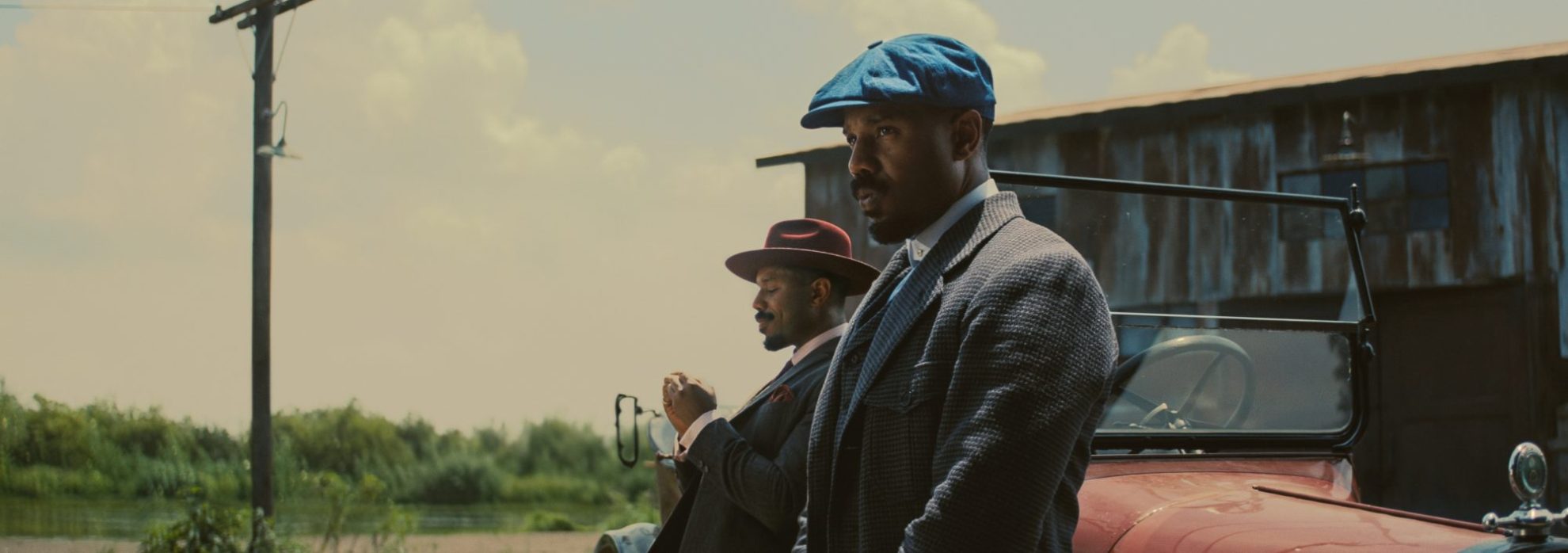
Twin brothers Smoke and Stack (both Michael B. Jordan) return to Mississippi to escape the madness of their lives in mobster-era Chicago. They’re looking for a fresh start with a new juke joint. But there are old loves and past sins to deal with first. Their plans for a new beginning go up in flames when they uncover a sinister presence lurking in the shadows of their community, Remmick (Jack O’Connell). As the SmokeStack Twins navigate the tangled legacies of their family-circle, religion, and the town’s history, they’re sucked into a battle against a parasitic force. One that feeds on rage, division, and despair because those are the forces that made him. What starts as a second chance transforms into a From Dusk Till Dawn (1996) x Demon Knight (1995) fight for survival—laced with an alternate version of the Robert Johnson legend —where music, love, laughs, and faith are the only weapons strong enough to stand against the darkness. So string your guitar, baby, and roll the dice.

Ryan Coogler has always been an insightful and inventive filmmaker, likewise, Michael B. Jordan is forever his magnetic movie-making muse. This new take on folklore is something different. Gorgeously grimy, gravitational, and grim, SINNERS grabs you by the throat, stares you down, and dares you to blink. But it’s not a horror movie. Fear isn’t the goal. Coogler is calling us in for a campfire tale, an alternate oral history, not a ghost story.
Jordan is phenomenal as Smoke and Stack, giving each brother a distinct voice and personality, layering in big brother versus little brother energy, and creating two characters we relate to differently as an audience. Delroy Lindo as Slim reminds us Lindo is a landmark—ain’t nobody he can’t play and play to perfection. Miles Caton as the Preacher Boy, Sammie, is in ‘future superstar’ mode. We inhabit this movie through his eyes; his sensitive performance grounds us in the stakes and the turmoil. This kid also has a voice built for the blues—deep and smoke-filled as whiskey. Caton is an unexpected discovery, but I didn’t see the romance coming. Wunmi Mosaku as Annie and Hailee Steinfeld as Mary aren’t just side stories on the sidelines—they’re fully fleshed-out characters with dreams, flaws, and fiery chemistry with Smoke, Stack, and with each other. This makes their relationships with the twins saucy and spicy, but also breathlessly loving. Li Jun Li as Grace is another perfomance that grabs you and sticks. Mosaku, Steinfeld, and Li are so good—I want to know these women.


Ruth Carter‘s costume design completes the characters, adding to their visual backstory, with every outfit dripping with personality and purpose. And then there’s the music. Coogler and composer Ludwig Göransson are unbeatable, but they’ve leveled up. Bringing in Brittany Howard, Rod Wave, and James Blake, the soundtrack is hypnotic. More than underscoring the action, it’s a form of spellcasting, a spiritual force that ties the film’s themes together. The most memorable scene starts as a performance on the juke joint stage, then morphs into a visualizer for Sammie’s song, conjuring his musical ancestors and descendants. Music from every time and various countries swells up, intermingling into a chorus of Black-American, Chinese, Indigenous, and Irish traditions, celebrating everything we are, will be, and have been. It’s transcendent—whatever juju inspired that scene needs to be sold at concessions and sprinkled on the popcorn.
The cultural groups at the center of SINNERS—Black-American, Chinese-American, Choctaw, and Old Country Irish—are part of a shared legacy that speaks to the broader history of this country. Those histories are deeply intertwined with the film’s central metaphor: the vampires. But these vampires aren’t just monsters or haints; they’re symbols of the outside forces that have historically infiltrated and torn communities apart from within. As the writer and director, Coogler says a lot in this film, with multilayered themes and metaphors running throughout, but he doesn’t over-explain it. That might be too much for some viewers, I appreciated the dimensionality (even though I’d be fine without the clan sightings). Regardless, Coogler lets the story breathe, trusting the audience to understand the weight of these interwoven lives and the rage they represent without spelling it out. But be warned, when three buzzards appear, something ugly is about to go down.

For me, SINNERS is where Coogler turns a corner as a director. He’s always been brilliant at finding the heart in true stories and the heroics in supers, but he does something special with this world from his imagination. I called it some “auteur sh!t” when I walked out of the theater. The themes—faith, family, and the unifying power of shared oppression—are heavy, but Coogler sidesteps preachiness, giving us folklore that could easily be expanded and blood tempered by winking wit. Everyone I talked to wants to see it again.
Wait, we have to talk about religion. SINNERS speaks to survival—not just physical, but cultural and spiritual. When it comes to vampires, you have to believe in something if you’re going to survive. That something isn’t the books or the words someone else gave you, it’s your gifts from God. In SINNERS, the truth within is what redeems, and for each character, it’s something different, but since Sammie is us, it’s the music that carries us through.
As a final thought, certain scenes brought Rosewood and the Tulsa Massacre to mind. I know I’ve said this isn’t a horror movie, but in that context, maybe it is. SINNERS is a paranormal allegory where vampires represent a parasitic rage that comes from outside and destroys from within. That’s my take, but in his most cinematic and lush storytelling so far, Ryan Coogler “can show you better than he can tell you.”
See it.
—xxoo—
sidebar: Can somebody ask Ryan Coogler when he’s going to give us a feature length romance?
For fans of vampires, paranormal, romance, dark comedy, history, music, the blues, Michael B. Jordan, Wunmi Mosaku, Hailee Steinfeld, Delroy Lindo, Ryan Coogler, cinematography, allegory, crime drama, Black-American culture, Chinese-American culture, Irish Culture, Choctaw culture, oral history, griots, storytellers, and spice
