
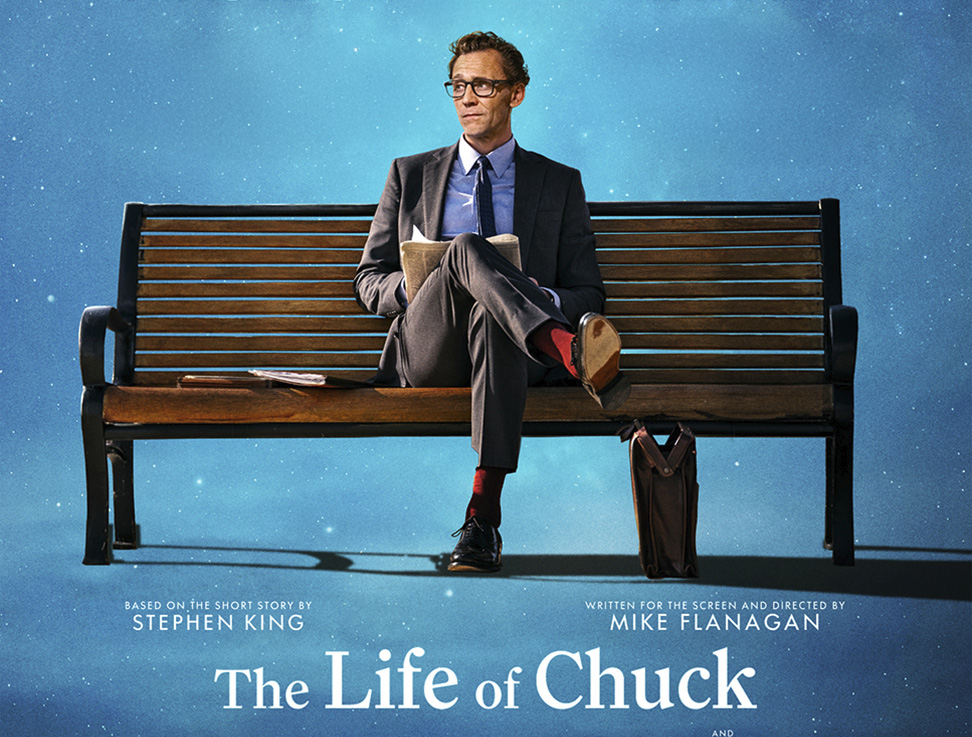
Mike Flanagan, a filmmaker who weaves the frightening with the deeply human (Doctor Sleep, The Haunting of Hill House), brings a faithful touch to The Life of Chuck. Adapted from Stephen King’s collection If It Bleeds, the film explores the beauty of life, the inevitability of death, and the moments in between that make it meaningful. Told in counter-chronological acts, the movie follows the life of Charles “Chuck” Krantz (Tom Hiddleston) in a mosaic of defining moments—some joyous, others heartbreaking, but only life. Flanagan and King are in sync, the film serves as a harmonious accompaniment for the book, bringing its themes to life with cinematic verve. It’s a meditation on mortality and memory that feels both vast and intimate, reminding us that life’s smallest, seemingly fleeting moments can carry the greatest weight.
During each act of Life of Chuck—in reverse order—I thought about a different universal truth. In Act 3, it was “You’re the hero of your own story.” Act 2 gave me “Dance like there’s no tomorrow.” Act 1 reminded me of Matthew 24:36: “But of that day and hour no one knows.” And yet, in its totality, the movie’s theme is clearly stated. It’s Walt Whitman’s “I am large. I contain multitudes.”

The multitudes are what get you. Our main character, Chuck—played with quiet grace and a touch of Gene Kelly by Hiddleston—is a person of many stories. As each of us are. But those multitudes are also a reflection of Stephen King as a storyteller. Each of the film’s acts shows us a different side of the genres King is known for: science fiction, existential musings on the meaning of life, and the juxtaposition of childhood joy with childhood horrors. All of them revolve around the same question: What does it mean to live when we all know we’re dying? That’s what makes The Life of Chuck beautiful.
But let’s go back to the beginning: The movie opens in a crumbling city, where billboards announcing “Thank You, Chuck” are a cosmic mystery and a harbinger of the end of the world. But which world? Is Chuck a hero? A god? Or just a man with the complexity of any man who has lived through pain studded with joy and joy speckled with pain? As the acts unfold, we move backward in time through Chuck’s life, witnessing the moments that shaped him and the people who left an impression.


Flanagan’s cast is tremendous, with Hiddleston’s nuanced performance as Chuck anchoring the film with warmth and vulnerability. Those traits are echoed in Jacob Tremblay‘s turn as young, although not the youngest Chuck (Benjamin Pajak). All three capture the innocence and fragility of growing up after tragedy in a way that’s relatable and moving. Mark Hamill and Mia Sara bring gravitas, warmth, and uncertainty tinged in the supernatural to Albie and Sarah, Chuck’s grandparents. While Chiwetel Ejiofor and Karen Gillan weave seamlessly into Chuck’s relationships within the apocalyptic framing of Act 1, adding a wistfulness for the time lost. In a special moment in Act 2—featuring Hiddleston’s dance skills—real-life drummer The Pocket Queen (Taylor Gordon) gives a cathartic performance, embodying the film’s central idea: to live fully, even when the end is in sight.
The film’s three acts work like flipping through a photo album in reverse, each one becoming more and more intimate, as though we’re drilling down to the root of what caused the apocalypse. Act 3, “Thanks, Chuck,” throws us into the last days when Chuck becomes a haunting phantom as everything falls apart. Act 2, “Buskers Forever,” gives us Chuck in his prime, showing how the smallest moments of happiness can feel like defiance. Act 1, “I Contain Multitudes,” takes us to Chuck’s childhood, where we discover the seeds of who he’ll become, and how the wonder of youth never truly leaves us.

The creatives behind The Life of Chuck imbue it with care and precision, balancing awe with emotional beats. The reverse structure, allows us to witness Chuck’s life and put the clues together in a way that feels interactive. We must actively engage to understand what life means to him. The Life of Chuck is visually lovely—even in its scariest moments—and each act has a distinct tone and aesthetic, gorgeously captured by cinematographer Eben Bolter. The Newton Brothers’ score ties it all together, moving from cataclysmic to quiet introspection to dread to soaring.
As I said up top, Flanagan brings a faithful touch to Stephen King’s The Life of Chuck, then Tom Hiddleston and Jacob Tremblay make it dance. Flanagan directs with an expansive tenderness that encompasses horror and hopefulness. This isn’t a movie that gift-wraps the answers for us; it asks us to reflect on our multitudes and the moments that make up our stories—and then to love the lights out.
Rating: B+
Level of Enthusiasm: 95%
