
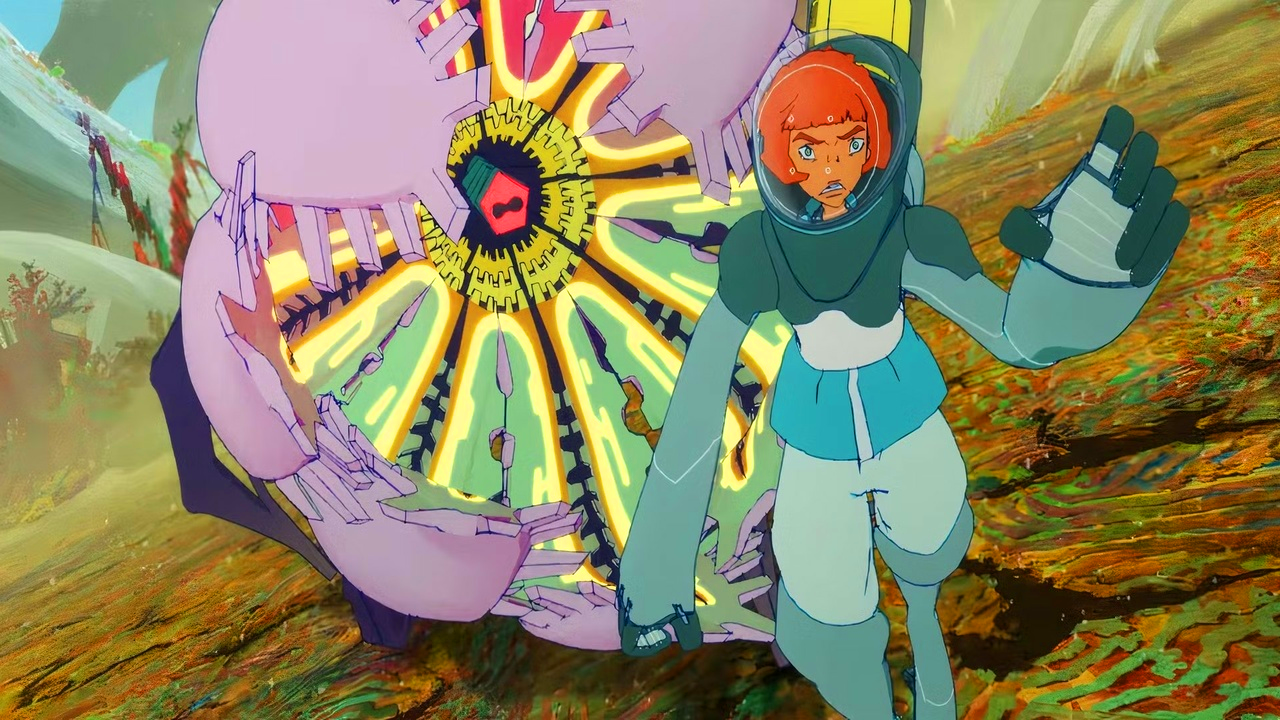
Rita is a survivor. Keiji is ingenious. All they need is to kill Darol, the giant alien flowering tree that’s invading Earth.
Director Kenichiro Akimoto’s new version of ALL YOU NEED IS KILL diverges from the original light novel by Hiroshi Sakurazaka with illustrations by Yoshitoshi Abe. This alternate universe version of the sci-fi story follows Rita (Ai Mikami in her first voice acting role), a teenager who’s lived a hard life and needs things to change. A year after Darol materializes out of nowhere and sets down toxic roots over 20 kilometers of Japan, Rita ends up as a volunteer, helping to rebuild by cutting back Darol’s roots.
In what might be retaliation, but is more likely a meticulously planned invasion, Darol’s seedpods burst and out comes a horde of monstrous spider-flowers. Murderous monster spider-flowers. Rita is killed in the brutal attack, but she wakes up on the same morning. And it begins again. Wake up. Run. Die. Wake up. Fight. Die. Until she meets another teenager, the reticent but smiling Keiji (Natsuki Hanae), who’s trapped in the time loop with her. Together, they fight for tomorrow and learn what a new day could mean.

Like Rita and Keiji, ALL YOU NEED IS KILL has lived many lives. After the light novel was published in late 2004, a manga adaptation by Ryosuke Takeuchi and illustrated by Takeshi Obata landed on VIZ’s Weekly Shonen Jump in 2014. A graphic novel adaptation by Nick Mamatas and Lee Ferguson came out in North America that same year. But if you haven’t read any of those, and the story sounds familiar, it’s because of the live-action version: Edge of Tomorrow, directed by Doug Liman, starring Tom Cruise and Emily Blunt. But what we’re here to talk about today is the new animated feature film from GKIDS.
Don’t worry, if you’ve read the book or seen the movie adaptation, this new anime still has almost as many surprises for you as for newcomers—like me. Although the other versions center on Keiji, Director Akimoto and screenwriter Yuichiro Kido swing the focus to Rita. We start with the difficult past she’s escaping and the monotony of her days before Darol lands. Soon, she realizes just how much she wants to live and begins to fight, but it isn’t until she meets Keiji that Rita wants more than just survival.
For both characters, the time loop represents the idea of repeating a lesson until you learn it. Eventually, they both resolve the trauma of their pasts. And the question becomes: What will they have to sacrifice for it?


The character and production design are different, too. The creative team swerves away from more traditional anime aesthetics and goes for a hyper-stylized look. Giving the characters a crunchier, lived-in appeal, while the alien Darol and its spider-flowers are both psychedelic and organic at the same time—acid rainbow colors, ridged white branches and roots, alien beauty that’s familiar, neon, and deadly.
The storytelling is engaging, but at a breakneck 85 minutes, there’s no time for depth of discovery—introspective or scientific. Another thing that’s missing is a clear understanding of how Keiji can accomplish so much in so little time each day. There are some beautiful moments between Rita and Keiji at the end, but they don’t get a chance to sink in. The same is true for the decisions the pair makes as they take turns at being the hero.
As a result, ALL YOU NEED IS KILL has a dreamy quality that pulls you in, but feels only partially remembered like a dream. It’s thought-provoking, visual adrenaline, and an engaging watch with an incredible message about creating your own tomorrow. But it’s more satisfying than dazzling.

