
SUNDANCE 2026
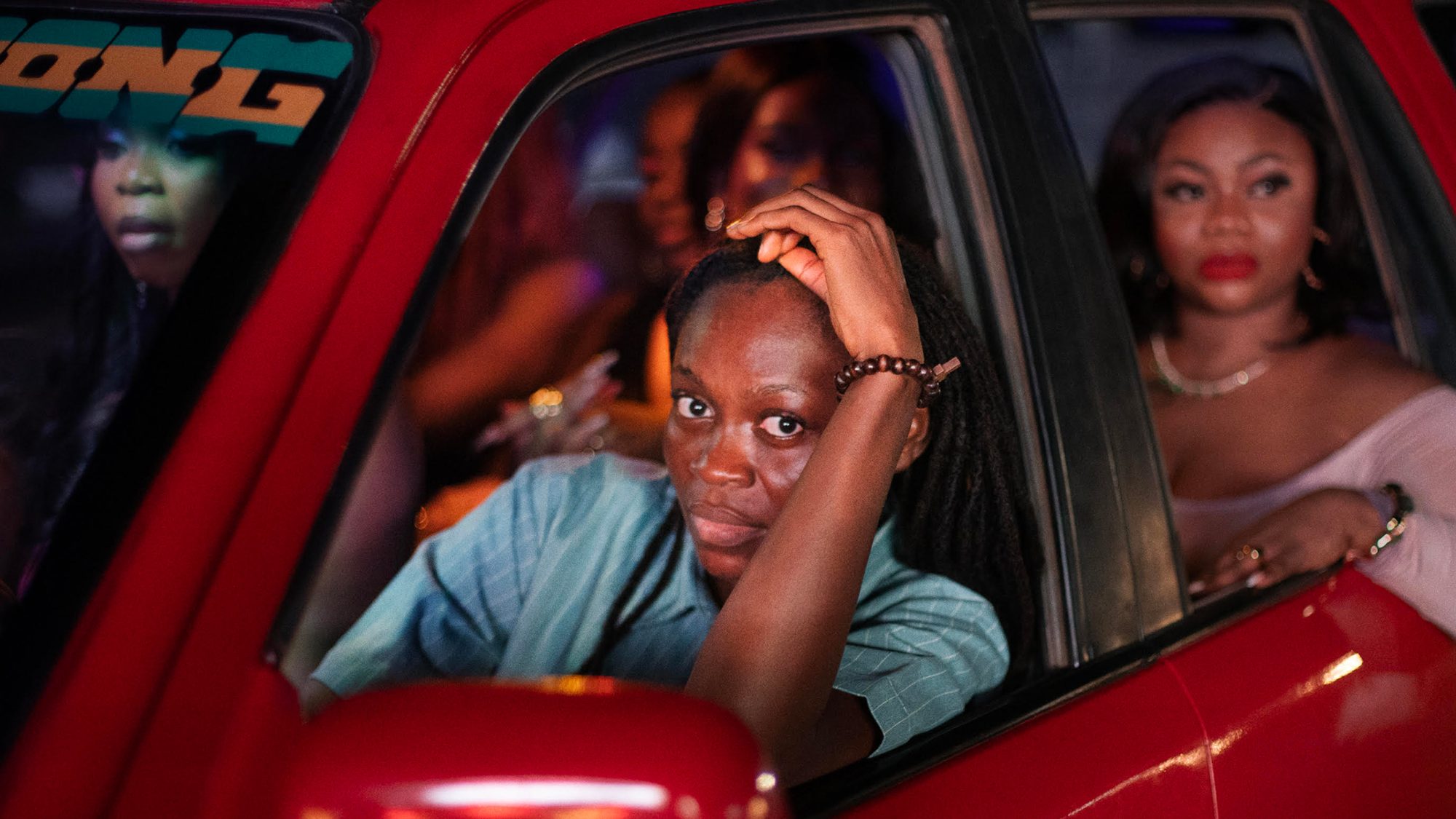
Olive Nwosu’s film begins with an upside-down scene of a boat traveling near docks, and we wonder what it might be telling us. The titular Lady (Jessica Gabriel’s Ujah) is a Legos taxi driver. She is kind and hardworking, but believes in keeping her head down, refusing to protest against rising fuel prices and opting to “hustle harder.” Early on, we wonder, with this as her starting point: how will she progress? The catalyst is the return of her friend, Pinky (Amanda Oruh), who shows up in the middle of the night after five years gone. When Pinky uses the term “sisters to the grave,” we also wonder if she’s chasing something or running from something else.
Pinky’s boss man, Fine Boy (Bucci Franklin), is looking for a new driver to chauffeur the girls around at night. With gas prices rising, could this be the new hustle Lady is looking for to help her leave Lagos for Freetown in Sierra Leone? Could that port city be why the film opens with an upside-down boat on the water?
Immediately, we notice the contrast between the bright, colorful girls on the street, their voices ringing out, and the shadowy men in the back rooms, cashing in with their drink and smoke. And although we’re afraid for her, Lady shows no weakness. She’s only there as a favor to Pinky. “This one has balls! I like it,” the crime boss says. And the deal is struck. But you know what they say about an offer you can’t refuse.
A visually vibrant and narratively textured film, Nwosu’s LADY is a study in contrasts: the day and night of Lady’s life, her sexual innocence versus the autonomous commodification of Pinky and the other girls, the male taxi drivers and the female sex workers, silence versus protest. Beyond the engaging storytelling and symbolism-rich cinematography, the film is filled with the beats and stumbles of daily life. It also features archival footage of both the real protests surrounding the fuel subsidy removal in Nigeria and testimony from sex working women.
In a stunning scene that sticks with you, Lady follows the sex workers inside on one of their jobs. There, we hear “Jezebel” by Sade in the background and see Pinky going about her work. The two women stare at each other for a moment, the song and the scene collide, triggering formative memories of Lady’s childhood. Those images from her past are not happy ones—the film twists the colors, motion, and sounds into something resembling a horror movie, and we understand our protagonist better. It’s a turning point in the film, but it is also foreshadowing. Another memorable scene is a conversation with Sugar (Tinuade Jemiseye), a reverse version of Pinky. Sugar seems brash but may be the strongest among them.
LADY is a film about buried rage and repercussions, but also the choices we make when options are limited. Even if the circumstances differ, the dichotomy of Lady’s fury versus hope is recognizable. However, what she does with it, the community of sex workers that forms around her, and how she reconciles the past keep us guessing. Writer/director Olive Nwosu repeatedly spins our point of view, daring us to see Lady, Pinky, and Sugar with fresh eyes. The same way she challenges Lady herself.
