
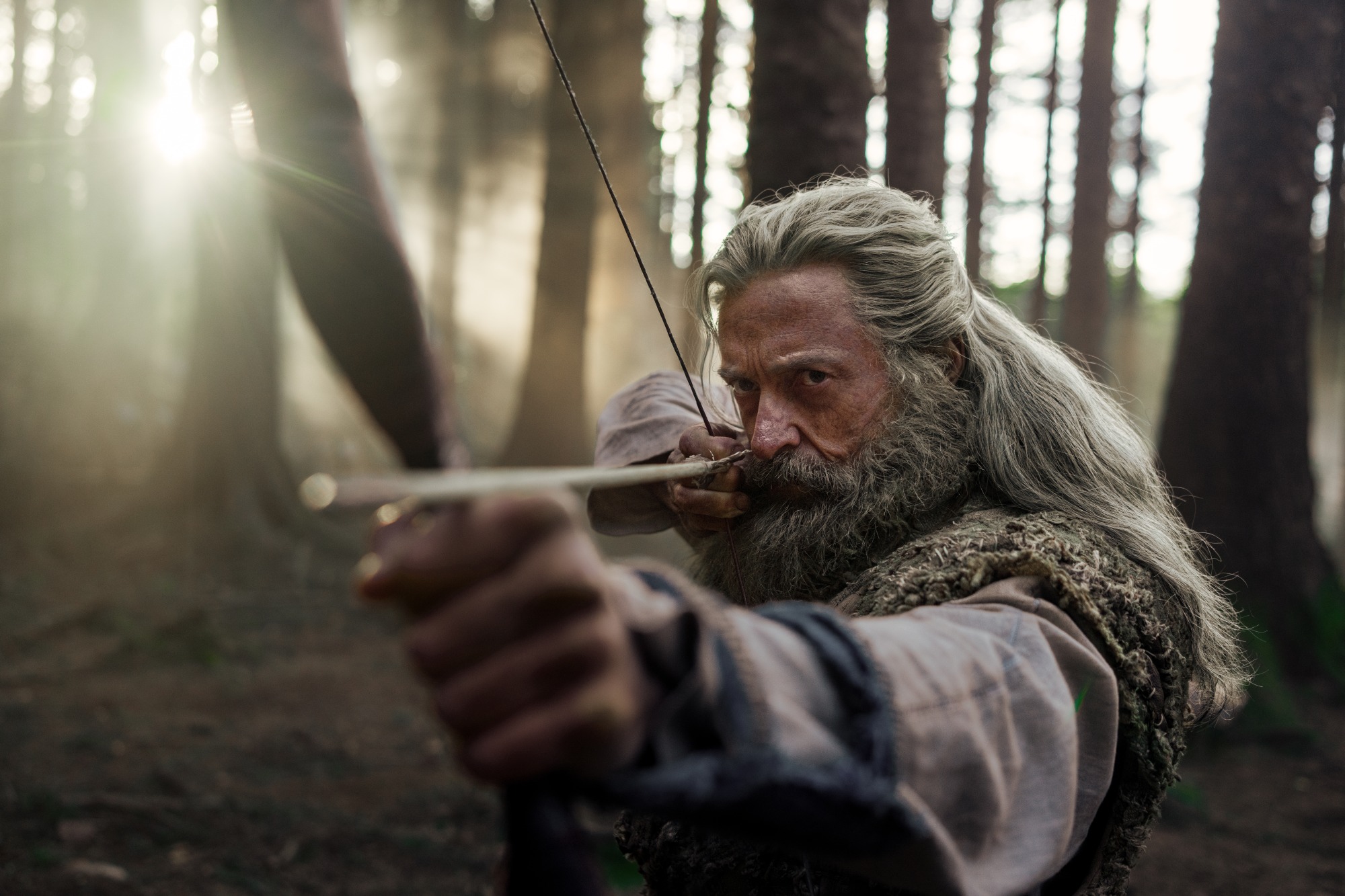
A dark reimagining of the tale of Robin Hood, The Death of Robin Hood has something interesting to say about the stories we tell — to each other, to ourselves, and the myth that stems from the blurred lines between them. Written and directed by Michael Sarnoski, the film teeters on the brink of going fully in-depth. Still, it holds itself back a bit with an ending that softens the rough edges surrounding its titular character. That’s not necessarily a bad thing, though there isn’t enough time to contend with the circumstances and the myriad feelings built through the characters’ relationships.
Robin Hood (a grisly Hugh Jackman) is practically living in solitary confinement when we meet him. He kills because he can, and no one is safe if they meet him. But his life takes an unexpected turn when Little John (Bill Skarsgård), Robin’s oldest and most loyal friend, asks for his assistance in taking back his home (which Little John stole to begin with, and subsequently changed his name to live a new life unmarked by his past).

Things go awry and Robin, gravely injured, is taken to a priory, where he’s nursed back to health by Sister Brigid (an excellent Jodie Comer), the prioress of the island, befriending a leper (a heartfelt Murray Bartlett), and watches over Little John’s daughter, Margaret (Faith Delaney, whose performance is layered with nuance beyond her age).
Jackman makes a good Robin Hood. The actor plays the role in a way that makes us believe Robin regrets some of the violence he’s doled out, but also wouldn’t take back what he’s done. We see it in every decision he makes and every look he gives. This is a violent man who doesn’t stew in remorse. In fact, he welcomes death like an old friend, perhaps believing that it’d be better for him and anyone who crosses his path. Having played Wolverine/Logan for years in the X-Men films, Jackman brings a Logan-like toughness to the character, but without the softer elements of his persona.

The Death of Robin Hood leans into the idea of a criminal, as Robin thinks of himself, having to come face-to-face with people he grows to care about, kindness, and the question of the truth in the face of death. All of these things come crashing down on the character, who “was no hero,” according to the film’s poster. There are layers to be dissected here, and Sarnoski doesn’t cut corners to get there as the film takes its time laying the groundwork for Robin’s reflection on his life.
The story is at its most interesting once Robin reaches the priory. Everything before that, while certainly necessary in witnessing the brutality of Robin’s violence, is a precursor that is more action-packed than revelatory. Where The Death of Robin Hood succeeds is in being a character study of a figure we all have ideas and thoughts about. Is Robin Hood a savior or a criminal? Did he kill for good or for fun? Can his heart be changed at the end of his life?

For most of the film, Robin has a good sense of who he is, but it’s the audience the film must convince. By the end, you may sympathize with him or, at best, feel a bit sad for him. More interesting is the exploration of the character and his connection to his own mythology and whether they can ever be separated. It doesn’t always earn its most devastating moments, with an ending that, compared with the rest of the film, feels rushed following a domino effect of revelations that don’t linger long enough to absorb the emotional impact of their meaning.
That isn’t enough to derail it, however. The film doesn’t deign to fully answer the questions it poses. Rather, it leaves the questions up for discussion, providing us with a journey worth taking and a title that takes on a crafty double entendre by the film’s end. With a truly excellent cast and a darkness that hovers over the story like a shadow that is hard to shake off, The Death of Robin Hood makes for a thoughtful take on a well-known figure.
Rating: C+
Level of Enthusiasm: 70%
