
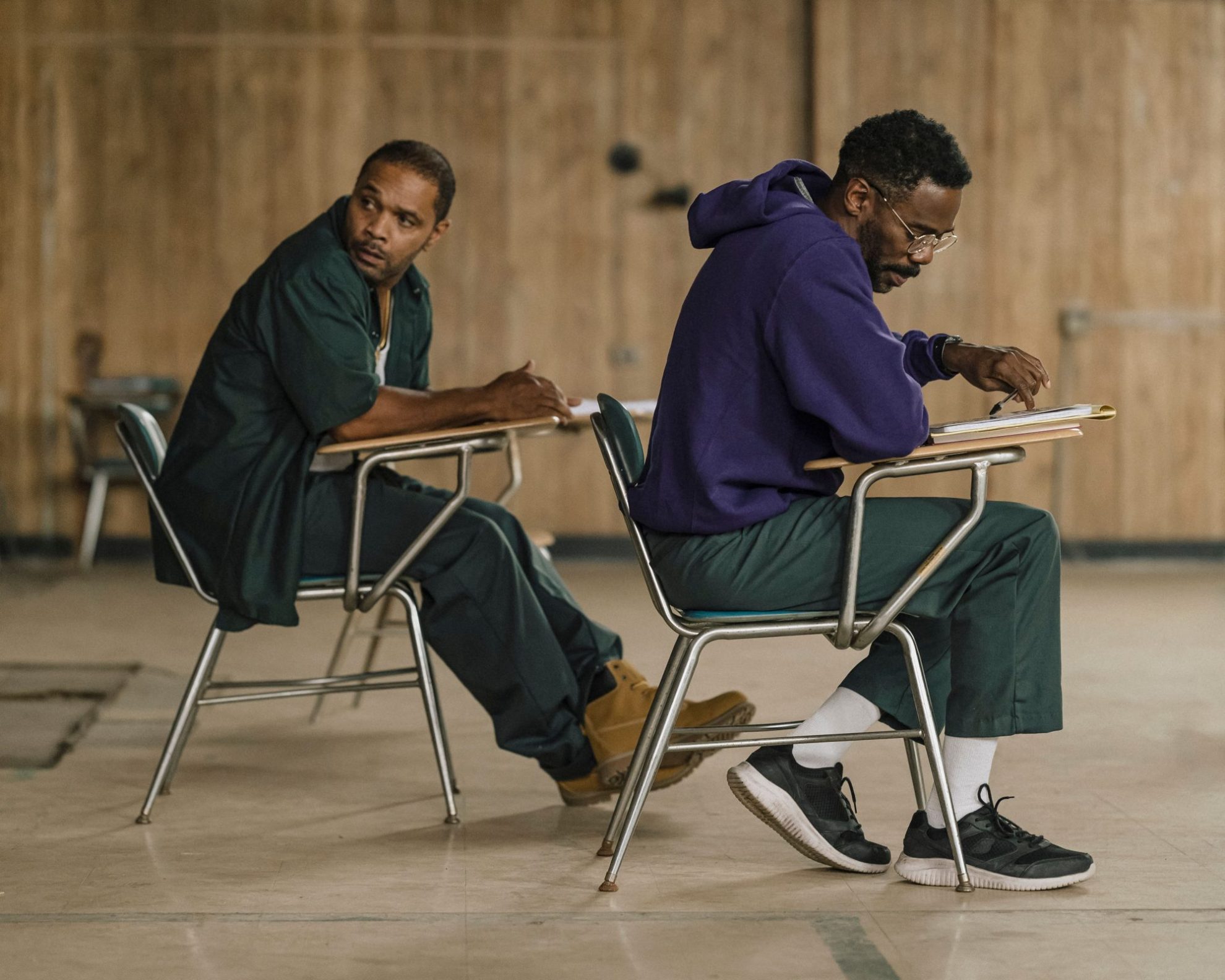
“That’s what I want you to take away with you. That radical love. Let this film be yours. And please, share it.” –Colman Domingo
My journey with the arts is from birth. We might have been twins in the womb. I have a degree in fine arts, I write about the arts and humanities, and I cannot imagine life without storytelling and aesthetics infusing every facet—from the metro trains to the libraries to the kickbacks. As artists, we describe our experiences as thought-provoking, or emotionally impactful, and from time to time: transformative. But when art hits, the experience is communal. The impact exudes from canvases and cameras. Sweeping through the creatives and the audiences. When art takes hold, it does all of that but it also becomes an expression of our humanity—a twin for life itself.
I’m talking about art. I’m talking about its anagram RTA (Rehabilitation Through the Arts). And I’m lifting my voice for Sing Sing.
While I knew the arts provide escapism, I didn’t realize: Art is Freedom.

From the first trailer, you know this is a good movie. Colman Domingo chooses his roles well. There are no disappointments, there is always something to ponder or to praise. This movie is different. When you’re standing in a circle with the men who lived the experiences depicted in Sing Sing, their excitement is palpable. Domingo called it propulsive. It’s true. Sing Sing lights you up with a kind of enthusiastic emotional upheaval:
Through a cinematic immersion, we go inside the prison system with Divine G (Domingo), Dino, JJ, Mike Mike (Sean San Jose), and Divine Eye. Two of them are actors, while the others portray themselves. The Rehabilitation Through the Arts program (RTA) is in motion when we join them. In it, these men mount full theater productions—play all the roles, act as stagehands, and sometimes write. The stage is a vehicle. It allows them to escape the locked windows and doors of the institution by embodying characters from other places and times. Each breath they take is an exaltation. We feel it in the audience. We also feel the tension that arises when Divine Eye auditions for the program. Eye is an agitator only because his spirit is distressed. While Divine G seeks more than redemption, he strives for exoneration. Through the growth of this ‘divine’ friendship and what the theater means to them all, Sing Sing lets the sunshine in, and we witness humanity from the inside.


For these men, who were previously incarcerated in that New York correctional facility, their enthusiasm stems from a deep desire to share their humanity with the world. The film captures their journey and, crucially, their success in conveying their stories. When they watch us react in awe, like they did during a screening at The National Museum for African American History and Culture (NMAAHC), they know they have succeeded. That another part of their dream has come true. This connection between the storytellers and the audience underscores the film’s powerful human element.
The credits for this A24 film are many. Written and directed by Greg Kwedar with his best friend, Clint Bentley, as his co-writer, Sing Sing is also based on the lives of Clarence “Divine Eye” Maclin and John “Divine G” Whitfield. With additional backstory from the book The Sing Sing Follies (A Maximum Security Comedy) by John H. Richardson; and adding another layer is Breakin’ the Mummy’s Code by Brent Buell (played by Paul Raci), the time-hopping comedy the group created and performs.


photos Sherin Nicole / Taunja Pegues
Monique Walton is the leading producer and, as I mentioned, Colman Domingo, Clarence Maclin, John Whitfield, Sean “Dino” Johnson, Jon Adrian “JJ” Velazquez, Paul Raci, and Sean San Jose star. Any one of them could win awards— and should. I’m predicting a couple of Academy Award nominations for Domingo and Maclin, but I wouldn’t be surprised to see Dino Johnson and San Jose there too.


Dino Johnson, JJ Velazquez, John “Divine G” Whitfield, Clarence Maclin, and Colman Domingo
photos by Taunja Pegues
Sing Sing surpassed my expectations. I was absorbed into it. The performances and storytelling are heavy hitters, but the visuals win too. The cinematography is a reminder of the metaphorical prisons we create for ourselves. We see every kind of institution here—those built by the government, those constructed by big business, and the ones designed by our internal architects. Yet in Sing Sing, there is perpetual light, square patches of sky breaking through the bars, and brotherhood. Metaphors for the unyielding human spirit.
That sense of unity, of changing the narrative, is in the language too. The men of the RTA shed the language of oppression and leave it outside the theater doors. For these primarily Black and Brown men, no utterance of the “double G” word is allowed. They call each other “beloved” to reinforce how much each of them matters.
And because that matters, that’s how I’ll close, with a quote from the movie. One that sums up my message to everyone involved: “You did your thing, beloved.”


