
“True creation requires sacrifice.”
Almost two years since we last left Middle-earth, The Rings of Power returns to prove that the wait was worth it. It’s no secret that J.R.R. Tolkien’s works hold a special place in my heart; it’s also no secret that I believe it’s okay to enjoy an adaptation that diverges from the original story, so long as it is done well and with care. And this is definitely a labor of love: The Rings of Power remains fearlessly bold with its storytelling while honoring the texts it pulls from. A large part of season 1 was spent setting up the world and making you believe in its people; season 2 reaps the rewards with a captivating run that’ll leave you breathless.
Darkness is growing over Middle-earth as Sauron’s influence and deceit begins to take hold. There is division amongst the Elves over how to save their race—and whether to leave mortals to their fate. Robert Aramayo shines as Elrond, showing his strength in both fighting power and in his compassion for all living things. He often acts as a foil to Galadriel’s plans, providing the balance in her struggle with the terrible thrall of Sauron. Morfydd Clark carries the immense pressure of Galadriel’s arc with grace and sincerity. And Benjamin Walker plays Gil-galad as the stern but loving father figure who presides over Elrond and Galadriel as they navigate the power of the Three Rings. Watching them spar together is a joy.


In Khazad-dûm, the promise of Rings of Power seeps into the hearts and minds of the Dwarves. King Durin (played with fervor by Peter Mullan) foresees great wealth and prosperity, taking an iron grip over his domain. But Prince Durin and his beloved Princess Disa fear there is doom held in the depths of the mountain. Their love is a soft yet unyielding challenge to the hard lines drawn across Khazad-dûm; Owain Arthur and Sophia Nomvete have fiery chemistry. Meanwhile, Durin’s love for his father—and for his people—is a test of strength from within.
Elsewhere, The Stranger (Daniel Weyman) and Nori (Markella Kavenagh) find themselves in Rhûn, a land filled with trials and treachery, but their journey also brings lighter moments as well as a strong yearning for home. Tom Bombadil (Rory Kinnear) has his part to play here, offering wisdom about what is truly important, in his own whimsical way.
In Númenor, the quest for power darkens all but the most faithful hearts of Men. Elendil (Lloyd Owen) has his loyalty put to the test, while Queen Regent Míriel (Cynthia Addai-Robinson) must prove her right to the throne. Pharazôn (Trystan Gravelle) has sinister plans of his own that have all-too-real parallels to our own world’s current struggle for democracy.


Following the creation of Mount Doom, Isildur (Maxim Baldry) is left stranded on Middle-earth, meeting some old friends and some new potential allies that make him question his future. And Adar grows increasingly obsessed with the whisper of Sauron, continuing to reshape our ideas about orcs and how much agency they have. Sam Hazeldine steps into the role well and confidently makes Adar his own.
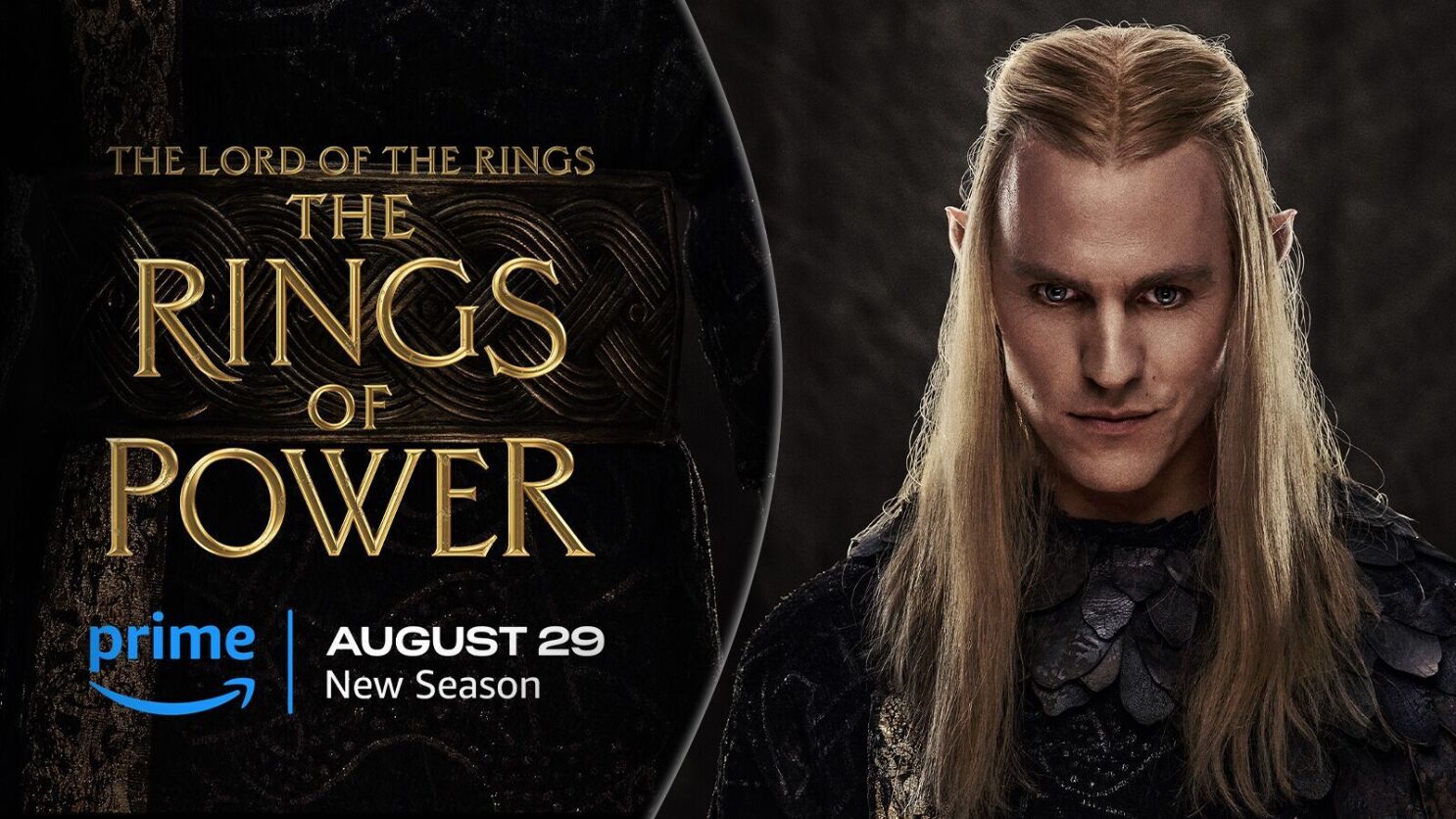
The threat of Sauron looms large over Middle-earth and the characters’ choices are colored by his shadow. Charlie Vickers is compelling as Sauron’s Elven form Annatar, reeling in the Elves and Free Folk alike with such intensity you almost believe his lies—almost. But it’s Charles Edwards as Lord Celebrimbor who steals the season; his performance deserves all the awards. Celebrimbor’s passion, his pain, his desire to prove himself works its way into your heart and Edwards makes you feel every crashing wave of emotion.
Visually, this season is much darker, following on from the cataclysmic events of its predecessor. But even in the growing gloom, Middle-earth remains beautiful: Eregion and Khazad-dûm in their splendor; Mordor in its evil; Rhûn in its desolation. Each location has its magic, welcoming you back to Middle-earth with open arms. The special effects root each location in fantasy, with Ents and Trolls and other magical beings lending their strength and grandeur to the story. The symbolism is magnificent and plays on folklore, reflecting parallels and setting up shots of pure wonder, ever elevated to new heights by the legendary Bear McCreary’s gorgeous score.


The Rings of Power season 2 made me fall in love with Middle-earth all over again. I devoured every episode, reveling in the epic battles and twists that made me gasp, while savoring the quiet moments that gave me room to catch my breath. My heart ached for Middle-earth’s plight and sang when there were times of triumph; I flinched at the brutal and unforgiving violence; I cried over the vast chasms of grief. But most importantly, I felt the balm of hope that is so often woven throughout the fabric of this world; it is (at least in my eyes) one of the most vital parts of Tolkien’s works and The Rings of Power upholds it with every decision the Free Peoples make.
With that said, it’s the small touches that really push this show into excellence. The care and attention to detail—the meticulous references to the source material, the nods to beloved film scenes from days gone by—the writers truly live and breathe Middle-earth. The levels of depth are all there for the hardcore Tolkien buffs, the fantasy movie & TV fans, and the casual viewers.


In a time when it seems more and more art is falling victim to the loudest subsect of internet trolls and ghoulish bottom-line decisions, The Rings of Power is a breath of fresh air. It asks its audience to be patient, to have a little faith, and we shall be rewarded. Any time I had questions or spotted some foreshadowing, it passed the test with flying colors. It is an immense challenge to stay true to the original texts, while still telling a story that is compelling and clear enough for those new to the franchise, and The Rings of Power walks the line with finesse. I am in awe of the layers to which anyone and everyone can appreciate the storytelling.
The only thing I wish for is more episodes—not because there is not enough here, but because, like a child listening to a cherished bedtime story, I want to keep on living in Middle-earth. As there are so many different plot lines running through the season, each episode takes turns rotating seamlessly between a select few. Instead of trying to cram everything in, the show takes its time with each arc and before you know it, you’re already swept miles down the road on an epic adventure. Some characters don’t get as much screen time as they deserve but, with this complex tapestry of stories, their time will come, if only we put our faith in its telling. It is a wide, wild world, after all.
