
Popular. It’s Gonna Be Popular.
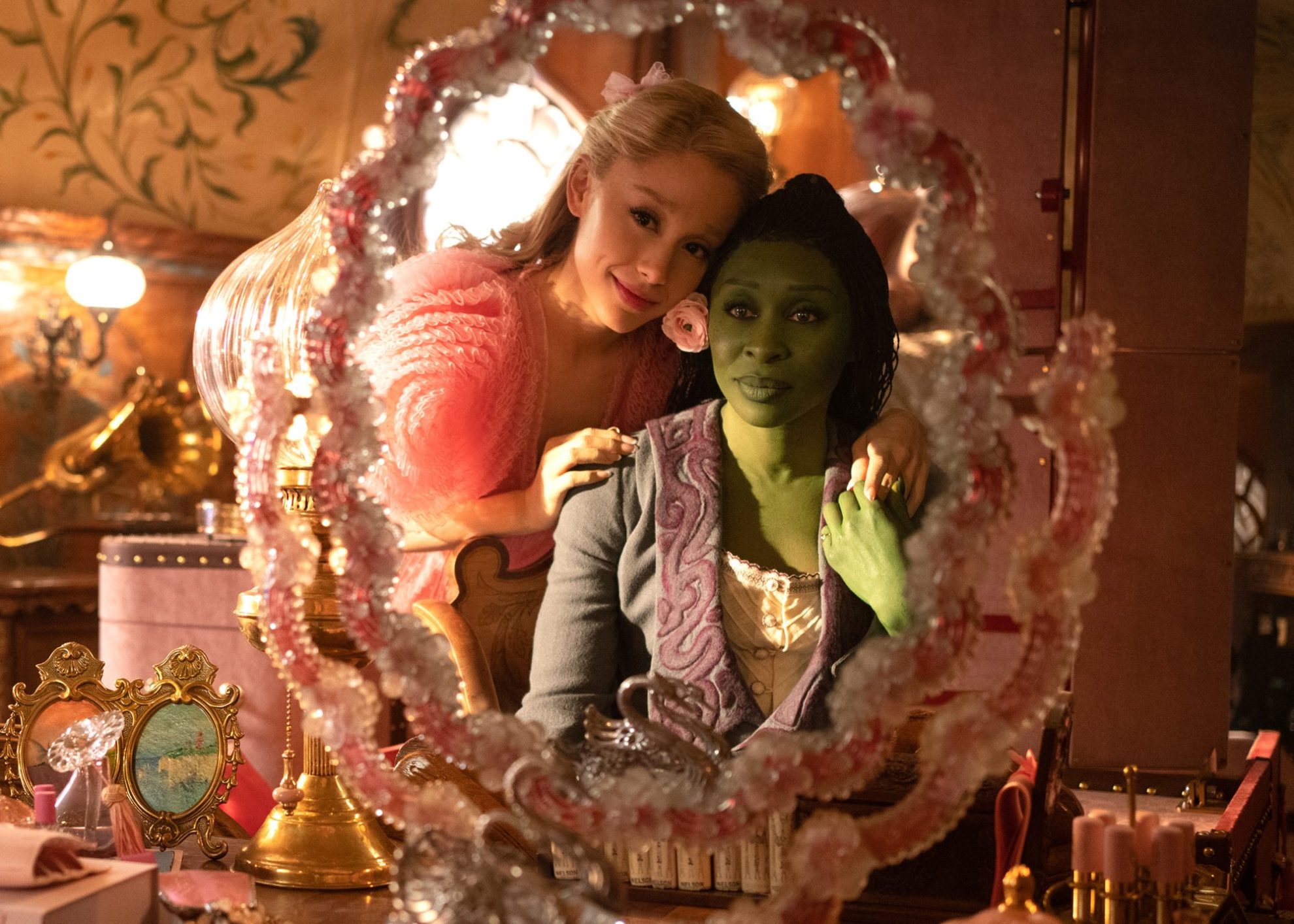
At its big, green, and tragic heart, Wicked is a prequel to The Wizard of Oz that unravels the origins of two iconic witches: Elphaba, the misunderstood emerald-skinned girl destined for infamy, and Glinda, the bubbly blonde on a collision course with goodness. In Jon M. Chu’s new movie, Cynthia Erivo and Ariana Grande-Butera step into these sparkly slippers—made legendary by Idina Menzel and Kristin Chenoweth.
Joining them is a starred ensemble including: Jonathan Bailey as the romantic lead Fiyero; Michelle Yeoh as the focused Madame Morrible; and Marissa Bode as Elphie’s baby sis, Nessarose. There’s also Ethan Slater as Boq, Peter Dinklage as the goat, Dr. Dillamond, and Jeff Goldblum as the Wizard. Now after the all-around-you, all-the-time marketing campaign, the Star Wars levels of merchandising, and the meme wars, I know you have one question:
Is this Wicked the Wicked we’ve longed and waited for?
Wicked Part 1, the first act from the Broadway musical is coming to theaters for your singalong1 pleasure this Friday (with more context from the novel). Chu’s decision to split the tale into two parts preserves the dramatic beats from Stephen Schwartz and Winnie Holzman’s much-loved show, ensuring that showstoppers like “Defying Gravity” and “Popular” buzz with the soaring emotions they were written for.


As Elphaba and Glinda navigate the treacherous waters of Shiz University, their unlikely friendship becomes the catalyst for a revolution that will shake Oz to its core—because we’ve seen the fallout in The Wizard of Oz, but this adaptation of an adaptation takes cues from a second point of origin. Gregory Maguire‘s Wicked: The Life and Times of the Wicked Witch of the West, published in 1995, reimagines L. Frank Baum‘s classic tale by flipping the POV to Elphaba, the real Wicked Witch of the West. By giving the talking animals a plight, adding disabled characters, and reimagining Elphaba as misunderstood and bullied—similar to other “witches” throughout history—Maguire speaks to various forms of discrimination and how women with power are maligned while their power is stolen. True evil often points the finger at the innocent to hide itself. That—in fact—is Wicked.
Winnie Holzman delivered on these central themes in her libretto for the musical. Thankfully, she’s back, teaming up with Dana Fox to capture new audiences and enrapture fans with a rendition that sings the big notes. Jon M. Chu adores this story, and it shows in his production. He lavishes his “cinema version” with storybook-styled visuals—both practical and CG—the team planted 9 MILLION tulips and waited for them to bloom, they also built a real working Emerald City Train and a mechanical Wizard’s head. Chu’s dedication also shows in his attentiveness to what Stephen Schwartz and Holzman wanted to include or to change but couldn’t. Through his receptiveness to the creators, to his vision, and to the audience’s hopes, Chu manifests visual delights and darkness. That juxtaposition is there in Glinda’s bubble and the ape-like ferocity of the Flying Monkeys. These factors blend symphonically, leading to fractured and flighty characters, each with individual twists and self-serving actions.

At Rise, we scan the aftermath of Dorthy’s watery attack on the Wicked Witch of the West. Someone asks: Is she truly dead? Then, Glinda takes over as the narrator and takes us back in time. This is where the story truly began.
Erivo and Grande are a true duo; their voices dance playfully around each other or intensify the other’s emotions. Erivo’s Elphaba is tender where Menzel was fierce, making for a character who truly comes of age while you watch her. If we, as an audience, could protect this sturdy yet fragile green girl from further pain, we would. For someone who proclaims: Menzel Forever, this made me happy. As the bubbly counterpart, although it sometimes seems she’s rebooting Chenoweth, Grande gives good Glinda. The arrogance, the ambition, and the depth beyond those things are all here. Glinda is becoming good while we watch.


Before I get to the rest of the cast, the production design is gorgeous, and so are the costumes. And if you wait for them, you might spot or hear a few cameos.
Jonathan Bailey is so very “that guy.” His Fiyero doesn’t have the foppish facade of the original. His portrayal makes us aware he’s more complex than he appears from the moment we meet him and his talking horse, but as a Prince Charming, his rizz is high. Who wouldn’t fall in love with Bailey (and who hasn’t)? Dinklage as Dr. Dillamond is another emotional touchpoint, while the pairing of Nessarose (Bode) and Boq (Slater) only hints at the tangled feelings they’ll share in Part 2.
I know you’re wondering if she hits the note. The one that proves nothing will ever bring her down. The riff that is so very Wicked, it’s instantly recognizable. Yes. She sings the battle cry in “Defying Gravity,” and then she doubles it. It was still superb, yet so subtly different my goddaughter cried right through her green facepaint. “What Is the Feeling” is great, too, and “Popular” is kinetic, with Grande sparkling all across the set. There’s more, but I want you to experience the highs you’re waiting for yourself. I can only tell you they’re all there; they’re all different, and I can’t wait to see what you think.
In the end, this IS the Wicked we’ve longed and waited for. Throw this creative team their roses. Now, we just have to get through a one-year intermission—and wait for Part 2 to land on us like a tornado-flung house from Kansas on Nov 21, 2025.
WICKED Part 1 defies gravity, in theaters on this Friday, Nov 22

- this isn’t entirely a cheeky take, the sing-along screenings of Wicked will land on Dec. 25 ↩︎
