
DrewNotes… adapted from a Stephen King story, fifty young men compete in a brutal competition where there’s only one winner and no finish line.
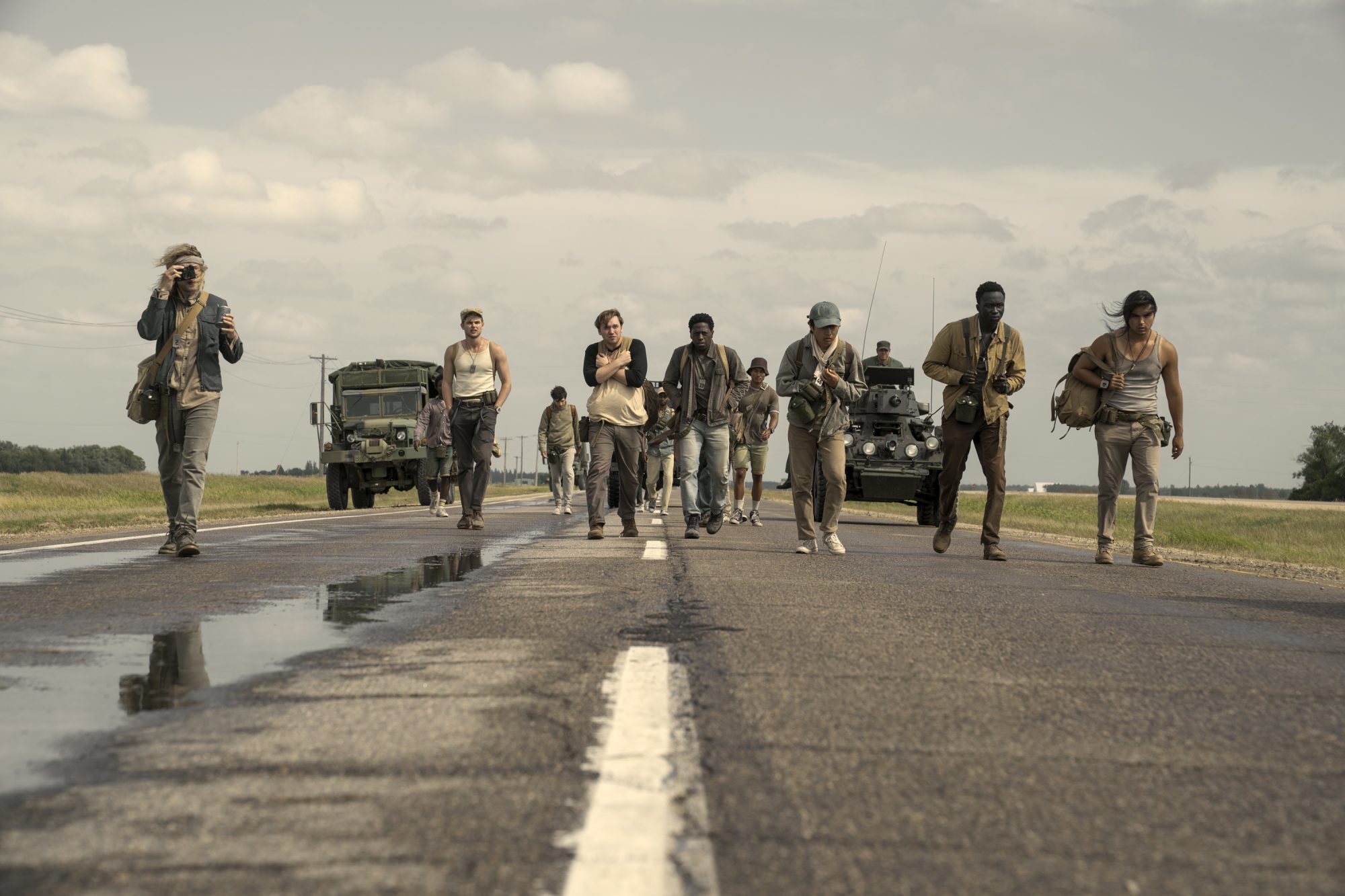
Directed by Francis Lawrence from a script by JT Mollner, THE LONG WALK is one of the bleakest of the “Bachman books”–novels written by Stephen King under his pen name Richard Bachman. Set in an impoverished and brutally fascistic United States, the titular competition is an annual event where fifty volunteers–one from every state–set out to see who can walk the longest, nonstop.
Literally nonstop.
There are no rest breaks, no bathroom breaks, no food but what they brought with them. Once they start, they must keep walking. Stopping or slowing below three miles per hour earns a warning; a walker can have only three warnings before the soldiers keeping pace on jeeps and half-tracks shoot to kill. Leaving the road? Instant execution.
The prize? A fortune–which, when everyone is poor, makes all the difference–and one wish: whatever the winner wants, they’ll get, if it is humanly possible.
The central character is Ray Garraty (Cooper Hoffman), whose mother (Judy Greer) is panicked that he won’t come home. He’ll get to see her once, though, as the Walk takes place in his home state and the route will take them close to where they live. Ray knows what he wants, and it isn’t the money. He has a very specific goal.
The only one to learn what Ray wants is Pete McVries (David Jonsson), a street kid who admits he has nothing to lose and everything to gain. Bearing a vicious scar across his face, Pete is the heart of the movie, keeping things light even as, one by one, the fifty are winnowed down.
And they are cruelly winnowed. A charley horse, an untied shoe, a broken ankle–one boy after another is lost early on, before the worst of their endurance test begins. Watched by the mirrored sunglasses of the Major (Mark Hamill), the boys stumble and march and grind forward mile by mile.

Ray and Pete are not alone (at first, anyway). Their fellow walkers include the kindly Art Baker (Tut Nyuot), the snarky Hank Olson (Ben Wang), the inscrutable Stebbins (Garrett Wareing), and the callous, mean-spirited Barkovitch (Charlie Plummer). We get to know these young men as the Walk reveals their character… and we get to mourn as their lives are taken.

There is an end to the Walk but who makes it and what happens next… well, that’s something you should see for yourself.

Lawrence, coming off THE HUNGER GAMES franchise, once again helms a movie where young folks die. Both share significant resonance, but where THE HUNGER GAMES is about resistance to oppression, THE LONG WALK engages themes of loss and how grief shapes our lives. Lawrence takes a fresh perspective on what could have been a simple retread of his past successes, forging something new and powerful from JT Mollner’s stunning adaptation of King’s book. (Worth noting that many have tried to make this film and it reached the point of being considered ‘unfilmable,’ until this effort succeeded.) Mollner’s script keeps the focus on the young men, Lawrence’s kinetic filming style keeps swerving between perspectives without falling into rote “they’re still walking” shots. It’s an effective combination.

As for the actors, Hoffman is a standout as Ray. He skillfully portrays Ray’s mix of naivete and good heart with darkness lurking beneath. It’s a tricky balance but Hoffman does wonderfully. (Side note: as the son of the late Philip Seymour Hoffman, it’s no surprise that Hoffman is a terrific actor.) But he can’t do it alone; more than once, he needs the friendship and literal support of Pete McVries. Jonsson (recently seen as Andy in ALIEN: ROMULUS) is a genuine star, giving a breakout performance that ought to earn him an award nomination or two. He is “the wise friend” in this story, providing all the help he can even as the miles roll past. If this movie is any indication, both Hoffman and Jonsson are destined for greatness.

But just like on the Walk, they don’t get there without help. Hamill is singular in his portrayal of smirking, ultra-nationalist malice as the Major, a force of evil like only King can create. He exhorts the boys to give their all but lets the fallen lie on the highway, like roadkill. He’s a genuine monster and Hamill (fresh off his genius work as Albie in THE LIFE OF CHUCK) devours the role with gusto.
Likewise, Nyuot and Wang, as the other two “musketeers,” provide humor, pathos and ultimately tragedy. They’re both phenomenal in these roles, giving dimension to two young men who are there to try their hardest and face their ultimate moments with a mix of despair and courage.
I could go on, because every performance in the movie is A-game material. There simply isn’t a weak link in this chain. Almost all of the young men here have credits to their names; I don’t doubt they’ll add starring roles very quickly now. Plummer, Wareing… future stars. Greer is not in the movie for many minutes of screen time but she gives a heart-wrenching performance as Ray’s terrified but supportive mother.
Be warned, the movie is extremely violent. Many of the executions are in mid-close up, with a few that are horrifying, but worth saying that “graphic” doesn’t just describe the violence here. As a parable of brotherhood, determination in the face of evil, and a nearly-hopeless struggle to survive when everything is stacked against you, though–it’s damned effective. And it’s one of the best adaptations of a Stephen King story yet.
Released by Lionsgate and in theaters this Friday, we’re giving this nine and a half blood-soaked sneakers out of ten.
Rating: A
Level of Enthusiasm: 99%
