
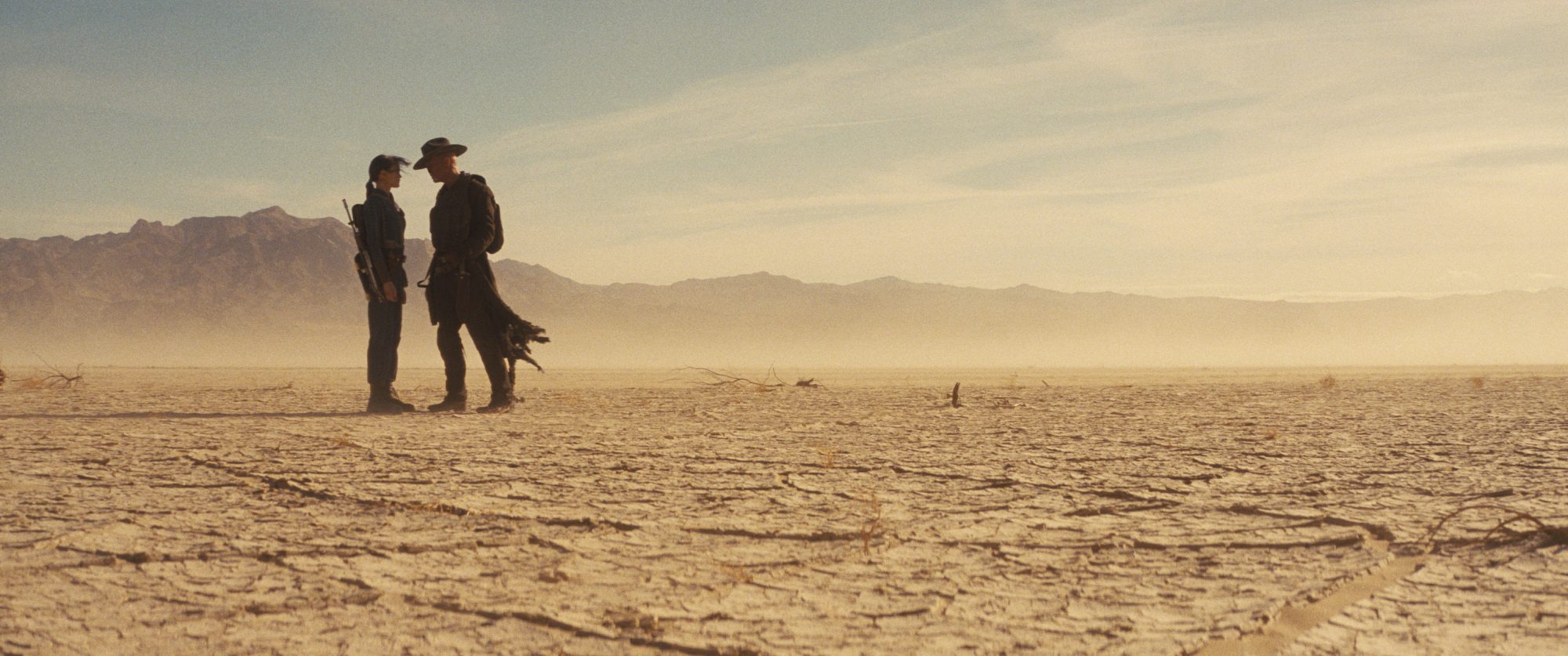
In this current era of adapting video games to film and television shows, the most surprising to me so far was 2024’s first season of Fallout. Going in the direction of setting a story in the world that games showed instead of trying to adapt one of the games directly, show creators Graham Wagner and Geneva Robertson-Dworet hit it out of the park with the show. Starting with Ella Purnell as Lucy MacLean, a perfect opening character and POV stand-in for the viewer that works like a player starting in the game, her journey in the first season is that of a young woman who lives within a Vault. In this underground community, people live after a conflict causes a nuclear war that leaves the United States an apocalyptic wasteland.
The great Walton Goggins plays the character that really steals you as The Ghoul – a gunslinging bounty hunter zombie looking mutant who’s like the Man with No Name but with a bit more wit. The first season showed him being this cool wasteland bad ass while using flashbacks to show his life as Hollywood star actor Cooper Howard, who is an ambassador for the big evil company of the series, Vault-Tec. The show explores how we got to the point the world is now. The two time periods are one of the most dramatic parts of the show, and work well with the stylized hyper violence you get in the parts set in the show’s present.

But enough about the first season, as you can read my review for all my thoughts on that. The second season starts with most of our main characters each going down different paths after the life-changing events of the season finale. Lucy and the Ghoul go off to Vegas to chase after her father, Hank MacLean (Kyle MacLachlan). At the same time, our empathic knight of the Brotherhood of Steel, Maximus (Aaron Moten), is now a star within his chapter of the order, thanks to being in the right place and the right time, as well as being picked by Elder Cleric Quintus (Michael Cristofer).
Moten’s Maximus had some of my favorite parts of the first season. His story arc was dramatic, with the idea of knights and these huge mechsuits as Maximus’ goal to become a knight drew me in. This season, I feel they didn’t give my guy the same amount of story, and it’s not as interesting as the first season. While the character is more self-assured in what he can do and what he should do, all we get is his coming to a decision and his friend Dane (Xelia Mendes-Jones) trying to keep him on the moral straight and narrow in his elevated position of power.

I think the Knights storyline loss of time is a boon for Moisés Arias’ Norm MacLean, the younger brother of Lucy, who stayed behind and ended up learning more about the Vaults than he bargained for once he got to Vault 31. I like Arias a lot this season as he gets to be much more than a younger brother to Lucy. I like to relate characters to how it is to play games in adaptations. While Lucy feels like the player going out into the world, Norm feels like you exploring the Vault and learning all the little backstory. Arias gets plays Norm as more mature, and as he learns more, unlike his sister, he is not as naïve about the situations he ends up in. He has some of the better story bits, but much like with Maximus, I don’t feel like we get as much as we should with him.
Speaking of the Vault, Leslie Uggams as Betty Pearson gets to do a bit more as she takes over the Vault. Her performance is pretty subdued, but going back to Vault 33, where we started the story, adds a nice little societal plot that is missing a bit from the main plotlines. What takes up most of this season is The Ghoul’s flashbacks and his connection to New Vegas back when it was just regular old Las Vegas. The Cooper Howard stuff has the right amount of mystery as he continues to learn more and more about the company he shills for and is the face of. The Ghoul in the present is softer as he bonds more with Lucy. Goggins and Purnell continue to have a great dynamic here as the weary gunslinger and the naïve, righteous person. They work well in the wild, western-like setting, and they also have great comedic back and forth. It’s very comfortable watching them together and having her learn more and more lessons about the world as The Ghoul gets her out of things.

The hyper violence still looks good and fun and not too gory. The makeup and production design feel even more improved as the show has a lot more settings than the first. The New Vegas setting, one being a fan favorite of the game series, adds a lot of potential that I don’t think is completely exploited. We don’t see as much of what New Vegas is, as we end up spending a lot of time in flashbacks. Having seen a good portion of the season, I still enjoy the show a lot, but I do think it’s trying to juggle too many plotlines and main characters that are disconnected from each other for too long.

The Kyle MacLachlan’s Hank stuff doesn’t wholly work for me as he still doesn’t feel as much of a compelling evil presence as he did at the end of season one. The fifties aesthetic is still strong, and the familiar elements of the game, like the Pip-Boy, still look cool, as with all the Vault-Tec stuff. It feels, though, that this season it’s a bit too slow and is more worried about Cooper’s human journey than the wasteland that Fallout is supposed to be about. While still an entertaining show, Fallout season two doesn’t reach the same heights as the first all the way through, but it definitely is entertaining and keeps me interested in what’s next for season three.
Rating: B
Level of Enthusiasm: 90%
