
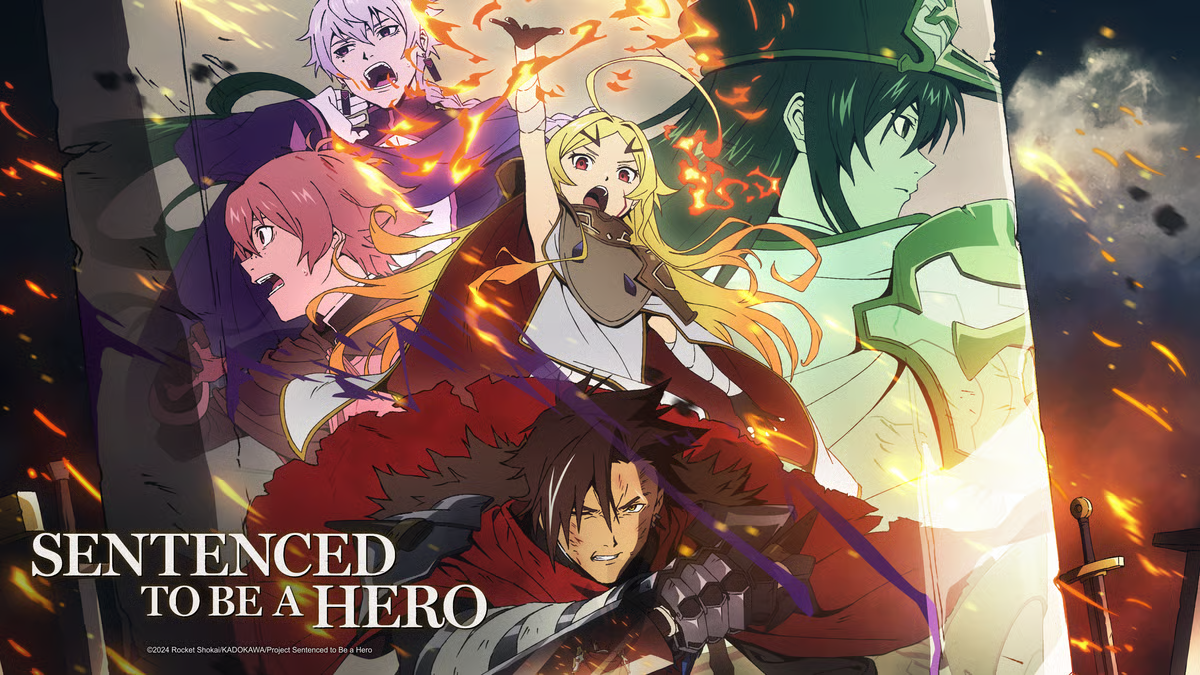
From the moment Sentenced to Be a Hero hits the screen, it announces itself without a shred of apology. Episode 1 is a bombastic opening salvo, pulling the ripcord right from the jump and challenging the viewer, us, to hang on for the ride—heaven help us, indeed—exciting from start to finish.
Director Hiroyuki Takashima and assistant director Yoshitake Nakakoji have crafted a dark fantasy world that wastes no time on pleasantries: bodies pile up, demon hordes swarm—technically fairies, and the sheer scale of carnage in the opening episode is enough to make the uninitiated question their anime-life choices.
The series almost seems to pride itself on this relentless pace, at the start, dropping bodies with the casual efficiency of a tornado sweeping fish out of a lake — except these fish are Holy Knights, heroes, and creatures twisted by demonic corruption, and the camera lingers just long enough to make it burn bright. And burn bright it does.
This is a show that knew exactly what it wanted to be before a single frame was drawn, and it commits to that vision with a ferocity that may set it apart from the crowded fantasy anime landscape.

The animation is, in a word, stunning — and that word barely does it justice. The team at Studio KAI delivers incredible action sequences featuring highly active characters, a strong sense of weight and impact, and cinematic touches that immerse the viewer in the scene. It has gruesome first-person shots of soldiers’ faces being eaten by bugs and claustrophobic moments that make you feel the walls closing in, while also managing the sweep of armies and giant creatures with equal confidence and less concern.
What makes the visual direction particularly impressive is its dual nature: it is simultaneously delightful, brutal, and then subtle in its quieter emotional beats, followed by explosively brash when the story demands it. And lord does it at times demand it.
The character designs, crafted by Takeshi Noda, are striking precisely because they refuse to let you comfortably pin anyone down. Aura-filled designs, sure, but nobody walks through this series wearing their morality on their sleeve, and the visual language reflects that—everyone looks like they’ve survived something terrible and may be capable of doing something even more terrible.

This brings us to the series’ most compelling thematic core: the question of what truly separates a hero from a villain, and whether that line is even worth drawing. In the noir world of Raymond Chandler, says:“a hero is someone of honor, both common and unusual, who navigates a corrupt, mean world without becoming tarnished, afraid, or indifferent.”
However, being a “Hero” in this world is a punishment for criminals. They are expected to follow orders, fight on the frontlines, and when they die in battle, they are resurrected and thrown back into the field—supposedly to continue acting as a “hero” would, whether they like it or not.
And then there is the resurrection system, which comes with its own grim horror: each revival chips away at the person, eroding memories and selfhood until only a hollow shell remains. As one character frames it, these are souls too scum-ridden, too wretched, for even death to take—and yet humanity depends on them to hold the line. The series dares to ask whether a system that treats people as disposable weapons can ever produce genuine heroism, if that system is worthy of heroes, or whether society is simply manufacturing suffering with a heroic label slapped on the glowing packaging.

Now, to the characters at the center of this moral maze. Xylo Forbartz, convicted of murdering his goddess, Senerva. Though his memories of that moment are, as the bards say, a hazy shade of winter, this is an unavoidable circumstance that shall be explored further. Because; reasons.
For now, he is a man consumed by the injustice of his situation, perpetually grumbling and cynical, and yet—and this is the genius of the anime’s writing— despite his constant grumbling, he does try to save as many lives as he can, which makes us wonder about the nature of his “crime”, and what a man like Xylo could have done to end up as a “Hero.” He is the reluctant protagonist in the truest sense; not because he lacks capability, but because every capability he possesses has been weaponized against him by a system he didn’t design and cannot escape.

Then there is Teoritta, the thirteenth goddess, a weapon of mass destruction who emerged from a coffin-like vessel and immediately latched onto Xylo as her chosen knight. Goddesses were human-like creatures created to defeat the Demon Lords.
There were thirteen made, and Teoritta is the goddess of swords—a good fit with Xylo’s fighting style. She is simultaneously devastating and disarming, capable of raining holy swords from the sky and shattering demon lords, and yet she craves something as simple as being told she did a good job—when it comes to praise, she is thirstier than a golden retriever left home over the holidays. She reads less like a traditional weapon and more like an entity that has never been permitted to simply exist. Which, given that she was literally manufactured for a single purpose, tracks painfully well.

As for Dotta Luzulas—if Xylo is the reluctant heart of the unit and Teoritta is its terrifyingly divine trump card, then Dotta is its sticky-fingered chaos agent. Nobody needed to tell us that Dotta was sentenced for theft, because he keeps stealing stuff —from knights, from mercenaries, from anyone within arm’s reach. He has the moral compass of a crow attracted to shiny objects, and yet his presence provides a kind of exhale, a beat of absurdist levity in a series that would otherwise risk suffocating us under its own darkness.
Episode 2 is where Sentenced to Be a Hero transitions from impressive premiere to something genuinely alarming in the best possible way. Where episode 1 introduced itself through spectacle and scale, episode 2 deepens the world-building and strengthens the supporting cast, proving that the series does not rely solely on shock or spectacle.
Treachery and betrayal move to the foreground. This is the moment the series reveals its real teeth. The action of episode 1 was thrilling; the moral horror of episode 2 is something darker and more durable. It’s also in episode 2 that the full weight of the ensemble begins to crystallize: we meet characters like Norgalle, a delusional self-styled king responsible for a large-scale terrorist attack, who treats his own mythology as a survival strategy. The show doesn’t play him for laughs—it grounds his absurdity in consequence.

What makes Sentenced to Be a Hero remarkable, and why Takashima and Nakakoji deserve significant credit, is that it manages to function on multiple registers at once without losing coherence. The script actually respects its audience’s intelligence—there isn’t a single line of narration explaining the world, not a mention of stats or classes as shortcuts for worldbuilding. Exposition comes through the characters’ discussion of their situation, reminding one another of the grim nature of their lives.
It is a series about punishment that doesn’t want to be poignant in the cheap, manipulative sense; it wants to be honest about what systems of punishment actually produce, which is people ground down to their rawest, most morally compromised selves—and then asked to be heroes anyway.
Whether any of them can actually become one, or whether “hero” will remain just another label the powerful stick onto the disposable, is the question this series seems intent on answering in the most uncomfortable way possible. And with animation this fluid and storytelling this sharp, the discomfort is very much worth sitting with.

But the good news is our motley crew lives to fight another day; the bad news is they live to fight another day.
SENTENCED TO BE A HERO CAN BE FOUND ON CRUNCHYROLL
